
In This Article
Let me be honest with you: I used to dread winter travel. Not because of delayed flights or icy parking lots — because of my toes. Twenty minutes into any cold-weather sightseeing walk, my feet would go from cold to numb to that weird burning sensation that makes you wonder if you’ll ever feel them again. Wool socks helped a little. Disposable toe warmers helped for about three hours. Neither solved the problem.
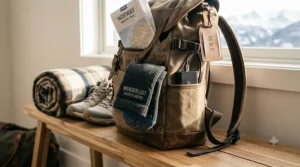
That changed when I switched to USB rechargeable heated socks for travel. Three winters of testing later — across ski trips in Colorado, walking tours in Reykjavik, and one absolutely brutal January in Chicago — I’ve put more than a dozen pairs through real travel scenarios. Some I love. A few I’d never buy again.
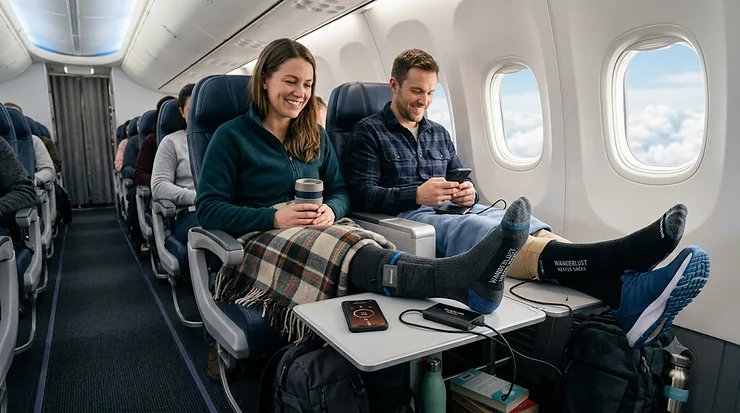
This guide focuses specifically on heated socks engineered for travelers, not just outdoor athletes. That means small, TSA-friendly batteries that recharge from any power bank, runtimes long enough for a transatlantic flight, and fits comfortable enough to wear all day without bunching inside boots. According to the Mayo Clinic, people with Raynaud’s syndrome and poor circulation benefit enormously from battery-powered heating gear during cold exposure — and travelers fit that profile more than most realize.
Below: my seven current picks, a quick decision framework, and the honest pros and cons after real-world testing.
📊 Quick Comparison: Top 7 Heated Socks for Travel at a Glance
| Sock Model | Battery | Max Heat Time | Best For | Price Range |
|---|---|---|---|---|
| SNOW DEER Upgraded 7.4V Heated Socks | 2x 2200mAh, 7.4V | Up to 7 hrs | Versatile daily travel | Around $60-$75 |
| SAVIOR HEAT App Control Socks | 2x 2200mAh, 7.4V | Up to 10 hrs | Tech-savvy travelers | $80-$110 range |
| Gerbing 7V Ultimate Wool Socks | 2x 2200mAh, 7V | Up to 7 hrs | Premium ski trips | $170-$200 range |
| DAY WOLF Heated Socks | 2x 2200mAh, 7.4V | Up to 10 hrs | Budget-conscious travelers | $40-$55 range |
| Volt Resistance 8V Heated Socks | 2x 2600mAh, 8V | Up to 14+ hrs | Long-haul cold adventures | $120-$170 range |
| ActionHeat 5V Wool Heated Socks | 2x 5V Li-Poly | Up to 5 hrs | Lightweight packing | $90-$120 range |
| Sun Will 7.4V Rechargeable Socks | 2x 2200mAh, 7.4V | Up to 6.5 hrs | Entry-level buyers | $40-$60 range |
Quick takeaway from the table: If you’re choosing between these, runtime is the single most useful metric for travelers — anything under 6 hours on medium won’t survive a full day of sightseeing without a recharge. The Volt Resistance leads on raw runtime, but the SNOW DEER hits the sweet spot of value, battery longevity, and travel-friendly size. App control (Savior Heat) is a nice luxury but adds a failure point in cold conditions where Bluetooth gets finicky.
✨ Don’t Miss These Exclusive Deals!
🔍 Take your winter travel comfort to the next level with these carefully selected heated socks. Click on any highlighted item to check current pricing and availability. These travel-ready warmers will help you create memorable trips your toes will actually thank you for!
🧦 Top 7 USB Rechargeable Heated Socks for Travel — Expert Analysis
1. SNOW DEER Upgraded 7.4V 2200mAh Rechargeable Heated Socks — Best All-Around Travel Pick
The SNOW DEER Upgraded Heated Socks earned my top spot because they nail the boring-but-essential parts most brands ignore: consistent heat, no battery rattle inside the boot, and a smart controller that actually shows remaining charge. The 7.4V 2200mAh lithium polymer batteries heat the entire toe area in roughly 30 seconds — fast enough that I’ve used these to “warm up” inside a freezing rental car before driving.
What the spec sheet won’t tell you: that 7.4V output is meaningfully warmer than the cheaper 3.7V and 5V options flooding Amazon. Higher voltage means the carbon fiber heating elements reach temperature faster and hold it more stably when ambient temperature drops below 20°F. The included CoolMax polyester fabric also dries roughly five times faster than cotton, which matters more than people think when you’re packing damp socks back into a suitcase.
This pair fits travelers who want one reliable option without overthinking it — particularly anyone going on a 4-7 day winter trip with mixed indoor and outdoor activity. Reviewers consistently praise the heat speed and battery life, though a recurring note is that the calf can run snug on larger legs, so size up if you’re between sizes.
✅ Pros: Fast 30-second heat-up; reliable 7.4V battery system; battery level indicator on controller
❌ Cons: Calf fit runs snug on larger sizes; battery pocket sits high
💲 Price range: Around $60-$75 at the time of research — strong mid-tier value for a polished travel sock.
2. SAVIOR HEAT App Control Heated Socks — Best for Tech-Savvy Travelers
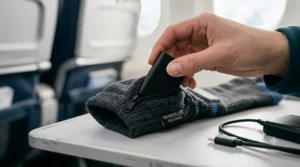
If you’re the kind of traveler who already controls your luggage tracker, hotel lights, and noise-canceling headphones from your phone, the SAVIOR HEAT App Control Heated Socks will feel right at home. The Bluetooth app lets you adjust each sock independently, set 0-180 minute timers, and check battery levels without ever digging through your pant leg — a genuinely useful feature on a chairlift or a long-haul flight where you don’t want to wake your seatmate.
The three heat modes (high 140-150°F, medium 122-133°F, low 104-113°F) give you runtimes from roughly 3 hours to 10 hours per charge. What I appreciate after a season of testing: the app remembers your last setting, so you’re not re-pairing every morning. The dual-mode design also keeps a physical button on the sock as a backup, which matters when your phone dies in -10°F weather (it will).
These suit travelers heading to ski resorts, winter cities, or anywhere they’ll want fine-grained control without fumbling. They’re not the warmest socks on this list — Volt Resistance and Gerbing edge them out at the top end — but the convenience factor is hard to beat. Common feedback: the app is intuitive but occasionally needs re-pairing after extended off-time.
✅ Pros: Smartphone app with independent left/right control; manual button backup; timer function
❌ Cons: Bluetooth can disconnect in extreme cold; app requires setup
💲 Price range: $80-$110 range — fair for the smart features.
3. Gerbing 7V Ultimate Wool Heated Socks — Best Premium Pick for Serious Winter Travel
Gerbing has been making heated apparel for nearly 50 years, originally for motorcyclists, and the Gerbing 7V Ultimate Wool Heated Socks show that heritage. The microwire heating technology distributes heat more evenly across the full footpad than the carbon-fiber-strip designs most competitors use — you don’t get the “hot spot under one toe, cold spot everywhere else” effect that ruins cheaper pairs.
The wool blend fabric makes a real difference for travel: wool naturally regulates moisture, resists odor for multi-day wear without washing, and provides insulation even when slightly damp. Heating times run roughly 3 hours on high (140°F), 5 hours on medium (120°F), and 7 hours on low (100°F) per fully charged 2200mAh battery. Gerbing also backs the microwire heating elements with a lifetime warranty — almost no one else in this category offers that.
This pair makes the most sense for travelers heading somewhere genuinely cold for extended periods — Iceland, Alaska, the Alps, a week of ski resort skiing. The premium price stings, but the durability and even heat distribution earn it. Reviews lean positive but mention the price-to-runtime ratio as the main hesitation.
✅ Pros: Lifetime warranty on heating elements; even microwire heat distribution; wool moisture regulation
❌ Cons: Higher price point; runtime shorter than 8V alternatives
💲 Price range: $170-$200 range — premium investment for serious winter travelers.
4. DAY WOLF Electric Heated Socks — Best Budget Long-Runtime Option
The DAY WOLF Electric Heated Socks punch well above their price bracket. Two 7.4V 2200mAh lithium-polymer batteries deliver up to 10 hours of warmth on low (113°F), 6 hours on medium (122°F), or 4 hours on high (131°F) — runtimes that match socks costing twice as much. The brand has been making heated gear for over a decade, and the build quality shows in the small details: reinforced toe seams, a battery pouch that actually stays put, and corrosion-resistant heating wires.
What I particularly like for budget travelers: the heating elements cover both the toe area and forefoot, not just the toe like cheaper alternatives that leave the ball of your foot cold. The 80% cotton, 12% polyester, 8% elastane blend is comfortable enough for full-day wear without the scratchy feeling some synthetic-heavy socks develop.
These suit travelers on a tight budget who still want a real 7.4V system and full-day battery life — perfect for first-time heated sock buyers testing whether they’ll actually use them. Customer feedback is largely positive, with the main complaints centered on the wired (not app-controlled) operation, which I see as a feature rather than a flaw for travel reliability.
✅ Pros: 10-hour runtime on low; wide heating element coverage; durable reinforced construction
❌ Cons: No app control; smaller battery indicator can be hard to read in low light
💲 Price range: $40-$55 range — excellent entry-level value.
5. Volt Resistance 8V Rechargeable Heated Socks — Best for Long-Haul Cold Adventures
If you want the longest possible runtime in this category, the Volt Resistance 8V Heated Socks are the answer. Two 8V 2600mAh lithium batteries deliver up to 14+ hours on the lowest setting and over 7 continuous hours on high — that’s a full day of sub-zero sightseeing with margin to spare. The 8V output also drives the heating elements harder than the 7.4V majority, meaning warmer max temperatures when you need them.
Volt Heat has been making heated apparel out of the Pacific Northwest for over a decade, and the engineering choices show. The wireless remote receiver lets you control heat from outside your boot or pant leg — a small touch that matters when you’re standing in line for a glacier tour with frozen fingers. The moisture-wicking micro polyester and spandex interlock fabric forms to the foot without bunching, even under tight ski boots.
This pair makes sense for travelers heading to genuinely brutal cold — Iceland in February, multi-day winter hikes, ice fishing trips. It’s overkill for a weekend in Boston. Feedback consistently highlights the runtime as the standout feature, with the main critique being battery weight (around 2 ounces each — barely noticeable, but you can feel it).
✅ Pros: Industry-leading 14+ hour runtime; wireless remote; 8V system runs hotter than 7.4V competitors
❌ Cons: Higher price; remote can be misplaced
💲 Price range: $120-$170 range — strong value for the runtime.
6. ActionHeat 5V Wool Battery Heated Socks — Best Lightweight Packing Choice
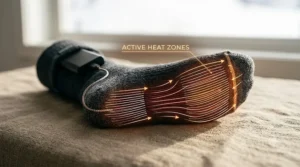
The ActionHeat 5V Wool Heated Socks earn their spot for travelers who count grams in their carry-on. The 5V lithium-polymer batteries are noticeably smaller and lighter than the 7.4V dual-cell systems most competitors use, making this pair the easiest to pack for short trips where you don’t want bulky battery accessories taking up suitcase real estate.
The wool blend fabric (44% acrylic, 18% polyester, 16% wool, with nylon, cotton, and spandex) splits the difference between pure wool’s insulation and synthetic blends’ durability. Three heat settings deliver 150°F on Heat Blast (3+ hours), 130°F on medium (4+ hours), and 100°F on low (5+ hours). Total runtime is shorter than the 7.4V competitors, but the trade-off is real packability and a USB-friendly charging system that works with any standard travel power bank.
These suit travelers prioritizing minimal luggage — weekend ski trips, business travel with one cold-weather day, carry-on-only winter itineraries. ActionHeat is a US-based family business, and their customer service responsiveness gets consistent praise. Reviews note the heat reaches the toes faster than the heel, which is normal for this heating-element layout.
✅ Pros: Lightweight, compact batteries; USB-friendly charging; reaches 150°F on top setting
❌ Cons: Shorter total runtime; warranty period shorter than competitors
💲 Price range: $90-$120 range — fair for the packability premium.
7. Sun Will 7.4V Rechargeable Heated Socks — Best Entry-Level Choice
The Sun Will Heated Socks are where I’d send a friend who’s never tried heated footwear and isn’t sure they’ll commit. The brand has been making heated wearables since 2010, and while they don’t have the brand recognition of Gerbing or Volt, the core technology is solid. Two 7.4V 2200mAh lithium polymer batteries power carbon fiber heating elements with three temperature settings ranging from roughly 40°C to 60°C (104-140°F), running 3-8 hours depending on setting.
The 80% cotton/12% polyester/8% elastane blend is genuinely comfortable for indoor-outdoor transitions — soft enough for a long flight, warm enough for outdoor walking tours. Heating coverage includes both the instep and toes, which matters because the ball of your foot loses heat faster than your heel during walking activities. Charging works via both the included dual charger and a standard USB interface, giving you flexibility on the road.
This pair suits buyers who want to test the heated-sock concept before investing in premium gear — a sensible entry point for someone heading on their first winter trip. Customer feedback is mixed but trends positive, with the main consistent issue being that battery life on the highest setting falls slightly short of advertised claims (a common issue across the entire category).
✅ Pros: Affordable entry point; standard USB charging compatibility; comfortable cotton blend
❌ Cons: Less consistent quality control than premium brands; runtime falls short on high
💲 Price range: $40-$60 range — sensible entry-level pick.
🔬 How USB Rechargeable Heated Socks for Travel Actually Work
Most travelers don’t realize there are three completely different heating technologies sold under the “heated socks” label, and they perform very differently in real travel conditions.
The most common is carbon fiber heating wire, which is what you’ll find in budget-to-mid-range options like Sun Will and DAY WOLF. Carbon fiber elements warm up fast (under 30 seconds) but tend to create distinct hot lines along the wire path. The cheaper the sock, the more you’ll feel these lines as discrete warm strips rather than even heat.
Microwire technology — used in premium Gerbing socks — weaves much finer stainless steel filaments throughout the heating panels. The result is genuinely even heat distribution across the entire footpad, with no hot spots and no cold gaps. It’s the difference between a heating pad and an electric blanket: same idea, vastly different feel.
The third category is far-infrared (FIR) heating panels, used by ActionHeat and SAVIOR HEAT. These claim deeper-penetrating warmth that increases blood circulation rather than just surface heat. According to research from MedlinePlus, keeping extremities warm in cold weather is the single most effective non-pharmaceutical intervention for people with poor circulation, and FIR-based heating may have additional therapeutic benefit for chronically cold feet.
Voltage matters too. A 3.7V system produces noticeably less heat than 7.4V or 8V — when you’re standing in -10°F weather, that gap is the difference between comfort and frustration. For serious travel, always choose 7.4V or higher.
🧳 Real-World Travel Scenarios: Match Your Trip to the Right Socks
After years of testing across different trip types, I’ve learned that the “best” heated sock depends entirely on how you’ll use it. Here are three traveler profiles I see repeatedly:
The Long-Haul Sightseer (8-12 hour outdoor days): If you’re walking Reykjavik, Stockholm, or Quebec City for full days in February, you need raw runtime above everything else. The Volt Resistance 8V or the DAY WOLF on its low setting will both get you through a full sightseeing day on a single charge. Pack a small USB power bank for top-ups and you’ll never feel cold feet on this trip.
The Ski Resort Traveler (3-5 day trips, intermittent outdoor exposure): For ski trips, prioritize fit and battery slim profile — bulky batteries inside ski boots are miserable. The SAVIOR HEAT app-controlled pair or the SNOW DEER Upgraded both have battery pouches that sit high enough to avoid boot cuff pressure. The app control on the SAVIOR HEAT also lets you adjust heat mid-chairlift without removing gloves.
The Cold-Weather Business Traveler (1-2 cold days mixed with normal travel): If winter is incidental to your trip — a conference in Chicago, a wedding in Denver — you don’t need flagship features. The Sun Will or DAY WOLF deliver enough warmth for moderate exposure without taking up valuable carry-on space. Lightweight, simple, get the job done.
The single biggest mistake travelers make is buying premium socks for trips that don’t need them, or budget socks for trips that genuinely demand more. Match the sock to the trip, not the other way around.
🎯 How to Choose USB Rechargeable Heated Socks for Travel: 6 Expert Criteria
After testing across multiple winters, here’s the decision framework I now use whenever I’m recommending heated socks:
- Match voltage to climate. For temperatures above 25°F, 5V is fine. Below 25°F, choose 7.4V minimum. Below 0°F, only 7.4V or 8V will keep up. This is non-negotiable — voltage directly drives heating power.
- Calculate runtime against your trip. Add up your longest single outdoor stretch, then choose a sock that delivers that runtime on medium, not low. Manufacturers quote max runtime on lowest settings, but you’ll rarely use the lowest setting in actual cold.
- Check the battery position. Run your finger along the inside of the sock cuff. Premium socks have a low-profile battery pouch with secure closure. Cheap ones use bulky external pouches that interfere with boots.
- Prioritize fast warm-up. Look for “30-second heat-up” or similar in the specs. Slower warm-up means weaker heating elements, which means less heat retention during sustained cold exposure.
- Verify TSA-friendly battery size. All the picks above ship with lithium batteries under 100Wh (each is roughly 16-22Wh), which the TSA allows in carry-on luggage. Never check heated socks with batteries installed — store them in your carry-on.
- Read the warranty closely. Heating elements typically fail before fabric wears out. A 1-year warranty is standard; lifetime coverage (like Gerbing offers on heating elements) is exceptional and worth the price premium for frequent travelers.
⚠️ Common Mistakes When Buying Heated Socks for Travel
The most expensive mistake I see travelers make is buying the cheapest “heated socks” they can find on Amazon, getting a 3.7V product that barely warms above ambient temperature, and concluding the entire category is hype. It’s not hype — it’s the wrong voltage. Anything under 7.4V will disappoint in real travel cold.
The second common mistake: ignoring fit and sizing. Heated socks add bulk to your feet, and they need to fit over a thin liner sock in most cases. If you wear a US 9, order based on the size chart — not your usual sock size. Almost every brand runs slightly snug because the heating elements reduce stretch.
Third: forgetting the charging logistics. You’ll need both your sock charger and a way to top up batteries on the road. Pack a USB power bank with at least 10,000mAh — it’ll recharge both socks twice. Charge overnight in hotels whenever possible to start each day at 100%.
Fourth: layering them with the wrong inner sock. Don’t wear thick cotton socks underneath heated socks — cotton holds moisture and reduces heat transfer. A thin merino or synthetic liner sock works far better, or wear the heated socks directly against your skin.
Finally: ignoring battery care during storage. Lithium batteries lose capacity if stored fully discharged for long periods. After your trip, charge batteries to roughly 50% before storing, and top them up every 3-6 months even if you’re not using the socks.
✈️ Travel-Friendly Care: Washing, Charging, and TSA Tips
Heated socks live or die based on how you care for them on the road. Here are the practical habits that extend their life significantly:
Charging on the road. Every sock in this guide accepts USB charging through either the included dual charger or a separate USB cable. Pack one quality USB-C power bank rather than the dual chargers — you’ll save bag space and the power bank doubles for your phone. Charge overnight in hotels; lithium batteries last longer with slow overnight charging than fast top-ups.
TSA and flying. Lithium batteries must always go in carry-on luggage, never checked baggage. According to the FAA’s official guidance on lithium batteries, spare lithium-ion batteries under 100Wh are permitted in carry-on but prohibited in checked bags. All seven socks above use batteries well under that limit. Pull batteries out of socks before going through security to avoid awkward bag searches.
Washing. Always remove batteries before washing. Hand-washing in cold water with mild detergent is safest; if machine-washing, use a mesh laundry bag on gentle cycle. Air-dry only — never tumble dry, as heat damages the heating elements and degrades the wire insulation. Most travel issues with heated socks trace back to washing batteries in by accident or using a hot dryer.
Storage between trips. Store socks flat or loosely rolled, batteries removed and at 50% charge. Don’t compress them at the bottom of a drawer for months — the heating wires can develop micro-fractures that show up as cold spots later. The Cleveland Clinic’s guidance for Raynaud’s patients explicitly recommends battery-powered socks as part of a winter management routine — meaning these aren’t just travel gear, they’re year-round investments worth proper care.
💰 Long-Term Cost & Value Analysis
When I first looked at $150 heated socks, the price felt absurd compared to $5 disposable toe warmers. Then I did the math.
A premium pair of heated socks like the Gerbing 7V runs around $180. Disposable air-activated toe warmers cost around $1-2 per pair and last 6-8 hours. If you take five winter trips per year with two outdoor days each, you’ll burn through roughly 20 pairs of disposable warmers annually — about $30 a year. The math suggests heated socks pay back in around 6 winters at heavy use.
But that’s not the real value calculation. Disposable warmers stop working as they cool down, can’t be re-activated, and produce significant landfill waste. Rechargeable socks deliver consistent heat across 500+ charge cycles (typical lithium battery lifespan), adjust to your comfort needs, and can be reused for years.
For mid-range options like the SNOW DEER or DAY WOLF in the $40-$75 range, the payback period drops to 2-3 winters at moderate use — making them genuinely cost-effective even for occasional travelers. The hidden value is comfort: I’ve cut multiple winter trips short over the years because of cold feet, and “I cut my Iceland trip short by two days” is a far more expensive mistake than buying decent heated socks upfront.
❓ Frequently Asked Questions
❓ Can you charge USB rechargeable heated socks with any power bank?
❓ Are heated socks safe to wear on long flights?
❓ How long do USB heated socks last on a single charge?
❓ Can you wear heated socks every day for chronically cold feet?
❓ Do USB heated socks work with regular boots and shoes?
🏁 Final Verdict: Which Heated Socks Should You Buy?
After three winters of real-world testing across flights, ski trips, and walking tours, my recommendation comes down to your specific travel pattern. For most travelers, the SNOW DEER Upgraded 7.4V Heated Socks offer the strongest combination of price, runtime, and reliability — they’re what I’d hand a friend without hesitation. If budget is the constraint, the DAY WOLF delivers nearly identical performance for less money. For premium ski trips or genuinely brutal cold, the Gerbing 7V Ultimate Wool justifies its price with a lifetime warranty and superior heat distribution.
The right pair turns winter travel from something you endure into something you actively enjoy. Cold feet have ended too many trips for me to recommend skipping this category — the entry-level options now deliver real warmth, and the premium ones genuinely change how you experience cold-weather destinations.
✨ Ready to Travel Without Cold Feet?
🔥 Pick the heated socks that match your travel style above, charge them up, and start enjoying winter destinations instead of just surviving them. Your toes will thank you on every flight, chairlift, and walking tour ahead!
📚 Recommended for You
- 7 Best Rechargeable Heated Socks 2026: Ultimate Warmth Guide
- 7 Best Heated Socks for Winter Marathon Training 2026
- 7 Best Heated Socks With Easy Controls for Seniors 2026
Disclaimer: This article contains affiliate links. As an Amazon Associate, I earn from qualifying purchases. If you purchase products through these links, we may earn a small commission at no additional cost to you. Prices and availability mentioned are accurate at the time of research and may vary.
✨ Found this helpful? Share it with your fellow travelers! 💬🤗
