
In This Article
Here’s a scenario most people know too well. You wake up, plant your feet on the floor, and the very first step of your day is a small act of suffering — a sharp, stabbing sting in your heel that fades only after you’ve hobbled to the coffee maker. Or maybe it’s the slow, relentless ache that builds through a long shift, turning your afternoon into a countdown to the moment you can finally sit down.
Foot pain is shockingly common. According to the National Institutes of Health, plantar fasciitis alone accounts for roughly 1 million outpatient visits per year in the United States, and it’s the single most common cause of heel pain in adults. Nearly 10% of Americans will experience it at some point in their lives. Yet most people’s solution is still the same factory foam insert that came with their shoes — a flat, generic pad that fits your foot about as well as a stranger’s glasses fit your eyes.
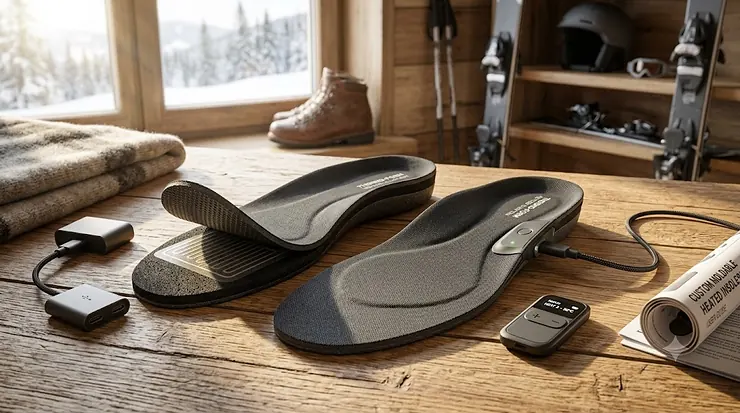
That’s where custom moldable heated insoles come in, and they represent a genuine leap forward in at-home foot care. The word “custom” is doing real work here: these aren’t just thicker foam. They use heat-activated materials — typically EVA or TPU composites — that soften, conform to your exact arch shape, heel depth, and pressure points, then re-harden into a personalized footbed. The result is support that feels like it was made specifically for you, because technically, it was.
The “heated” dimension adds another layer of value. Whether we’re talking about the thermal insulation of cork-based materials, the gentle warmth of rechargeable electric heating elements, or simply the body-heat molding process itself, these insoles address cold feet, poor circulation, and winter discomfort in ways that passive foam simply cannot.
What is a custom moldable heated insole? It’s a foot orthotic insert made from heat-responsive materials that conform to your individual foot shape when exposed to warmth, providing personalized arch support, heel alignment, and thermal comfort — all in a single product.
In this guide, I’ve dug into seven real, currently available products on Amazon to help you cut through the noise and find the pair that matches your feet, your lifestyle, and your budget.
Quick Comparison Table: 7 Best Custom Moldable Heated Insoles at a Glance
| Product | Molding Method | Arch Support Level | Best For | Price Range |
|---|---|---|---|---|
| PowerStep Heat Moldable (Archmolds) | Oven (225°F) | Medium–High, all arches | Daily wear, plantar fasciitis | $$ |
| SOLE Active Medium | Oven or wear-in | Universal, zero-drop | Athletes, versatile use | $$ |
| SOLE Active Thick | Oven or wear-in | Universal, deep heel cup | Work boots, heavy wear | $$ |
| Inocep Heat Formable Orthotics | Oven (200°F) | Rigid, ultra-low profile | Dress shoes, overpronation | $–$$ |
| Happystep Heat Moldable Insoles | Oven + trimable | Medium, Plastazote top | Sensitive/diabetic feet | $ |
| Yoosolle Custom Arch Support | Oven or boiling water | Medium | Budget buyers, first-timers | $ |
| Betterform Sportsole Heat Moldable | Oven, low arch focus | Low arch specific | Flat feet, work/sports | $–$$ |
Reading the table: The standout patterns here tell a useful story. SOLE dominates the middle ground — two excellent variants for different shoe types, both at competitive price points. PowerStep brings the medical credibility (#1 podiatrist-recommended brand). And for flat-fee, budget-accessible entry into custom orthotics, Yoosolle and Happystep punch above their weight. The right choice depends almost entirely on your shoe type, arch profile, and how much you’re willing to invest in your feet’s long-term health.
💬 Just one click — help others make better buying decisions too! 😊
Top 7 Custom Moldable Heated Insoles: Expert Analysis
1. PowerStep Heat Moldable Archmolds Insoles
PowerStep built its reputation as the #1 podiatrist-recommended insole brand in the U.S., and their Heat Moldable Archmolds represent the most clinically credible option on this list.
Key Specs (What They Actually Mean): The oven-molding process (225°F for about 5–7 minutes) activates a heat-sensitive EVA base that softens to take on your unique arch shape — low, standard, or high — then re-hardens as it cools inside your shoe. The dual-layer cushioning system pairs a plush foam top layer with this moldable structural base, which means you get both immediate comfort and corrective support. No trimming required, which matters more than it sounds: getting the sizing right out of the box means the molded footprint is already calibrated to your shoe’s interior dimensions.
What most buyers overlook about this model is the anatomical heel cradle. It doesn’t just cushion your heel — it cups and stabilizes it, reducing the micro-wobble that silently contributes to ankle fatigue, shin splints, and knee tracking issues over thousands of steps. If your knees have ever ached after a long day on your feet, your heels not being stabilized is frequently the culprit.
This is the insole I’d hand first to someone dealing with active plantar fasciitis, someone who’s recently been told by a podiatrist to “get better arch support,” or anyone transitioning from prescription orthotics and looking for a more affordable maintenance option. The heat-molding technology brings you legitimately close to a lab-fitted result at a fraction of the cost.
Customer feedback consistently highlights reduced morning heel pain within the first two weeks of use, though a small percentage report the molding process requiring two attempts to get right.
✅ True custom-fit for all arch types with no trimming
✅ Dual-layer cushioning — plush comfort and structural support
✅ No trimming required — clean fit straight from the oven
❌ Molding process can feel intimidating for first-timers
❌ Slightly bulkier profile — may not fit slim dress shoes
In the mid-price range, these offer genuinely close-to-clinical performance. Strong value for daily wearers and anyone managing heel or arch conditions.

2. SOLE Active Medium Insoles
SOLE is one of the few insole brands with actual clinical data behind them. Their signature shape has been shown to reduce plantar fascia strain by up to 34%, and the Active Medium is their versatile everyday workhorse.
Key Specs (What They Actually Mean): At 3.2mm total thickness with 1.6mm of Softec EVA cushioning, the Active Medium hits the sweet spot for most athletic shoes, casual sneakers, and lighter work footwear. The zero-drop platform is a bigger deal than the marketing language suggests: it means the heel and forefoot sit at the same elevation, encouraging neutral foot alignment rather than the heel-elevated position that quietly tilts your entire kinematic chain forward. Pair this with the deep heel cup and you have a self-correcting alignment system that works passively, all day, without you thinking about it.
The heat-or-wear molding duality is genuinely useful. Oven molding (a conventional oven at low heat for a few minutes) gives you an immediate custom fit. Wear molding — simply putting them in your shoes and letting your body heat do the work over a few days — suits anyone who finds the oven process fussy. Most buyers opt for the oven method; the results are noticeably more precise.
This is the insole for people who are on their feet for moderate periods — teachers, retail workers, weekend runners, casual hikers — and want genuine orthotic-level support without the orthopedist bill.
Customer reviews are exceptional, with thousands of verified buyers reporting lasting plantar fasciitis relief and improved energy after long walking days.
✅ Clinically proven to reduce plantar fascia strain up to 34%
✅ Zero-drop platform promotes neutral alignment
✅ Two molding methods — oven or gradual wear-in
❌ Medium thickness may feel too thin for heavy boots
❌ Cork/EVA base can feel firm initially during break-in
Mid-price range with premium-level clinical credentials. A legitimate best-in-class everyday choice.
3. SOLE Active Thick Insoles
Same DNA as the Active Medium, but designed for the boots and heavier footwear where most insoles fail completely.
Key Specs (What They Actually Mean): At 4.8mm total (3.2mm of Softec cushioning), the Active Thick addresses a genuine gap in the market: most insoles designed for trail boots or work boots are either too thin to provide meaningful support or so thick they turn the boot into a compression device for your foot. SOLE threads this needle by maintaining their zero-drop platform and deep heel cup geometry even at this greater thickness — you’re not just getting more foam, you’re getting the same corrective architecture scaled up for footwear with volume to spare.
The cork-and-EVA composite construction is worth singling out. Cork is a natural thermal insulator — it reduces heat transfer through the sole of your shoe in cold conditions, providing passive warmth without batteries or wires. For people who work outdoors in winter or spend hours on cold concrete floors, this is the thermal insole feature that requires zero maintenance and never runs out of charge.
This is the insole for construction workers, warehouse staff, hikers, winter sports enthusiasts, and anyone who lives in thick-soled footwear for the majority of their day.
✅ Maximum cushioning — 4.8mm with structural support intact
✅ Cork provides natural passive thermal insulation 🌡️
✅ Deep heel cup scales up properly for heavy footwear
❌ Too bulky for slim athletic shoes or dress footwear
❌ Slightly higher price than standard Active Medium
The thickness upgrade is worth it specifically for work boots and hiking shoes. Don’t buy these for your running shoes.
4. Inocep Heat Formable Orthotic Copper Insoles
The unsung hero of this list. Low profile, medically rigid, copper-infused — and designed for the shoe types most orthotic brands completely ignore.
Key Specs (What They Actually Mean): At ultra-low profile, these are engineered for dress shoes, oxfords, and fashion sneakers where bulk is a dealbreaker. But the spec sheet undersells the real story: the rigid EVA base is the key differentiator. Where most insoles cushion the foot, this one controls it. The rigid construction limits excessive pronation and supination — the uncontrolled rolling that strains tendons and creates the chronic aches that build up over months of repetitive daily movement.
The copper-infused yarn woven into the top fabric isn’t a marketing gimmick. Unlike surface copper coatings that wash out after a few weeks, this is integrated into the textile, providing long-lasting antimicrobial and odor-resistant properties. Nine precise size options ensure specific arch placement rather than the one-size-vaguely-fits-all approach of many competitors.
Inocep is ideal for the professional who wears dress shoes five days a week and has been told their shoes are too slim for traditional orthotics. It’s also the smart choice for anyone whose primary complaint is overpronation or fallen arches rather than impact cushioning.
Customer reviews highlight its effectiveness in dress shoes and boots where other insoles can’t fit.
✅ Ultra-low profile — fits dress shoes where others can’t
✅ Rigid base for active motion control and pronation correction
✅ Copper-infused fabric for lasting odor and antimicrobial protection
❌ Rigid feel takes adjustment — not suitable for high-impact sports
❌ Dual molding options require patience to get the custom fit dialed in
Budget-to-mid range, representing outstanding value for professional footwear wearers.
5. Happystep Custom Fit Heat Moldable Shoe Insoles
A thoughtful product for a specific audience — people with sensitive or diabetic feet who can’t compromise on top-layer materials.
Key Specs (What They Actually Mean): The standout feature isn’t the heat moldability — it’s the Plastazote top layer. Plastazote is a skin-friendly, pressure-distributing foam originally developed for medical applications in diabetes care and prosthetics. It minimizes friction hotspots and accommodates foot irregularities that would cause standard foam to create pressure sores. Available in five sizes (XS to XL), and critically, these are trim-to-fit, meaning you can fine-tune the length beyond just choosing a size.
The arch support targets medium arches and provides ball-of-foot and heel cushioning in addition to arch reinforcement — a more comprehensive coverage profile than single-focus orthotics. For diabetic patients advised by their physician to use accommodative orthotics, or for anyone with sensitive skin who reacts poorly to synthetic insole materials, this is the product most worth discussing with a foot care professional before purchase.
Customer feedback emphasizes all-day comfort for standing jobs, with particular praise from healthcare workers and retail employees.
✅ Plastazote top — medically validated for sensitive/diabetic feet
✅ Trim-to-fit across five sizes for precision fitment
✅ Ball-of-foot and heel cushioning beyond just arch support
❌ Medium arch support only — not ideal for very high or flat arches
❌ Plastazote softens faster than EVA under heavy use
Budget-friendly for the specialist application it serves. Don’t overlook this one if sensitive skin or diabetic foot care is your context.

6. Yoosolle Custom Arch Support Insoles
The honest entry-level option — not perfect, but legitimately useful for buyers testing custom orthotics for the first time.
Key Specs (What They Actually Mean): The Yoosolle can be molded via oven or boiling water, giving it unusual flexibility in the molding process. The trim-to-fit design accommodates nearly any shoe type. The EVA base provides solid arch reinforcement at a price point that makes buying multiples (for every pair of daily shoes) financially sensible.
The spec sheet won’t tell you this, but the foam lacks the advanced cushioning layers of premium models — comfort diminishes after 4+ hours of continuous standing, which is the honest ceiling of this product’s performance. That said, for light daily use, occasional wear, or someone just beginning to explore orthotic support, these deliver real pressure distribution and arch support that most factory insoles can’t touch.
Where the Yoosolle shines is as a gateway product: buy these, try custom molding, figure out whether your feet respond well to the arch positioning, then upgrade to SOLE or PowerStep with the knowledge you’ve gathered.
Customer reviews reflect positive experiences for moderate activity, with some noting the molding requires careful timing to avoid over-warping.
✅ Oven or boiling water molding — flexible setup options
✅ Trim-to-fit for broad compatibility
✅ Budget price makes multi-pair purchases viable
❌ Comfort fades after extended high-intensity standing
❌ Lower durability compared to premium EVA models
Budget range — the smart first step into custom moldable territory.
7. Betterform Sportsole Heat Moldable Orthotics
The veteran on this list — Betterform has been making medical-grade heat moldable orthotics since long before it was fashionable, and the Sportsole is their long-standing flagship.
Key Specs (What They Actually Mean): The Betterform Sportsole is available in a remarkable nine size variants (A through I) covering women’s sizes 5 through 13+ and men’s 3 through 11.5, including half-sizes — a precision of sizing that most brands don’t offer. The low-arch specific design is the key differentiator: while most custom moldable insoles claim to “work for all arch types,” the Betterform is engineered specifically for flat feet and low arches, providing the level of medial support that people with collapsed arches actually need.
Medical-grade credentials matter here. These were designed with clinical input, and the heat-molding process — oven-based, similar to the SOLE method — produces a footbed that faithfully captures the low-arch geometry rather than pushing a one-size-fits-all arch profile onto a foot that doesn’t have one.
The breathable fabric top keeps feet cooler during extended wear, and the full-length coverage ensures toe-to-heel pressure distribution. Customers with plantar fasciitis specifically attribute long-term relief to this model, with several reviewers noting they’ve bought multiple pairs for every shoe they own.
✅ Nine precise size options — half-sizes included
✅ Clinically designed specifically for flat feet and low arches
✅ Breathable fabric top for all-day freshness
❌ Not ideal for medium or high arch types
❌ Oven molding required — no wear-in option
Budget-to-mid range with medical-grade heritage. The definitive choice for people with flat feet.
How to Mold Your Insoles at Home: A Step-by-Step Guide (Plus the Mistakes That Ruin the Result)
This is the section Amazon product listings genuinely cannot give you — because the molding process is where most buyers either unlock the full potential of their insoles or accidentally reduce them to overpriced foam pads.
Step-by-Step: The Oven Method
Step 1 — Preheat precisely. Most moldable insoles specify 200–225°F. Resist the temptation to rush it by going higher. Temperatures above 250°F can warp the structural base permanently, turning your $40 investment into cardboard.
Step 2 — Remove the factory insoles from your shoes first. Sounds obvious; skipped constantly. The custom insole needs to sit flat inside the shoe with no underlying layer displacing it.
Step 3 — Heat one insole at a time. Place it fabric-side up on the middle rack for the manufacturer’s specified time (typically 3–5 minutes). Set a timer. Walking away and “checking back” is how you overdo it.
Step 4 — Transfer to your shoe immediately. You have roughly 45–60 seconds from oven to shoe before the material begins re-hardening. Have your shoes unlaced, open, and positioned within arm’s reach of the oven before you start.
Step 5 — Stand still, weight evenly distributed, for 1–2 minutes. Toes forward, shoulder-width stance. Don’t rock, shift weight, or walk during this phase — you’ll capture movement into the mold instead of your static foot shape.
Step 6 — Let cool completely before walking. At least 10 minutes. The biggest mistake buyers make is testing the fit immediately, before the material has fully re-hardened.
The Three Mistakes That Ruin Custom Moldable Insoles
Mistake 1: Wearing heavy socks during molding. Sock thickness changes the contact geometry. Mold in the socks you’ll actually wear with the shoe.
Mistake 2: Molding in the wrong shoe. If you buy insoles for your running shoes but first mold them in your dress shoes, the fit will be subtly wrong in both. Mold each pair in its intended footwear.
Mistake 3: Rushing the re-mold. Most insoles can be re-molded once if you don’t love the first result. But re-molding before the material has fully set — especially if you attempt it within a few hours — can compromise the structural integrity of the base.

Real-World Buyer Profiles: Which Insole Is Right for Your Life?
Different feet. Different schedules. Different priorities. Here’s how to match the product to the person.
The Nurse or Healthcare Worker 🏥
You’re on your feet for 10–12 hour shifts on hard floors. Fatigue doesn’t start in your mind — it starts in your heels and works up. Your priority is cushioning endurance: an insole that maintains its performance at hour eight, not just hour two. The SOLE Active Thick or PowerStep Archmolds are your best options. The SOLE’s cork layer provides passive thermal insulation on cold hospital floors; the PowerStep’s deep heel cradle reduces the micro-impact load that accumulates across thousands of steps per shift.
The Casual Runner with Morning Heel Pain 🏃
That first step out of bed — you know the one. This is classic plantar fasciitis presentation. You need corrective arch support that reduces tensile load on the plantar fascia during the heel-strike phase of your gait. The SOLE Active Medium (clinically proven at up to 34% plantar fascia strain reduction) or the PowerStep Archmolds are the two evidence-backed choices here. Combine either with proper calf stretching before your first steps of the day for faster recovery.
The Office Professional in Dress Shoes 👔
Your shoes are sleek. Your feet are suffering. Standard insoles turn your oxfords into hiking boots. The Inocep Heat Formable Copper Insoles are designed precisely for this gap — ultra-low profile, rigid motion control, fits where others can’t. No compromises on the look of the shoe.
The Flat-Footed Budget Buyer 💸
You have flat arches, you’ve always had flat arches, and you need something specifically designed for low-arch biomechanics rather than a universal product pretending to fit your foot. The Betterform Sportsole is the pick — medically designed for flat feet, available in half-sizes for precision fit, at an accessible price point. If you want to upgrade later, the SOLE Active Medium with its zero-drop platform is excellent for graduated flat-foot correction.
The Winter Outdoor Worker or Enthusiast ❄️
Cold feet compromise everything — dexterity, focus, and mood. You need passive thermal insulation baked into the insole itself. The SOLE Active Thick (cork’s natural insulating properties) paired with appropriate insulated footwear creates a warm, custom-supported environment that electric heated insoles can’t match for all-day durability.
Heated Insoles vs Traditional Insoles: The Full Comparison
| Feature | Custom Moldable Heated | Standard Foam Insoles | Prescription Orthotics |
|---|---|---|---|
| Custom fit | ✅ Personal to your foot | ❌ Generic shape | ✅ Lab-fitted |
| Thermal benefit | ✅ Cork/material warmth | ❌ None | ❌ Usually none |
| Arch support quality | ✅ High | ⚠️ Low–Medium | ✅ Highest |
| Cost | $–$$ | $ | $$$$ |
| Availability | Amazon, instant | Any store | Requires specialist |
| Remoldable | ✅ Yes | ❌ No | ❌ No |
| Break-in period | Short (days) | None | Weeks |
What this table means for you: Prescription orthotics will always provide the highest quality fit — they are, after all, made from a physical cast or 3D scan of your foot by a specialist. But at $300–$800+ per pair, they’re also prohibitive for most people and overkill for moderate foot conditions. Custom moldable insoles occupy the compelling middle ground: dramatically better than generic foam, legitimately close to prescription quality for most common conditions, and available for under $50. For anyone who’s been told to “just try better insoles” by their doctor, this is the category they mean.
✨ Don’t Miss These Exclusive Deals!
🔍 Take your foot health to the next level with these carefully selected custom moldable insoles. Click any highlighted product name to check current pricing and availability. Your feet carry you through millions of steps — give them support that’s actually built for your feet!
How to Choose the Right Custom Moldable Heated Insoles: 6 Criteria That Actually Matter
Most buying guides give you a list of spec categories without telling you which ones are worth caring about. Here’s the honest version.
1. Know Your Arch Type Before You Buy
This is the single most important variable. Low arches (flat feet) need medial support that fills the gap between your foot and the ground. High arches need cushioning under the metatarsal arch to absorb impact. Standard arches benefit from moderate support across the full footbed. Guessing wrong means the insole works against your natural biomechanics. A wet-foot test (wet your foot, step on paper, examine the print) takes 30 seconds and saves you a frustrating return.
2. Match the Insole Thickness to Your Shoe Volume
The spec that most buyers ignore. A 4.8mm thick insole in a slim running shoe will create pressure across the top of your foot. A 1.6mm insole in a wide hiking boot will float around uselessly. The product description for your shoe (removable factory insole? deep toe box?) tells you which thickness tier to target.
3. Rigid vs. Cushioned: Different Goals, Different Designs
Rigid orthotic bases (like Inocep’s) control motion — they correct biomechanical errors. Cushioned bases (like SOLE’s Softec) absorb impact. Most people with foot pain benefit from motion control first; people with impact-related conditions (runners, concrete workers) benefit from cushioning first. The best custom moldable insoles for most people combine both: a firm structural base with a cushioned top layer.
4. Molding Method: Oven vs. Wear-In vs. Boiling Water
Oven molding is faster and more precise — recommended for serious alignment correction. Wear-in molding is more convenient and appropriate for mild support needs. Boiling water methods (used by Yoosolle and similar) are effective but require careful handling to avoid burns and over-softening. Your lifestyle determines which is realistic.
5. Thermal Properties: What “Heated” Really Means in This Context
In most moldable insoles, thermal benefit comes from the materials (cork, dense EVA) rather than active heating elements. Cork provides genuine passive insulation — it slows heat transfer out of your foot. Active rechargeable heated insoles (a separate product category) add electronic elements that can fail, run out of charge, and add bulk. For the vast majority of cold-foot concerns, a cork-based moldable insole delivers reliable warmth without the maintenance overhead.
6. Remodeling Potential
Life changes — weight gain, a running injury, a new pair of boots — all affect your foot’s support needs. Most quality moldable insoles can be gently re-heated and remolded once or twice before the structural material fatigues. This is a hidden long-term value factor: one well-chosen pair can adapt as your needs evolve, rather than becoming landfill after three months.
Common Mistakes When Buying Custom Moldable Insoles (That Are Very Easy to Avoid)
Buying One Size Up “For Comfort”
Insoles need to fit precisely inside your shoe, not inside your foot. Sizing up creates folding and bunching at the toe box that turns a potentially helpful product into a blister machine. If you’re between sizes, size down and use a trim-to-fit design — or choose a product (like Betterform with its half-size options) that gives you precision sizing.
Treating All “Moldable” Claims Equally
There’s heat moldable, there’s wear moldable, and there’s “moldable” printed on packaging where the material barely softens. The gold standard is a rigid or semi-rigid EVA or TPU base that genuinely softens to your foot geometry and re-hardens into a stable shape. Soft foam that “conforms” to your foot is just regular foam — it doesn’t retain a custom shape.
Neglecting the Break-In Period
Even perfectly molded insoles create micro-adjustments in your gait as your body adapts to corrected alignment. Expect mild muscle awareness in your calves and arches for the first week. Starting with 4–6 hours of daily wear (rather than immediately going to 12 hours) prevents the kind of overuse soreness that makes people abandon orthotics unnecessarily.
Using the Same Insoles in Every Shoe Simultaneously
Your running shoes, work boots, and dress shoes have different geometry, heel heights, and toe box volumes. One insole can’t serve all three optimally. If budget is a constraint, prioritize the footwear you spend the most hours in. A second pair for your weekend shoes is a small investment compared to the long-term cost of undertreated foot conditions.

Long-Term Cost and Real-World Value of Custom Moldable Insoles
The math here is straightforward but rarely spelled out. A pair of quality custom moldable insoles in the mid-price range, used in a single pair of shoes worn 200 days a year, costs roughly 20–25 cents per day of use. A single podiatry consultation for foot pain runs $150–$400. A pair of prescription orthotics: $300–$800.
According to the NCCIH at the National Institutes of Health, 41% of plantar fasciitis patients use prescription pain medications to manage their condition, with all the cost, side effects, and dependency risk that implies. For a condition that conservative research (NCBI) shows resolves in roughly 80% of cases with consistent conservative care — proper footwear, stretching, and orthotic support — the case for investing in quality custom moldable insoles before reaching for medications or specialist intervention is compelling.
The durability question is equally important. Quality EVA-based insoles (SOLE, PowerStep) typically last 12–24 months under regular use — significantly longer than fashion-brand insoles that compress and flatten within 3–4 months. The cork-and-EVA composites can outlast that estimate with proper rotation across multiple pairs of shoes.
What to watch for as your insoles age: Visible compression creasing, loss of the heel cup depth, and a “flat” feeling underfoot that wasn’t there at month one all signal it’s time to remold or replace. The structural base typically outlasts the cushioning layer — you can often extend useful life by remolding the base even as surface foam compresses.
Learn more about foot health, plantar fasciitis, and orthotic support science at the American Orthopaedic Foot & Ankle Society and through peer-reviewed research published via PubMed.
FAQ: Custom Moldable Heated Insoles ❓
❓ How long do custom moldable heated insoles last before needing replacement?
❓ Can custom moldable insoles really help with plantar fasciitis, or is that marketing?
❓ Can I remold my insoles if the first fit doesn't feel right?
❓ Are custom moldable heated insoles safe for diabetic feet?
❓ What's the difference between trimable and non-trimable moldable insoles?
Conclusion: The Best Investment Your Feet Will Ever Get 🏆
Most people treat their feet like an afterthought — the foundation of every step, every mile, every workday, and yet the body part that gets the least intentional care. Custom moldable heated insoles won’t fix serious orthopaedic conditions on their own, but for the vast majority of everyday foot discomfort, they represent a genuinely transformative upgrade from generic foam.
The options reviewed here span the full spectrum: clinical-grade precision (PowerStep Archmolds, SOLE Active Medium), specialized design for specific needs (Inocep for dress shoes, Betterform for flat feet, Happystep for sensitive skin), and accessible entry points for first-time orthotic users (Yoosolle). There’s no single right answer — only the right answer for your arch type, your shoes, and how you spend your days on your feet.
Start with your arch type. Match the thickness to your shoe volume. Mold carefully (re-read that step-by-step guide). Give the insoles a genuine week to let your body adapt. The research is clear: consistent use of properly fitted arch support is among the most effective conservative interventions for the foot conditions that affect millions of Americans every year.
Your feet are the only pair you’ll ever have. The 20 cents a day to support them correctly might be the smartest recurring investment you make this year.
✨ Don’t Miss These Exclusive Deals!
🔍 Ready to find your perfect pair? Browse all seven options above, click the product name that matches your needs, and check current pricing and availability on Amazon. Your feet will send you a thank-you note — or at least stop complaining first thing every morning! 😄
Recommended for You 📚
- Best Disposable Heated Insoles for Skiing: 7 Top Picks (2026)
- 7 Best Rechargeable Heated Insoles in 2026
- 7 Best Heated Thermal Underwear Sets of 2026 That Will Crush the Cold
Disclaimer: This article contains affiliate links. As an Amazon Associate, I earn from qualifying purchases. If you purchase products through these links, we may earn a small commission at no additional cost to you.
✨ Found this helpful? Share it with your friends! 💬🤗
