

In This Article
Somewhere between “my apartment has one radiator and it’s clearly decorative” and “central heating costs more than my rent,” most of us land on the same solution: a fan heater. It’s the appliance equivalent of a good pocketknife — small, unglamorous, and weirdly essential the moment the temperature drops. But walk into the heater aisle (or scroll through Amazon at 11 p.m. in a cold apartment, no judgment) and you’ll find dozens of nearly identical white boxes promising the same thing. Picking the best fan heater for your specific situation means looking past the marketing copy and into the actual specs, the actual reviews, and the actual math on your electric bill.

A fan heater is, at its core, refreshingly simple: it pulls in room-temperature air, pushes it across a heated element, and blows the warmed air back out with a built-in fan — which is exactly what separates it from a plain radiant heater that just glows and waits for you to walk in front of it. That fan is the whole point. It’s why a decent electric fan heater can raise the temperature of a small bedroom noticeably faster than a radiator that has to heat the air passively.
This guide breaks down seven real, currently available fan heaters spanning desktop-sized mini units to a genuinely fancy bladeless model, with honest analysis of who each one is actually built for. We’ll also get into the heater types you’ll see on spec sheets, the mistakes that lead to buyer’s remorse, and the real-world performance numbers that Amazon listings tend to leave out.
Quick Comparison Table
Before the deep dive, here’s how the seven models stack up on the basics that matter most: wattage, coverage, noise, and who they suit.
| Heater | Wattage | Best For | Noise Level | Price Range |
|---|---|---|---|---|
| Honeywell HeatBud | 170W/250W | Desktop spot heating | Whisper-quiet | Around $15–$20 |
| De’Longhi Capsule | 1500W | Fast heat in tiny rooms | Moderate | $35–$50 range |
| Vornado VH200 | 1500W | Quiet whole-desk warmth | Very quiet | $50–$65 range |
| Pelonis 23″ Tower | 1500W | Oscillating medium rooms | Under 55dB | $60–$85 range |
| Dreo Solaris 718 | Up to 1500W | Smart touchscreen control | 11% quieter than average | $70–$100 range |
| Lasko FH500 | 1500W | Whole-room heating | Moderate | $110–$135 range |
| Dyson AM09 | 1500–2000W | Safety-first, year-round use | Low hum | $300–$500 range |
Looking at the table, a clear pattern emerges: wattage tops out at 1500W across nearly every model here, because that’s the ceiling U.S. safety standards place on portable electric heaters — so the real differentiator isn’t raw power, it’s how intelligently each unit distributes that power. The Honeywell HeatBud sits in its own category entirely, sipping power to warm a person rather than a room, while the Dyson AM09 justifies its price tag through engineering rather than extra wattage. If you’re heating anything bigger than a home office, the oscillating models — Pelonis and Lasko — will earn their keep faster than the compact desktop units.
Just one click — help others make better buying decisions too!😊
Top 7 Best Fan Heaters: Expert Analysis
We dug into real specs, real owner reviews, and independent lab testing (where available) to build this list. Coverage spans budget desktop units, oscillating mid-range towers, and one genuinely premium pick — because “best” depends entirely on your room, not just your budget.
1. Honeywell HeatBud — smallest footprint for desktop spot heating
The Honeywell HeatBud is proof that a fan heater doesn’t need to heat a whole room to be worth owning. At just 4 x 5.7 x 6.5 inches and under a pound, it’s built to warm one person, not one house. The two-heat-setting design (170W low, 250W high) means it draws barely more power than a laptop charger, and the ceramic element with a small fan pushes gentle warm air rather than a blast — ideal for tucking under a desk. Based on the spec comparison with full-size units, the trade-off is obvious: you’re getting personal warmth, not room-filling heat, and this mini fan heater simply isn’t designed to change the temperature of a 200-square-foot bedroom.
Reviewers consistently report using it for cold feet under a desk, drafty home offices, and even mild arthritis relief from targeted warmth — several long-term owners mention buying a second or third one after years of reliable service. A common complaint in user reviews is the faint “new element” smell in the first few uses, which typically fades after the initial burn-in period. What most buyers overlook about this model is that its tip-over shutoff and overheat protection meet the same Honeywell safety program used across the brand’s larger heaters, despite the toy-like size.
Pros:
- ✅ Tiny footprint fits any desk or cubicle
- ✅ Extremely low power draw keeps bills unchanged
- ✅ Cool-touch housing safe near hands and pets
Cons:
- ❌ Not intended to heat an entire room
- ❌ No oscillation or fan-only mode
At around $15–$20, the Honeywell HeatBud is less a heater and more a warmth accessory — and for that specific job, it’s hard to beat the value.
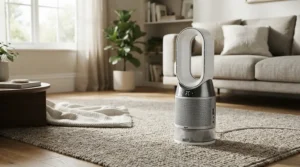
2. De’Longhi Capsule — fastest instant warm-up in a travel-ready shell
If “instant warm air heater” is what you searched for, the De’Longhi Capsule is built to earn that exact phrase. At 1,500 watts and just 1.3 pounds, it’s a ceramic fan heater engineered to deliver focused heat within seconds of flipping the switch, backed by a folding base and a built-in carry handle that make it genuinely portable between rooms. The 5,118 BTU output covers roughly 55 square feet, which — based on the spec comparison — puts it squarely in “bathroom, small bedroom, or dorm nook” territory rather than open-plan living rooms.
The anti-freeze standby setting is the standout feature here: when the room dips below 41°F, the heater kicks on automatically, which is a genuinely useful trick for basements or vacation homes prone to frozen pipes that most competing capsule heaters in this price bracket don’t offer. Reviewers consistently note that it warms a small bathroom in the time it takes to shower, and one recurring theme in aggregated feedback is appreciation for the fan-only summer mode, which extends the appliance’s usefulness past a single season. On the downside, a common complaint in user reviews is a noticeable hum at the high setting in very quiet rooms — not loud, but noticeable if you’re a light sleeper.
Pros:
- ✅ Genuinely instant heat output within seconds
- ✅ Anti-freeze standby mode for cold basements
- ✅ Foldable base and handle for easy transport
Cons:
- ❌ Limited to roughly 55 square feet of coverage
- ❌ Noticeable hum on the high setting
Priced in the $35–$50 range, the De’Longhi Capsule delivers strong value for anyone who wants speed and portability over whole-room ambition.
3. Vornado VH200 — quietest vortex circulation for small rooms
The Vornado VH200 takes a different approach to the standard fan heater formula: instead of blasting air in one direction, its Vortex Circulation technology pulls air from the room, heats it, and pushes it out in a swirling pattern designed to reach corners a straight-line fan heater would miss. What most buyers overlook about this model is that it runs on a simple mechanical thermostat rather than digital controls, which sounds old-fashioned but is exactly why owners report exceptional reliability — there’s less electronics to fail over years of seasonal use. At 1,500 watts with three heat settings, including a 750W energy-saving mode, it strikes a genuinely useful middle ground between the tiny HeatBud and the room-filling towers further down this list.
Aggregated review sentiment is unusually consistent for a budget appliance: reviewers across Walmart, Best Buy, and Home Depot repeatedly describe it as “quiet,” “compact,” and “effective,” with several noting they can’t tell it’s running except by the indicator light. A recurring complaint, however, is that it’s simply underpowered for anything larger than a small-to-medium bedroom, and a handful of recent reviewers have flagged a plastic odor on newer production units that older VH200s didn’t have — worth airing out for a day before first use. Consumer Reports’ lab testing backs up the real-world feedback, confirming it heats a seated person quickly while keeping the exterior housing safe to the touch.
Pros:
- ✅ Vortex airflow reaches corners evenly
- ✅ Exceptionally quiet even at full power
- ✅ Simple mechanical controls rarely fail
Cons:
- ❌ Underpowered for large or open rooms
- ❌ Some newer units report a plastic odor
At $50–$65 range, the Vornado VH200 is the pick for buyers who value quiet reliability over bells and whistles.
4. Pelonis 23″ Oscillating Ceramic Tower — widest oscillation for medium rooms
Stepping up in both size and coverage, the Pelonis 23″ Oscillating Ceramic Tower uses a PTC ceramic element paired with 75-degree oscillation to spread heat across up to roughly 220 square feet — a meaningful jump from the desktop and compact models above it. The touch panel and included remote allow 1-degree Fahrenheit precision, and the 12-hour timer means you can set it and genuinely forget it, something the mechanical-thermostat Vornado can’t match. Here’s what to weigh: PTC ceramic elements heat up almost instantly, but they also cycle on and off more frequently to hold a set temperature, which is part of why Pelonis rates this unit under 55 decibels even on its higher settings.
Reviewers consistently praise the rapid warm-up — several describe feeling heat within moments of powering on — and the flame-retardant housing and dual tip-over/overheat protection get called out specifically in aggregated feedback as reassuring for pet owners. On the other hand, a recurring theme among long-term owners is reduced reliability after a year or more of regular use, with some reporting the unit eventually gets stuck between heat settings — a pattern worth factoring in if you expect years of daily service rather than seasonal use. The company’s claim of raising room temperature by 70°F in three seconds is marketing hyperbole worth taking with a grain of salt; what’s verifiable is that the initial blast of warm air is genuinely immediate, even if the whole room takes longer.
Pros:
- ✅ Wide 75-degree oscillation for medium rooms
- ✅ Quiet operation under 55 decibels
- ✅ Precise 1-degree thermostat control
Cons:
- ❌ Some long-term durability complaints
- ❌ Marketing claims outpace real-world heating speed
In the $60–$85 range, the Pelonis 23″ Oscillating Ceramic Tower offers strong coverage for the money, provided you manage expectations on longevity.
5. Dreo Solaris 718 — quietest smart touchscreen control
The Dreo Solaris 718 is the heater you buy when you’re tired of appliances that look like appliances. Its slim, matte cylindrical body houses five heat settings and three fan speeds, with 120-degree oscillation and Dreo’s proprietary ObliqueAirflow technology, which the company states reduces airflow noise by roughly 11% compared to standard fan heaters. Based on the spec comparison, what separates this from the Pelonis and Vornado is the touchscreen-plus-remote control scheme that adjusts temperature in single-degree increments, alongside a genuine eco mode that tapers power output as the room approaches the target temperature rather than simply cycling fully on and off.
Reviewers consistently highlight how quiet it runs at every setting — a notable claim given that most fan heaters get louder as they get hotter — and multiple independent reviews specifically call out the eco mode as their default, all-the-time setting rather than an afterthought feature. Aggregated sentiment also flags the safety stack (V0 flame-retardant materials, overheat protection, child lock, and ETL listing) as genuinely reassuring for households with kids. The one consistent knock, based on real user feedback, is the control panel’s icon-only labeling, which several reviewers found unintuitive until they’d used it a few times — Dreo ships a sticker legend in the box, which feels like it’s compensating for a design choice that should’ve been solved with printed labels.
Pros:
- ✅ Genuinely quiet across every heat setting
- ✅ Smart eco mode reduces power as room warms
- ✅ Strong safety certifications and child lock
Cons:
- ❌ Icon-only controls have a learning curve
- ❌ No HEPA filtration despite the premium feel
Sitting in the $70–$100 range, the Dreo Solaris 718 is the strongest all-around mid-range pick if quiet operation is your top priority.

6. Lasko FH500 All Season Tower — best all-rounder for whole-room heating
Independent lab testing gives the Lasko FH500 a genuine edge here: in controlled room tests, it was the only model in its comparison set to consistently raise room temperature by a full 10 degrees Fahrenheit, and to do so evenly across the space rather than just near the unit. That’s a meaningful, verifiable data point rather than marketing language, and it’s why this 42-inch tower earns the “best all-rounder” tag. With three heat settings, four fan speeds, 45-degree oscillation, a digital thermostat with eco mode, and an 8-hour timer, it’s the most fully-featured model in the mid-price tier, and — critically for a year-round appliance — it doubles as a genuinely capable standalone fan once winter ends.
Reviewers consistently note the remote control as a real convenience rather than a gimmick, since the FH500 can also be programmed directly from its panel if the remote goes missing (a common fate for small heater remotes). A common complaint in user reviews is the size: at 12.5 pounds and nearly 42 inches tall, this isn’t a heater you tuck under a desk, and it needs genuine floor space to stand safely. What most buyers overlook about this model is the eco mode’s actual mechanism — it’s not just a lower wattage setting, it’s a full thermostat cycle that shuts the heating element off entirely once the target temperature is reached, which is where most of the real energy savings come from.
Pros:
- ✅ Verified 10-degree room temperature increase
- ✅ Doubles as a genuine standalone fan
- ✅ Full digital thermostat with real eco cycling
Cons:
- ❌ Large footprint needs dedicated floor space
- ❌ Heavier than compact desktop alternatives
At $110–$135 range, the Lasko FH500 is the clearest pick if you want one appliance to genuinely heat a whole room, not just a corner of it.
7. Dyson AM09 Hot+Cool Jet Focus — safest bladeless design for homes with kids and pets
The Dyson AM09 is the outlier on this list, and it knows it. Using Air Multiplier technology, it has no visible blades and no exposed heating element, which — based on the spec comparison against every other product here — makes it the meaningfully safer option in homes with curious toddlers or heater-chewing pets. It runs at 1,500–2,000 watts depending on mode, offers ten fan speeds, a Jet Focus setting for directed heat and a Diffused mode for even room coverage, plus a temperature range up to 37°C (about 99°F) and multiple timer options up to nine hours.
Consumer Reports’ lab data confirms it heats a standard room and a seated person very quickly, and independent reviewers consistently rate the build quality and remote control as best-in-class, holding a 4.4 out of 5 average across hundreds of verified ratings on Dyson’s own platform. Here’s what the spec sheet won’t tell you: this is fundamentally a design-and-safety purchase, not a raw-heating-power purchase, since it produces no more warmth per watt than a $50 ceramic tower. A recurring theme in aggregated feedback is genuine appreciation for year-round dual use as both heater and cooling fan, though several owners note the price only makes sense if you actually use both functions rather than treating it as a seasonal heater alone.
Pros:
- ✅ Bladeless design is genuinely safer around kids
- ✅ True dual-purpose heater and cooling fan
- ✅ Ten fan speeds with precise digital control
Cons:
- ❌ Price far exceeds its raw heating output
- ❌ No air-purifying filtration on this specific model
In the $300–$500 range, the Dyson AM09 is a premium design purchase first and a heater second — worth it only if that trade-off appeals to you.
Practical Usage Guide: Setup, Safety & the First 30 Days
Getting a new fan heater right starts before you even plug it in. Unbox it fully, including any protective film over vents, since blocked airflow is one of the most common causes of early overheat shutoffs. Place it on a hard, level, non-flammable surface — never carpet, never a rug — and keep it at least three feet from curtains, bedding, furniture, and anything else combustible, a spacing rule the U.S. Consumer Product Safety Commission specifically recommends for every portable electric heater, regardless of brand or wattage.
During the first few uses, expect a faint “new appliance” smell from the heating element as manufacturing residue burns off — this is normal for nearly every model on this list and typically clears within 10–15 minutes of continuous use in a ventilated room. Always plug directly into a wall outlet; extension cords and power strips are a leading cause of the roughly 1,600 heater-related house fires CPSC records annually, since they’re rarely rated for the sustained current a 1,500-watt heater draws.
For ongoing maintenance, unplug the unit and wipe down intake vents monthly with a dry cloth or a vacuum brush attachment — dust buildup restricts airflow and forces the element to work harder, which shortens its lifespan and can trip overheat protection prematurely. A common first-30-days mistake is running a fan heater continuously overnight; most manufacturers, including Lasko and Dreo, recommend a maximum three-hour continuous runtime as supplemental heat, not a replacement for central heating.

Real-World Scenarios: Who Should Buy Which Fan Heater
The remote college student in a dorm with strict wattage limits. A dorm outlet shared with a mini-fridge and a laptop charger doesn’t leave room for a 1,500-watt space heater — and many dorms ban them outright. The Honeywell HeatBud at 250 watts max is often the only option that’s both compliant and genuinely useful for warming cold feet during a late study session.
The remote worker with a drafty home office and a tight budget. If you’re heating one desk-sized zone for eight hours a day, five days a week, the math favors efficiency over raw power. The Vornado VH200 or De’Longhi Capsule, both under $65, will warm a single desk area without meaningfully moving the needle on a monthly electric bill, and their compact size means they can travel between rooms as your schedule changes.
The family with a large, chilly living room and pets underfoot. Bigger spaces need oscillation and real coverage, not just wattage. The Lasko FH500 or Pelonis 23″ Tower both spread heat across a wider arc, and their tip-over shutoffs matter more in a household where a dog’s tail or a toddler’s foot is a real possibility rather than a hypothetical.
The design-conscious renter who wants one appliance for both seasons. If storage space is tight and you’d rather own one good appliance than two mediocre ones, the Dyson AM09 earns its premium price by handling summer cooling and winter heating in the same bladeless unit — provided the higher upfront cost fits your budget.
How to Choose the Best Fan Heater
What is a fan heater? A fan heater is a compact electric appliance that uses an internal fan to blow air across a heated element, producing faster, more evenly distributed warmth than a heater without a fan.
Choosing the right model comes down to matching a handful of specs to your actual room and habits:
- Measure your room, not your ambition. A 1,500-watt heater comfortably covers roughly 100–150 square feet; anything larger needs either a stronger unit or supplemental central heating.
- Check for oscillation if the room is wider than it is deep. A stationary fan heater in a wide living room leaves cold pockets that an oscillating model like the Pelonis or Lasko simply avoids.
- Prioritize a tip-over switch and overheat protection — non-negotiably. These two features alone account for most of the difference between a heater that’s merely annoying to lose and one that could start a fire.
- Decide if you need portability or permanence. A carry handle and sub-2-pound weight (like the De’Longhi Capsule) matter if the heater moves between rooms daily; a heavier tower makes more sense if it lives in one spot all winter.
- Factor in noise tolerance for bedrooms. If it’s going next to a bed, look specifically for a stated decibel rating under 55dB, which rules out several louder budget models not covered here.
- Consider a digital thermostat with eco mode over a basic on/off dial. The energy savings from a heater that actually cycles off at a set temperature can offset a higher upfront price within a single winter.
- Match your budget to realistic expectations, not marketing claims. A $20 mini heater and a $130 tower heater are not competing products — they’re solving different problems.
Small Electric Heater Types Explained
Not every fan heater uses the same heating technology, and understanding the differences among small electric heater types clears up a lot of confusing spec-sheet language. Ceramic heaters, used in the Lasko, De’Longhi, and Pelonis models above, pass electricity through a ceramic plate that heats up quickly and self-regulates as resistance changes — they’re the most common type in this price range because they balance speed, safety, and cost well. PTC (positive temperature coefficient) ceramic elements, specifically featured in the Pelonis tower, take this a step further by automatically limiting their own maximum temperature as a built-in safety mechanism, without needing extra electronic sensors.
Metal-coil or wire-element heaters, like the one inside the Vornado VH200, heat up fastest of all but run hotter to the touch near the grille, which is why manufacturers pair them with vortex or vane-based airflow designed to spread heat before it reaches you directly. Then there’s portable convection heating, a category that technically includes any heater relying primarily on natural air movement rather than a fan to distribute warmth — oil-filled radiators are the classic example. None of the seven fan heaters above are pure convection units, since a fan-heater by definition adds forced airflow, but understanding portable convection heating matters for comparison shopping: convection-only heaters run quieter and hold heat longer after shutoff, at the cost of a noticeably slower initial warm-up than any fan-assisted model on this list.
Finally, infrared or radiant heaters — not featured here — skip air-heating almost entirely, warming objects and people directly via infrared radiation, which explains why they feel warm instantly but don’t raise a room’s overall air temperature the way a ceramic or metal-coil fan heater does over time.
Electric Fan Heater vs Traditional Space Heater
The term “space heater” gets used loosely, but there’s a real technical distinction worth understanding before you buy. A traditional space heater often refers to oil-filled radiators or baseboard-style units that rely on convection and radiant heat with no fan at all, while an electric fan heater specifically forces air across a heated element for faster, more directional warmth.
| Factor | Electric Fan Heater | Traditional Oil-Filled Radiator |
|---|---|---|
| Warm-up speed | Seconds to a couple of minutes | 15–30 minutes |
| Noise | Audible fan hum | Silent |
| Heat retention after shutoff | Minimal | Extended, holds heat for hours |
| Best For | Quick spot heating, small-to-medium rooms | Overnight bedroom heat, allergy-sensitive users |
The comparison table makes the trade-off clear: an electric fan heater like the Lasko FH500 or Dyson AM09 wins decisively on speed, which matters if you’re heating a room you’re about to occupy right now. A traditional radiator wins on quiet, sustained warmth, which matters more for overnight use or for anyone sensitive to the low hum every fan heater on this list produces to some degree. If you split your needs — quick daytime warmth plus quiet overnight heat — owning one of each isn’t unreasonable, since neither fully replaces the other’s specific strength.
Common Mistakes When Buying a Fan Heater
The single most common mistake is buying based on square footage claims printed on the box without checking independent testing, since manufacturer coverage estimates (like Pelonis’s 220-square-foot claim) tend to assume ideal conditions — no drafts, high ceilings excluded, doors closed. A second mistake is ignoring noise ratings entirely, then discovering the “quiet” 1,500-watt tower is genuinely disruptive in a bedroom at 2 a.m.; always check for a stated decibel figure rather than trusting adjectives like “whisper-quiet” on their own.
Buyers also frequently underestimate how much a tip-over switch and overheat protection matter until an actual incident happens — these features should be treated as mandatory, not optional extras, on every single fan heater purchase regardless of price point. Another recurring error is choosing a mini fan heater like the HeatBud to heat a full bedroom, then blaming the product for underperforming a job it was never designed to do; matching wattage to room size upfront avoids this entirely. Finally, skipping the safety certification check (UL, ETL, or CSA listing) to save a few dollars on an off-brand unit is a false economy — uncertified heaters are disproportionately represented in the fire statistics CPSC tracks each winter.
What to Expect: Real-World Performance
On paper, most fan heaters in this price range look nearly identical — 1,500 watts, a couple of heat settings, tip-over protection. In practice, real-world performance diverges quickly once a heater is running in an actual room rather than a spec sheet. An instant warm air heater like the De’Longhi Capsule genuinely delivers a noticeable blast of warmth within seconds, but that speed is localized; it takes considerably longer for that warmth to raise the overall air temperature of even a small room, which is why independent lab testing measures whole-room temperature change over 15–30 minutes rather than the first few seconds.
Reviewers consistently underestimate how much airflow direction matters versus raw wattage — a heater aimed at a wall or under a desk wastes much of its output, while the same unit aimed into open floor space performs noticeably better. Expect any 1,500-watt fan heater to measurably raise the temperature of a well-insulated 100–150 square foot room by roughly 5–10 degrees Fahrenheit within 20–30 minutes, based on the independent lab data available for models like the Lasko FH500 and Vornado VH200; poorly insulated rooms, older windows, or high ceilings will all reduce that real-world result regardless of what the box promises.
Best Mini Fan Heater Picks for Small Spaces, Dorms & Renters
Renters and dorm residents face a specific set of constraints — shared circuits, restrictive lease terms, and often a genuine ban on high-wattage appliances — that make a mini fan heater the more realistic category to shop rather than a full tower unit. The Honeywell HeatBud, at a maximum draw of 250 watts, is the clearest fit here: it’s unlikely to trip a shared circuit breaker, it’s cheap enough to leave behind at the end of a lease without regret, and its size makes it easy to hide in a drawer during university housing inspections that prohibit visible heating appliances.
For renters with slightly more flexibility — a private studio apartment rather than a shared dorm room — the De’Longhi Capsule and Vornado VH200 both offer a meaningful step up in actual heating capability while remaining light enough to move between a bedroom and a home office as needed throughout the day. What most buyers overlook about this category is that a smaller heater used correctly, positioned close to where you’re actually sitting, often delivers better perceived warmth than a larger unit heating an entire room you’re not fully occupying — spot heating is frequently the smarter, cheaper choice for single-occupant spaces, not a compromise.
Long-Term Cost & Maintenance
| Model | Est. Cost per 8-Hr Day* | Maintenance Needs |
|---|---|---|
| Honeywell HeatBud | Roughly $0.03–$0.05 | Minimal — no filter, occasional dusting |
| Vornado VH200 / De’Longhi Capsule | Roughly $0.19–$0.29 | Vent cleaning every few weeks |
| Pelonis / Dreo / Lasko (1500W) | Roughly $0.19–$0.29 on high, less on eco mode | Monthly vent cleaning, remote battery swaps |
| Dyson AM09 | Roughly $0.19–$0.32 depending on mode | Occasional wipe-down, no filter on this model |
*Estimated using a national average electricity rate; your actual cost will vary by local utility rates and how often you run high heat versus eco settings.
The table above underlines a point that surprises a lot of first-time buyers: daily running cost differences between most 1,500-watt models are minor, since wattage — not brand or price — drives electricity use. Where the real long-term cost savings show up is in eco-mode cycling, which the Dreo Solaris 718 and Lasko FH500 both implement well, potentially cutting effective runtime (and cost) by a third or more compared to a heater left on a fixed high setting all day. The Honeywell HeatBud, meanwhile, is in a different league entirely for total cost of ownership, since its low wattage means even months of near-continuous use barely registers on a monthly bill.
Safety, Regulations & Compliance Guide
U.S. safety standards cap portable electric space heaters, including every fan heater on this list, at 1,500 watts of output — which is why you’ll never see a model here exceeding that figure on its highest ceramic or PTC heat setting (the Dyson’s 2,000W peak applies specifically to its combined fan-and-heat mode, not the ceramic element category most competitors use). Every model reviewed here carries a recognized safety certification — UL, ETL, or CSA — which the Consumer Product Safety Commission specifically recommends checking before purchase, since uncertified heaters lack independent verification of their overheat and tip-over protections.
Beyond certification, the core safety habits apply universally regardless of which fan heater you choose: keep a three-foot clearance from anything flammable, plug directly into a wall outlet rather than an extension cord or power strip, never leave a heater running unattended or while sleeping, and place it only on hard, level, non-carpeted surfaces. Households with small children or pets should specifically weigh the exposed-element risk — models like the Vornado VH200 and Lasko FH500 have visible heating elements behind a safety grille, while the Dyson AM09’s bladeless, elementless design removes that specific concern entirely, which is a legitimate reason some families pay its premium price.
Frequently Asked Questions
❓ What is the best fan heater for a small bedroom?
❓ Is an electric fan heater cheaper to run than central heating?
❓ How many watts does a fan heater use?
❓ Are mini fan heaters safe for dorm rooms?
❓ What is the difference between a ceramic and PTC fan heater?
Conclusion
There isn’t one universally best fan heater — there’s a best fan heater for your specific room, budget, and daily habits, and the honest answer usually becomes obvious once you’re clear on which of those three factors matters most to you. If you’re heating a single desk or a dorm corner, the Honeywell HeatBud solves that cheaply and safely. If you need genuine whole-room warmth with real independent testing behind the claim, the Lasko FH500 earns its spot through verified performance rather than marketing language. And if design, year-round dual use, and bladeless safety around kids matter more than squeezing every dollar of heating value from your purchase, the Dyson AM09 is a legitimate, if pricier, answer.
Whichever you choose, the fundamentals don’t change: match wattage to your actual square footage, never skip the tip-over and overheat protections, and keep three feet of clearance from anything that burns. Do that, and any of the seven fan heaters covered here should get you through the cold months without drama — or a surprising electric bill.
Recommended for You
- Best Oscillating Ceramic Heater 2026: 7 Top Picks
- Best Desktop Ceramic Heater (2026): 7 Picks Office Workers Actually Love
- Best Tower Ceramic Heater 2026: 7 Picks Worth Buying
Disclaimer: This article contains affiliate links. As an Amazon Associate, I earn from qualifying purchases. If you purchase products through these links, we may earn a small commission at no additional cost to you.
✨ Found this helpful? Share it with your friends! 💬🤗
