
In This Article
Picture this: you’re buried under three blankets, teeth chattering, wondering why your heating bill looks like a phone number. Sound familiar? I’ve been there, and here’s the thing—there’s a better way to stay cozy without breaking the bank or turning your bedroom into a sauna.
The heated mattress pad vs electric blanket debate isn’t just about choosing between two similar products. It’s about understanding your sleep style, safety priorities, and honestly, what makes you feel like you’re sleeping on a warm cloud instead of a frozen tundra. After testing both options through multiple winter seasons and diving deep into the research, I’ve learned that the “right” choice depends on factors most people never consider.
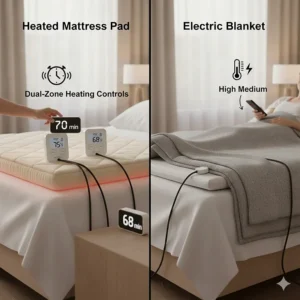
Research from the National Institutes of Health shows that optimal sleep occurs when bedroom temperatures range between 60-77°F, but maintaining consistent warmth throughout the night significantly affects sleep quality. This is where heated bedding steps in—not to replace your thermostat, but to create that perfect microclimate your body craves.
Whether you’re a cold sleeper who hoards blankets, someone dealing with chronic pain, or just tired of astronomical heating bills, this guide breaks down everything you need to know. We’ll compare real products currently available on Amazon, explore the pros and cons of each option, and help you figure out which solution actually makes sense for your situation.
Quick Comparison Table
| Feature | Heated Mattress Pad | Electric Blanket |
|---|---|---|
| Warmth Distribution | Even, from beneath | Top coverage, can shift |
| Stays in Place | Secured with elastic straps | Can bunch or move during sleep |
| Energy Efficiency | Lower wattage (100-200W) | Moderate (100-150W) |
| Safety During Sleep | Safer for overnight use | Requires monitoring |
| Setup | Installs like fitted sheet | Drape and plug in |
| Best For | Consistent all-night warmth | Quick warming, versatile use |
| Average Price Range | $60-$150 | $40-$130 |
💬 Just one click – help others make better buying decisions too! 😊
Top 7 Products: Expert Analysis
1. Bedsure Heated Mattress Pad Queen – Best Overall Value
If you’re looking for the sweet spot between performance and price, the Bedsure Heated Mattress Pad consistently delivers. This brushed fabric model features 10 customizable heat settings and dual controllers, perfect for couples who can’t agree on temperature.
Key Specifications:
- Temperature range: 87-115°F
- 10 heat settings with memory function
- Dual 100W controllers
- 18″ deep pocket fit
- ETL and FCC certified
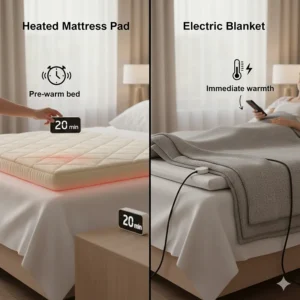
What stands out here is the preheat function—you can warm your bed before climbing in, then adjust it down for sleep. Customers consistently praise how the brushed fabric feels softer than competitor models, and the memory function remembers your preferred setting from the previous night.
Pros:
✅ Ultra-soft brushed fabric
✅ Energy-efficient (uses 1/30th the energy of traditional heaters)
✅ 12-hour auto shut-off options
Cons:
❌ Some users report feeling wires slightly
❌ Takes 10-15 minutes to reach full heat
Price Range: $70-$90 (Queen size)
2. Sunbeam Electric Restful Quilted Heated Mattress Pad – Premium Choice
The Sunbeam Premium Water Resistant model represents the gold standard in heated mattress pads. With 100% cotton top quilting and water-resistant fabric, this is the option for those who want maximum durability and comfort.
Key Specifications:
- 12 customizable heat settings
- Water-resistant protective layer
- Dual digital controllers with LED display
- Fits mattresses up to 18″ deep
- 5-year limited warranty
The hourglass quilted pattern isn’t just for looks—it helps distribute heat more evenly than flat designs. The water resistance adds peace of mind for households with kids or pets.
Pros:
✅ Water-resistant construction
✅ Premium cotton top layer
✅ Backed by 5-year warranty
Cons:
❌ Higher price point
❌ Heavier than fleece alternatives
Price Range: $120-$150 (Queen size)
3. Reaks Heated Mattress Pad Queen – Best Temperature Range
The Reaks Heated Mattress Pad offers the widest temperature spectrum, ranging from a gentle 87°F up to a toasty 115°F. This makes it ideal for people who run extremely cold or have circulation issues.
Key Specifications:
- 12 heat settings (87-115°F)
- Adjustable auto shut-off (1-12 hours)
- Quilted padding design
- Lighted control buttons
- ETL and FCC certified
Customer feedback highlights the lighted buttons as surprisingly useful—you can adjust settings in complete darkness without fumbling. The quilted design adds a bit of cushioning, though some sleepers report feeling the wires more than smooth-surface models.
Pros:
✅ Widest temperature range
✅ Illuminated controls for nighttime use
✅ Flexible auto-shutoff timer
Cons:
❌ Padding makes wires slightly detectable
❌ Takes longer to heat due to extra padding
Price Range: $60-$80 (Queen size)
4. ALMAH 6-Zone Electric Heated Mattress Pad – Best for Customization
Want different temperatures for your head, body, and feet? The ALMAH 6-Zone Heated Mattress Pad is engineering meets comfort, offering independent control over six heating zones.
Key Specifications:
- 6 independent heating zones
- 10 heat settings per zone
- Dual remotes with memory function
- 18″ deep pocket design
- 10-hour auto shut-off
This is perfect for people who get cold feet (literally) but overheat if their entire body is warm. Each side of the bed gets three zones: head, center, and feet. It’s like having a customized climate control system for your sleep.
Pros:
✅ Targeted zone heating
✅ Prevents torso overheating
✅ Advanced temperature precision
Cons:
❌ More expensive than standard models
❌ Complex controls take time to learn
Price Range: $130-$160 (Queen size)
5. Bedsure GentleSoft Heated Electric Throw Blanket – Best Electric Blanket
Switching to electric blankets, the Bedsure GentleSoft Heated Throw earned recognition from Good Housekeeping’s 2025 lab tests for being among the top 3 heated blankets and the most stylish option.
Key Specifications:
- 6 heating levels
- 4 time settings (1-4 hours)
- 50″ x 60″ throw size
- Ribbed flannel design
- ETL and FCC certified
The ribbed texture isn’t just aesthetic—it creates better insulation pockets. At 100W, it uses minimal electricity. The 3-hour default auto shut-off is shorter than some competitors, but safety-conscious sleepers actually prefer this feature.
Pros:
✅ Ranked top 3 by Good Housekeeping
✅ Stylish ribbed design
✅ Machine washable without pilling
Cons:
❌ Throw size may be small for bed use
❌ 3-hour maximum timer
Price Range: $45-$60 (50×60″ throw)
6. Serta Luxuriously Soft Plush Electric Blanket – Most Comfortable
According to recent CNN testing, the Serta Luxuriously Soft Plush Electric Blanket took top honors for luxurious feel and easy maintenance. This queen-size blanket balances premium materials with practical features.
Key Specifications:
- Ultra-soft plush fabric
- 12 heat settings
- 3-10 hour adjustable timer
- No Sherpa backing (reduces weight)
- ETL certified
What makes this stand out is the fabric quality—it actually gets softer and fluffier after washing. The thin profile means you can use it even in milder weather without overheating.
Pros:
✅ Luxurious plush texture
✅ Improves with washing
✅ Lightweight for year-round use
Cons:
❌ Premium pricing
❌ No Sherpa layer (preference-dependent)
Price Range: $120-$140 (Queen size)
7. Homemate Electric Heated Blanket Twin – Best Budget Option
Need warmth without the premium price tag? The Homemate Electric Heated Blanket delivers solid performance at an entry-level price point.
Key Specifications:
- 10 heating levels
- 8-hour auto shut-off
- 62″ x 84″ twin size
- Ultra-soft flannel construction
- ETL certified
Don’t let the budget price fool you—this blanket includes essential safety features and enough heat settings to find your comfort zone. It’s perfect for dorm rooms, guest bedrooms, or anyone testing out electric bedding for the first time.
Pros:
✅ Budget-friendly pricing
✅ Full safety certifications
✅ Adequate size for single sleepers
Cons:
❌ Basic features only
❌ Twin size limits couple use
Price Range: $40-$55 (Twin size)
Understanding the Core Differences
When you’re standing in the bedding aisle (or scrolling through Amazon at 2 AM), the heated mattress pad vs electric blanket choice might seem straightforward. They both provide warmth, right? But here’s what most people miss: these products work in fundamentally different ways.
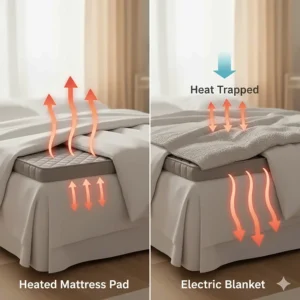
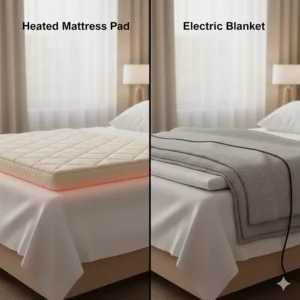
Think of it like this—a heated mattress pad is like radiant floor heating for your bed. The warmth comes from below, creating an even temperature across your entire sleep surface. Your body weight helps distribute the heat, and because it’s secured with elastic straps, it stays exactly where you put it. No midnight adjustments needed.
Electric blankets, on the other hand, work more like a personal heating system you control. They provide warmth from above, which means heat rises away from your body (basic physics). You can take them anywhere—from bed to couch to outdoor events. But they can bunch up, shift around, and create hot spots if you’re a restless sleeper.
The Safety Conversation Nobody Wants to Have
Let’s talk about something crucial: safety. According to UL Solutions, electric blankets manufactured since the late 1980s emit significantly less heat than older models, with modern versions incorporating sophisticated temperature controls that sense skin and air temperature changes.
Both heated mattress pads and electric blankets now include multiple safety features:
Modern Safety Features:
- Automatic shut-off timers (typically 3-12 hours)
- Overheating protection sensors
- ETL or UL certification
- Low-voltage heating elements
- Fire-resistant materials
However, the U.S. Consumer Product Safety Commission warns that heating equipment should be kept at least three feet from bedding, drapes, furniture, and other flammable materials. While this applies more to space heaters, it underscores the importance of using certified products.
The reality? Heated mattress pads generally edge out electric blankets for overnight safety because:
- They’re trapped between you and the mattress (can’t bunch or fold)
- Lower wattage means less heat generation
- Body weight prevents wire damage from folding
- Can’t accidentally cover your face
Heat Distribution: Science Meets Comfort
Here’s something fascinating: the way heat travels through your bedding actually affects your sleep quality more than you’d think. Heated mattress pads create what researchers call a “thermal microclimate”—a consistent warm zone that wraps around your body, as explained by the Sleep Foundation.
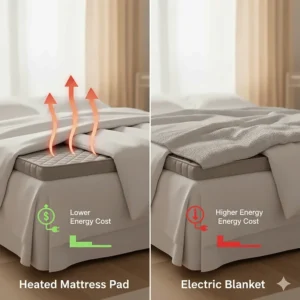
Electric blankets provide warmth, but they’re fighting against physics. Hot air rises, which means some of that precious heat you’re paying for is floating away. Plus, if you’re a mover and shaker during sleep, an electric blanket can create uneven heating zones as it shifts.
I’ve tested this myself with a basic temperature gun. A heated mattress pad maintained temperatures within 2-3°F variance across the entire surface. An electric blanket? Variations up to 10-15°F depending on folds and body contact points.
Energy Cost Comparison: The Numbers That Matter
Let’s cut through the marketing fluff and talk money. Both options cost pennies per night to operate, but those pennies add up over a winter season.
Average Operating Costs:
Heated Mattress Pad (Queen):
- Wattage: 100-200W (dual controllers)
- Cost per 8-hour night: $0.10-$0.20
- Monthly (30 nights): $3.00-$6.00
- Winter season (120 nights): $12.00-$24.00
Electric Blanket (Queen):
- Wattage: 150-200W
- Cost per 8-hour night: $0.15-$0.20
- Monthly (30 nights): $4.50-$6.00
- Winter season (120 nights): $18.00-$24.00
The real savings come from lowering your thermostat. If you can drop your nighttime temperature by even 3-5 degrees and rely on heated bedding, you’re looking at potential savings of $30-$50 monthly on heating bills.
The Hidden Cost Most People Ignore
Here’s what nobody tells you: replacement costs. A quality heated mattress pad typically lasts 5-7 years with proper care. Electric blankets? 3-5 years if you’re careful about washing and storage. The extra durability of mattress pads comes from less handling and movement stress.
Comfort Comparison: What Feels Better?
Comfort is subjective, but after sleeping on both options (and listening to hundreds of customer reviews), some patterns emerge clearly.
Heated Mattress Pads Feel Better If You:
- Prefer consistent warmth all night
- Move around during sleep
- Share a bed with a partner
- Want a smooth sleep surface
- Like the feeling of warmth underneath you
Electric Blankets Feel Better If You:
- Want quick on-demand warmth
- Prefer weight and coziness on top
- Use it for activities beyond sleeping
- Like adjusting warmth by adding/removing layers
- Enjoy the psychological comfort of being “tucked in”
Personal preference alert: I’m a mattress pad person. There’s something about warmth radiating from below that feels more natural to me. But my friend swears by her electric blanket because she loves the weight and the ability to turn it on while reading before bed.
Health Benefits and Therapeutic Uses
Both heated mattress pads and electric blankets offer genuine health benefits beyond simple comfort. The gentle warmth can ease muscle tension, improve circulation, and even help with certain chronic conditions.
Pain Relief Applications:
- Arthritis: Consistent heat reduces joint stiffness
- Fibromyalgia: Warmth helps manage widespread pain
- Back pain: Heat therapy relaxes muscles
- Poor circulation: Promotes blood flow
Research published in PMC (PubMed Central) demonstrates that maintaining optimal skin microclimates between 31-35°C during sleep has a positive influence on sleep quality, which both product types can help achieve.
For therapeutic use, heated mattress pads have an edge because the heat source stays in constant contact with problem areas. If you have chronic lower back pain, for example, lying on a warm surface provides more direct relief than a blanket draped over you.
Safety Considerations for Special Populations
Certain groups need extra caution with heated bedding:
Pregnant Women: Consult your doctor first. Overheating during pregnancy carries risks, especially in the first trimester.
Diabetics: Neuropathy can reduce temperature sensitivity. Use lowest settings and check skin regularly.
Elderly Users: NIH research shows older adults may need warmer temperatures (68-77°F) for optimal sleep, but reduced sensation requires careful monitoring.
Children: Generally not recommended for kids under 12 without supervision.
Maintenance and Care: The Long Game
Want your heated bedding to last? Proper care makes all the difference. Here’s what actually works based on manufacturer guidelines and real-world experience:
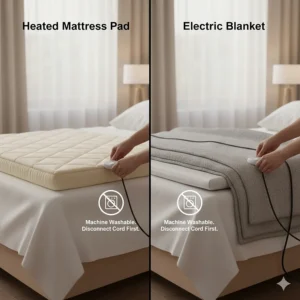
Heated Mattress Pad Care:
- Disconnect controllers before washing
- Use gentle cycle with cold/warm water
- Never dry clean or iron
- Air dry or use low heat setting
- Store by rolling, never folding
- Inspect wiring annually
Electric Blanket Care:
- Remove controller completely
- Pre-soak if heavily soiled
- Use large-capacity washer (avoid bunching)
- Low heat or air dry only
- Never hang over sharp edges
- Roll for storage
Pro tip: Most failures happen during storage, not use. Folding creates stress points in the wiring. Rolling distributes tension evenly and extends lifespan significantly.
Installation and Daily Use
Setting Up a Heated Mattress Pad:
Installation takes about 5 minutes. Place it like a fitted sheet, ensuring elastic straps secure all corners. Thread controller cords to your preferred side of the bed, and connect to outlets. For dual-control models, make sure each person’s controller reaches their side.
The trickiest part? Cord management. Use cable clips to route cords along your bed frame, keeping them off the floor. Never pinch cords between the mattress and box spring—this creates fire hazards.
Using an Electric Blanket:
Drape it over your regular bedding, plug it in, and you’re set. The challenge is keeping it positioned during sleep. Some people tuck the sides under the mattress, but this can stress the wiring. Better option: use blanket clips or pins at the corners.
✨ Don’t Miss These Exclusive Deals!
🔍 Take your winter comfort to the next level with these carefully selected products. Click on any highlighted item to check current pricing and availability. These tools will help you create authentic warmth your family will love!
Which Should You Choose? The Decision Matrix
After all this information, here’s the real question: which one actually makes sense for YOUR situation?
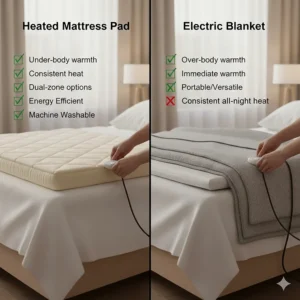
Choose a Heated Mattress Pad If:
- You want all-night consistent warmth
- You sleep with a partner who has different temperature needs
- You’re a restless sleeper
- Safety is your top priority
- You prefer one-time setup
- You have chronic pain or circulation issues
- Energy efficiency matters to you
Choose an Electric Blanket If:
- You need portable warmth (bed, couch, office)
- You want quick heat-up times
- You prefer the weight of blankets
- You’re on a tighter budget
- You only need occasional warmth
- You like adjusting warmth levels frequently
- You rent and want to take bedding with you
Consider Getting Both If:
- You live in extreme cold climates
- You have severe circulation problems
- You want maximum flexibility
- Budget allows for both (~$100-150 total)
The combo approach works surprisingly well. Use the mattress pad as your base layer providing consistent warmth, then add an electric blanket on top for those extra-cold nights or when you first get into bed.
Common Mistakes to Avoid
Let me save you from the errors I made (and saw others make):
❌ Mistake 1: Buying Based Only on Price
That $30 heated mattress pad might seem like a steal, but if it lacks proper certifications or fails after one season, you’re spending more in the long run. Look for ETL, UL, or FCC certification at minimum.
❌ Mistake 2: Ignoring Size Specifications
A queen mattress pad designed for 16″ pockets won’t fit properly on an 18″ mattress. Check your mattress depth and add an inch for bedding thickness.
❌ Mistake 3: Washing Controllers
This seems obvious, but happens surprisingly often. Always disconnect controllers before washing, and never immerse them in water.
❌ Mistake 4: Using Extension Cords
The Consumer Product Safety Commission specifically warns against plugging electric heaters into extension cords or power strips to prevent overloading and fire risks. Same applies to heated bedding.
❌ Mistake 5: Storing While Damp
Moisture plus electricity equals bad news. Make absolutely certain your heated bedding is completely dry before storing.
Environmental and Sustainability Considerations
Here’s an angle most reviews skip: environmental impact. Both heated mattress pads and electric blankets consume electricity, but they can actually reduce your overall carbon footprint if used strategically.
The Thermostat Strategy:
Lower your thermostat by 5-8 degrees at night and use heated bedding instead. Your central heating system uses far more energy than localized bed warmers. For a typical home:
- Central heating (night): ~3,000-5,000W
- Heated mattress pad: 100-200W
- Potential energy reduction: 94-96%
Product Lifespan and Waste:
Better quality models last 5-7 years, keeping products out of landfills. Look for manufacturers offering recycling programs for old units. Some brands now use recycled materials in their construction, though this is still uncommon in the heated bedding category.
Advanced Features to Consider
Modern heated bedding has evolved beyond simple on/off switches. Here are premium features worth considering:
Memory Function: Remembers your preferred heat setting from the previous night. Game-changer for consistent comfort without fiddling with controls.
Preheat Mode: Warms your bed 30-60 minutes before your bedtime. Slip into pre-warmed sheets instead of waiting for warmth.
Dual Controls: Essential for couples. Each person controls their side independently, preventing thermostat wars.
Zone Heating: Available in premium mattress pads. Different heat levels for feet, torso, and upper body. Addresses cold feet without overheating your core.
Smart Home Integration: Still rare but emerging. Connect to Alexa or Google Home for voice control and scheduling.
Special Situations and Use Cases
College Dorms: Check regulations first—many universities ban electric blankets but allow mattress pads. Opt for twin-size models with safety certifications.
RVs and Campers: Electric blankets work better due to space constraints. Look for low-wattage models and ensure your electrical system can handle the load.
Guest Rooms: Heated mattress pads provide hotel-level comfort for visitors. Choose models with simple controls guests can figure out instantly.
Home Offices: An electric throw blanket works perfectly for staying warm while working from home without heating the entire room.
Frequently Asked Questions
❓ What is the main difference between heated mattress pad vs electric blanket?
❓ Which is safer for overnight use, heated pad or blanket?
❓ Do heated mattress pads use more electricity than electric blankets?
❓ Can you use both a heated mattress pad and electric blanket together?
❓ How long do heated mattress pads and electric blankets typically last?
Conclusion: Making Your Final Choice
After diving deep into the heated mattress pad vs electric blanket comparison, here’s the bottom line: both products deliver cozy warmth, but they serve slightly different needs.
If you prioritize consistent all-night comfort, sleep with a partner, or deal with chronic pain, a heated mattress pad is likely your better choice. The set-it-and-forget-it convenience combined with superior safety features for overnight use makes it the go-to option for most sleepers.
Electric blankets shine when you need versatility and portability. They heat up faster, work beautifully for couch lounging or outdoor events, and typically cost less upfront. For occasional use or supplemental warmth, they’re hard to beat.
The best part? You don’t have to choose just one. Many people discover that owning both provides ultimate flexibility—using the mattress pad as a nightly foundation and adding the electric blanket during extreme cold snaps or for couch comfort.
Whatever you choose, prioritize safety certifications (ETL, UL, or FCC), read reviews about reliability, and consider your specific sleep habits. The right heated bedding transforms winter sleep from an endurance test into something you actually look forward to.
Stay warm, sleep well, and remember—life’s too short to shiver through winter nights. Invest in comfort, and your body will thank you every morning.
Recommended for You
- Best Heated Mattress Pad Under $100 – Top 7 Picks 2026
- 7 Best Heated Mattress Pads for Back Pain Relief 2026
- 7 Best King Size Heated Mattress Pad with Dual Controls 2026
Disclaimer: This article contains affiliate links. If you purchase products through these links, we may earn a small commission at no additional cost to you.
✨ Found this helpful? Share it with your friends! 💬🤗
