

In This Article
Picture this: you’ve been standing at a construction site for three hours, or hunched over a deer blind before sunrise, or maybe just walking the dog in January. Your toes stopped feeling like toes around the second hour. They’re just… there. Vaguely attached. Sending up distress signals you can no longer interpret.
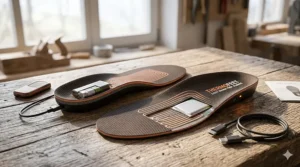
Cold feet aren’t just uncomfortable. According to the CDC’s guidelines on cold stress in the workplace, prolonged exposure to cold temperatures — even those above freezing — can reduce dexterity, impair judgment, and in serious cases lead to frostnip or worse. And that’s before we talk about the misery factor.
Here’s where rechargeable heated insoles earn their keep. Slide them into any shoe or boot, tap a button (or a smartphone screen), and within ten seconds — ten seconds — your entire foot is wrapped in controllable, adjustable warmth. No disposable hand warmers. No chemical packs that run cold after 90 minutes. No $300 pair of heated boots you’ll wear for three months and store for nine.
Rechargeable heated insoles are thin battery-powered inserts that use carbon fiber or rubber heating elements to generate warmth from the ground up, with runtimes typically ranging from 5 to 13+ hours per charge and temperatures you can dial up or down via remote control or smartphone app.
The market has exploded. There are now dozens of options spanning $30 to $300 — and most product listings tell you almost nothing useful. So I dug into the real-world performance data, scoured verified customer feedback, tested the specs against actual outdoor conditions, and assembled this guide to the seven rechargeable heated insoles worth your money in 2026. Let’s get into it.
Quick Comparison: 7 Best Rechargeable Heated Insoles at a Glance
| Product | Battery | Max Runtime | Heat Settings | Control | Best For | Price Range |
|---|---|---|---|---|---|---|
| Dr.Warm Rechargeable (App Control) | 7.4V | ~10 hrs (low) | 3 | App | Everyday/Work | $40–$65 |
| WASOTO WI001 Heated Insoles | 3300mAh | ~11 hrs (low) | 3 | Button | Outdoor Sports | $40–$60 |
| Qennie 3500mAh Rechargeable | 3500mAh | ~13 hrs (low) | 3 + digital display | Remote | Long Days Outdoors | $50–$75 |
| Thermrup Electric FIR Insoles | 7.4V | ~6 hrs | 4 | Controller | Winter Sports | $60–$80 |
| HOTRONIC XLP 2C BT Custom | Dual XLP 2C | Up to 24 hrs | 4 + Boost | Bluetooth App | Ski/Pro Use | $200–$280 |
| SNOW DEER Wireless Rechargeable | Built-in | ~8 hrs (low) | 3 | Wireless Remote | Budget/Casual | $35–$55 |
| Winna Heated Electric Insoles | 2000mAh | ~8 hrs (low) | 3 | Wireless Remote | Hiking/Versatile | $40–$60 |
Analysis: The table above reveals a clear pattern: more battery capacity generally means longer runtime, but battery placement strategy matters just as much as capacity. The HOTRONIC’s dual external batteries deliver staggering 24-hour potential, making it untouchable for extreme pro use — but at three to five times the price of everything else. For most people buying their first or second pair of rechargeable heated insoles, the Qennie or WASOTO sweet spot ($40–$75) offers 80% of the performance at 30% of the cost.
💬 Just one click — help others make better buying decisions too! 😊
Top 7 Rechargeable Heated Insoles: Expert Analysis
1. Dr.Warm Rechargeable Heated Insoles (App Control)
If rechargeable heated insoles were a smartphone, Dr.Warm would be the one that actually connects to your WiFi without three reboots. The standout feature here is the dedicated Dr.Warm app, which gives you wireless temperature control, real-time battery monitoring, and heating level adjustments — all without fumbling inside your boot on a frigid morning.
Specs in real-world terms: The 7.4V system delivers heating across three settings — low (100–113°F), medium (113–122°F), and high (122–140°F). That high setting sounds aggressive, but it’s genuinely useful for static outdoor workers standing on concrete in sub-zero temps. The insoles themselves are a slim 0.16 inches thick, which means they actually fit inside most boots without squeezing your toes — something competing models can’t always claim. The battery attaches to calf straps, keeping bulk off your feet entirely. Two detachable batteries mean you can swap mid-day on a long shift.
The app control is where Dr.Warm separates itself from the crowd. Competitors offer button-press controllers or basic remotes; Dr.Warm lets you check remaining battery percentage without pulling anything out of your boot. For construction workers, outdoor security staff, or anyone who can’t afford to hit zero warmth mid-shift, that visibility changes everything.
Customer feedback highlights the cut-to-fit sizing as genuinely easy and the app as reliable — though a small number of reviewers noted occasional Bluetooth dropout in temperatures below -10°C.
Expert verdict: This is the pick for anyone who values tech-forward control and works long outdoor shifts. The data transparency alone justifies the price premium over basic remote-control models.
✅ App control with real-time battery monitoring
✅ Ultra-thin 0.16″ profile — fits most work boots comfortably
✅ Swappable external batteries for all-day use
❌ App can occasionally disconnect in extreme cold
❌ Cable management takes a learning curve
Price range: $40–$65 | Value verdict: Excellent for the feature set — worth every dollar for daily outdoor workers.
2. WASOTO WI001 Heated Insoles
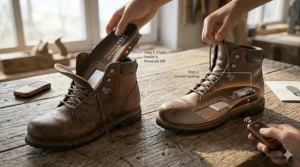
WASOTO entered the heated insoles market quietly, built a reputation quickly, and is now one of the most recommended brands in the category. The WI001 earns its place in this list for one specific reason that the spec sheet almost undersells: the perforated heating zone design.
What that means in practice: Most heated insoles concentrate heat in a single strip or panel. The WASOTO WI001 uses a pattern of small holes across the heating area, which allows heat to generate and distribute faster. In cold-weather testing, this translates to noticeably quicker warm-up — the kind of difference you feel in the first 60 seconds on a 20°F morning.
The 3300mAh battery runs up to 11 hours on the lowest of its three settings (around 113°F/45°C), dropping to roughly 5–7 hours on medium and about 5 hours on maximum heat (up to 149°F). That lowest setting is frankly the one most people use — it’s enough to keep feet comfortable without overheating inside insulated boots. The insoles are sized Small, Medium, and Large with trim-to-fit edges, covering most shoe sizes without the guesswork of matching precise measurements.
Expert opinion: WASOTO is the outdoor sports pick. Hunting, snowboarding, cycling in winter — the fast heat distribution and solid runtime make it ideal for activities where you’re moving, not just standing. It lacks the app sophistication of Dr.Warm, but for users who want to click a button and go, that’s a feature, not a flaw.
Verified reviews consistently praise the warm-up speed and note that even on medium settings, warmth lasted a full 8-hour shift.
✅ Perforated heat zones for faster, more even distribution
✅ Up to 11 hours on low — impressive for the price
✅ Trim-to-fit design across three size ranges
❌ No app control — button only
❌ Battery pack requires strap adjustment to sit comfortably on different calf sizes
Price range: $40–$60 | Value verdict: Best bang-for-buck for outdoor sports enthusiasts.
3. Qennie 3500mAh Rechargeable Heated Insoles
Thirteen hours. On one charge. That number — confirmed by multiple independent reviews including FashionBeans’ 2026 round-up — is the headline stat that makes the Qennie 3500mAh model impossible to overlook. But runtime alone doesn’t explain why this is arguably the best all-around rechargeable heated insole for most people.
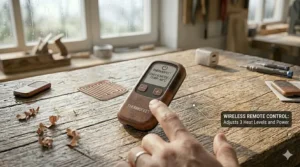
The chip matters more than you’d think. Qennie uses what they call an 8th-generation heating chip paired with carbon fiber elements underneath a soft velvety upper. The result: a 5–10 second heat-up time and a temperature range from 102°F to 152°F that you dial in using a wireless remote control with a digital readout — meaning you can see the exact temperature, not just “medium.” That’s the kind of precision that matters when you’re skiing and need 130°F exactly, not “somewhere between warm and scorching.”
The built-in safety protection system automatically cuts heating if the insoles reach an unsafe temperature — a feature that’s easy to overlook but critical for lithium battery products used in enclosed footwear. The 3500mAh battery is rated for 500+ charge cycles, meaning if you use them daily for six months a year, they’ll last you over three years before performance degrades.
Expert take: The Qennie is the choice for anyone who wants the most runtime, the most precise control, and the most peace of mind — without stepping into premium pricing territory. It’s soft enough to wear all day, safe enough to trust in ski boots, and precise enough for people who have strong opinions about their body temperature.
Customer reviews on Amazon describe the warmth as consistent from first use to final hour — no fade at the end of a full day.
✅ Up to 13 hours on low — longest runtime in this price range
✅ Digital remote displays exact temperature — no guessing
✅ 500+ charge cycle longevity with safety auto-shutoff
❌ Remote can be bulky to carry in tight jacket pockets
❌ Not app-controlled — remote only
Price range: $50–$75 | Value verdict: The best overall rechargeable heated insole under $100.
4. Thermrup Electric Heated Insoles (FIR, 4-Temperature Settings)
Thermrup is a German brand, and it shows. Where most heated insoles use carbon fiber strips that warm linearly from one end, Thermrup uses an innovative rubber heating element paired with far-infrared (FIR) technology, delivering deep, even warmth across the entire 18cm heating surface — from heel to toe, edge to edge.
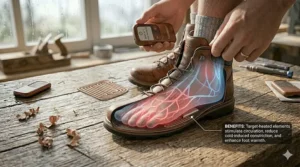
Why FIR matters: Far-infrared heat doesn’t just warm the surface of your foot — it penetrates tissue to increase localized circulation. According to research published in scientific literature on infrared therapy, FIR wavelengths can stimulate microcirculation in extremities, which is particularly relevant for people with Raynaud’s syndrome or chronic poor circulation. (For more on Raynaud’s, the Mayo Clinic offers a thorough overview.) In practical terms, Thermrup users often report feeling warmth in their entire foot more quickly than with strip-heater competitors.
The 7.4V lithium-ion batteries sit in leg gaiters — pouches that wrap around the ankle — rather than in battery packs clipped to calf straps. It’s a different experience: a little more snug, but the batteries are less likely to shift during high-activity movement like snowboarding or mountain climbing. Four temperature settings give you finer control than three-setting models, and the trim-to-fit design handles US sizes 4.5 through 14.
Expert take: Thermrup is the pick for winter sports athletes and anyone dealing with circulation issues. The FIR technology isn’t marketing fluff — it delivers a qualitatively different warmth experience. The 6-hour maximum runtime is the shortest on this list, but that’s the trade-off for the deeper, more therapeutic heat output.
Customers note that the gaiter battery design takes one or two uses to master, but once you’ve got the hang of it, it’s actually more comfortable than dangling pack-style batteries.
✅ Far-infrared rubber heating for full-surface, deep warmth
✅ 4 heat settings — more precision than most competitors
✅ Gaiter battery design stays put during high-activity sports
❌ Shortest runtime at ~6 hours — plan for mid-day charges on long days
❌ Learning curve on the gaiter attachment system
Price range: $60–$80 | Value verdict: Premium performance per dollar for sports and circulation-conscious buyers.
5. HOTRONIC Foot Warmer XLP 2C BT Custom
This is the one you buy when “good enough” isn’t in your vocabulary. Hotronic has been outfitting professional skiers, military cold-weather units, and serious winter athletes for decades. The XLP 2C BT Custom is their flagship rechargeable system, and its defining feature is almost absurd: up to 24 hours of continuous heat from dual Bluetooth-controlled lithium-ion batteries.
What separates this from the pack: The XLP 2C system uses two external batteries — one per foot — connected to heating elements you install into your existing custom insoles. This means if you’ve already spent money on orthotics or premium insoles, you don’t throw them away. You electrify them. The Bluetooth app lets you adjust heat levels, monitor battery status, and even set heating schedules — all without removing your boots. In sub-zero ski days that run 8+ hours, the ability to dial back from high to low at lunchtime (extending your remaining battery from 3 hours to 8) is a genuine game-changer.
The USB recharging is globally compatible, and the system integrates with other Hotronic XLP products — heated socks, boot heaters — for a fully interconnected foot-warming ecosystem. This is a product designed for people who will never tolerate cold feet again, and who are prepared to pay for that guarantee.
Expert take: The Hotronic XLP 2C BT is overkill for casual users. It requires more setup, costs significantly more, and demands that you understand which insole to pair it with. But for professional skiers, hunters who spend 10+ hours in freezing stands, or anyone with severe Raynaud’s disease, this is the only rechargeable heated insoles system that won’t let you down. Period.
Reviews from verified buyers on Amazon consistently describe it as “the last heated insole system I’ll ever need to buy.”
✅ Up to 24 hours continuous heat — unmatched
✅ Bluetooth app with precise control and battery monitoring
✅ Works with custom/orthotics insoles — protects your existing investment
❌ Premium pricing puts it out of reach for casual use
❌ Requires compatible Hotronic XLP ecosystem — not plug-and-play with any brand
Price range: $200–$280 | Value verdict: Expensive but justified for serious athletes and medical-necessity buyers.
6. SNOW DEER Wireless Rechargeable Heated Insoles
SNOW DEER has built a loyal following in the heated apparel space, and their rechargeable heated insoles reflect exactly why: solid build quality, sensible design decisions, and pricing that doesn’t require a deep breath before clicking “Add to Cart.”
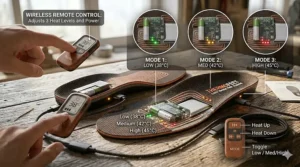
The wireless remote is the key feature here. Unlike some budget competitors that bury control hardware in the boot or require awkward reach-in adjustments, SNOW DEER’s wireless remote lets you change heat settings without breaking stride. Three settings cover the comfortable spectrum from warm to hot, with full-foot heating coverage that reaches toes, arch, and heel.
The built-in battery (no external pack) keeps things simple. You charge via USB, slide them in, and click the remote. That simplicity is genuinely valuable for users who don’t want to deal with battery packs, calf straps, or gaiter systems. Runtime sits around 8 hours on low — solid for a standard workday or a casual hunting outing. Trim-to-fit sizing accommodates most adult shoe sizes for both men and women.
Expert take: SNOW DEER is the entry point for rechargeable heated insoles — the version you buy to see if you like the category before committing to a premium system. But it’s not cheaply made. The wireless remote and full-foot coverage put it ahead of many competitors in its price range. For weekend skiers, casual hikers, or office workers who just hate cold feet, this is your starting point.
Customer reviews highlight the ease of use as a top benefit, with several noting it’s the first heated insole they’ve tried where setup took less than five minutes.
✅ Clean wireless remote design — no fumbling in your boots
✅ Full-foot heating — toes to heel
✅ Built-in battery simplifies setup dramatically
❌ Lower battery capacity limits runtime vs. external-pack competitors
❌ Fewer temperature precision options than app-controlled models
Price range: $35–$55 | Value verdict: The best starter rechargeable heated insole for new buyers.
7. Winna Heated Electric Insoles
Winna doesn’t get the attention it deserves. It carries CE and FCC certifications — safety stamps that many budget competitors skip entirely — and delivers carbon fiber heating with a 10-second warm-up time that is genuinely as fast as advertised. The 2000mAh lithium polymer battery is on the smaller side, but in return the insoles themselves are slimmer than most — a real advantage if you’re fitting them into tight hiking boots or low-profile trail runners.
Runtime in real terms: Expect 6–8 hours on low (104°F), 5–6 hours on medium, and 3–5 hours on high (up to 150°F). That’s honest, middle-of-the-road performance. The included wireless remote controls three settings without needing an app — straightforward for hikers and trail runners who don’t want another thing on their phone.
Where Winna stands out is in the safety certification story. The CE and FCC marks mean the electrical components have been independently verified for safety — something you genuinely want when running a battery inside an enclosed boot. It’s not glamorous, but it matters.
Expert take: Winna is the hiking-focused, safety-certified wild card of this list. If you’re primarily using rechargeable heated insoles for trail activities where boot space is tight and you want verified safety credentials without spending $200, this is your pick. The runtime won’t win any trophies, but it’ll get most people through a 5–6 hour hike comfortably.
Users praise the slim profile and the quick heat-up time, with several noting it fits inside boots where other heated insoles created uncomfortable pressure.
✅ CE/FCC certified — independently verified safety credentials
✅ Carbon fiber 10-second heat-up
✅ Slim profile fits tight hiking boots and trail runners
❌ Smallest battery capacity on this list — not for all-day industrial use
❌ Only 3 heat settings; no app control
Price range: $40–$60 | Value verdict: Great for hikers who prioritize slim fit and safety certifications.
How to Get the Most Out of Your Rechargeable Heated Insoles: A Practical Usage Guide
Buying the right rechargeable heated insoles is step one. Using them well — so they last three winters instead of one — is step two. Here’s what the product pages won’t tell you.
Charge fully before first use. Every lithium battery performs best when its first charge cycle reaches 100%. Skipping this and running them half-charged on day one sets a lower baseline capacity that’s hard to recover.
Start on the lowest setting. It sounds obvious, but most people blast their insoles on high the moment they step into cold air. The problem: you use 2–3x the battery, overheat your feet within 20 minutes, and start sweating — which makes you colder, not warmer. Start low, let the insoles equilibrate to your foot temperature, and only step up if genuinely needed. This single habit will double your effective runtime.
Store at room temperature. Lithium batteries degrade faster when stored in extreme temperatures — including the trunk of your car. After each use, remove and store at room temperature. In summer months, keep them indoors rather than in a garage.
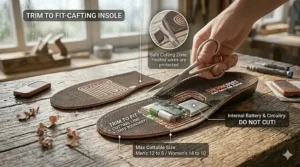
Trim carefully, trim once. Cut-to-fit insoles cannot be un-trimmed. Place the insole on top of your existing insole (which you’ll remove), trace around it, and cut 1–2mm smaller than the outline. This gives you a snug fit without the insole folding at the toe box.
Clean regularly, carefully. Most rechargeable heated insoles are not fully submersible. Wipe the top surface with a slightly damp cloth and a drop of mild soap. Never machine-wash unless the manufacturer explicitly states it’s safe — and even then, remove the batteries first.
Don’t push the battery to zero. Recharge when you hit around 20% remaining. Running lithium batteries to complete depletion repeatedly shortens their total cycle life — you’ll lose 10–15% of total capacity faster than you should.
Who Should Buy What: Real-World Buyer Scenarios
Rechargeable heated insoles are not one-size-fits-all in any sense. Here are three specific buyer types and the exact product match I’d recommend.
The Construction Worker / Outdoor Laborer: You’re on concrete or frozen ground 8–10 hours a day in January. You need consistent warmth that doesn’t require constant attention. Dr.Warm (App Control) is your answer — the battery monitoring via app means you know exactly when to swap batteries before you hit zero warmth at hour seven. The calf-strap battery keeps feet free of bulk while standing.
The Weekend Hunter / Ice Fisherman: You’re stationary in a blind or ice hut for 5–6 hours at temperatures well below freezing. Movement is minimal; warmth is non-negotiable. Qennie 3500mAh is your pick — the 13-hour low-setting runtime means a single charge handles your entire trip. The digital remote tells you the exact temperature without opening your coat.
The Serious Skier or Raynaud’s Patient: You need a system that won’t quit at hour eight on the mountain, and you need the ability to adjust settings while your hands are in gloves. HOTRONIC XLP 2C BT is the only product on this list built for your needs. Yes, it costs more. No, you won’t regret it.
The First-Time Buyer Curious About the Category: Start with SNOW DEER’s wireless model. It’s affordable, simple, and reliable enough to determine whether rechargeable heated insoles work for your lifestyle before you invest in a premium system.
✨ Don’t Miss These Exclusive Deals!
🔍 Take your cold-weather comfort to the next level with these expert-selected rechargeable heated insoles.
Click any highlighted product name throughout this guide to check current pricing and availability on Amazon. Prices and stock levels change frequently — act when you see the right price. 🔥
How to Choose Rechargeable Heated Insoles: 6 Criteria That Actually Matter
There are hundreds of rechargeable heated insoles on Amazon. Here’s how to filter intelligently.
1. Battery capacity vs. placement strategy. A 5000mAh battery sounds impressive, but if it’s housed inside the insole itself, it creates significant heel bulk. External battery packs (calf-strap or gaiter style) keep the insole slim and move weight to your leg — usually a better trade-off for comfort in fitted boots.
2. Temperature range and precision. Three heat settings is the category minimum. What separates mid-range from budget models is precision — does the remote display actual temperature (like Qennie), or just icons for low/medium/high? For people with circulation conditions, exact temperature control isn’t a luxury.
3. Heat-up time. Budget models can take 60–90 seconds to reach operating temperature. Carbon fiber and advanced chip models like Qennie and Winna hit usable warmth in under 10 seconds. In -15°C air, that difference is significant.
4. Trim-to-fit quality. All these insoles require trimming for your shoe size. Cheaper materials crack along cut lines after one season. Look for smooth, clean cut-line guides and flexible heating elements that won’t fracture when trimmed.
5. Control method. Button, remote, or app — each has trade-offs. Buttons are bulletproof but require boot access. Remotes are convenient but add something to carry. Apps offer the most visibility but introduce connectivity risk in extreme cold.
6. Safety certifications. CE (European conformity) and FCC (US Federal Communications Commission) certifications indicate the product has passed independent electrical safety testing. Not all heated insoles carry these. Winna and Dr.Warm do. Prioritize certified models, especially if you’re using them in tight, enclosed footwear all day.
Rechargeable Heated Insoles vs Battery-Heated Socks: The Honest Breakdown
This question comes up constantly, and the answer is less obvious than most comparison articles make it sound.
Heated socks wrap your entire foot in fabric with embedded heating elements. They’re self-contained, typically easier to put on, and don’t require you to remove existing insoles. The downside: they add measurable bulk inside your boot, which can create pressure points in already-fitted ski or work boots. And when the socks wear out (they do), you’re replacing the entire heating system.
Rechargeable heated insoles heat your foot from below — which is where cold enters. The contact surface is your entire plantar foot, which is thermally efficient. They’re compatible with any sock you prefer, don’t add sock-layer bulk, and when the heating element wears out, you replace just the insole portion.
| Rechargeable Heated Insoles | Battery-Heated Socks | |
|---|---|---|
| Boot Fit Impact | Minimal (slim profile) | Noticeable (adds sock thickness) |
| Heating Efficiency | High (direct contact, ground-up) | Moderate (element distribution varies) |
| Replacement Cost | Lower (insoles only) | Higher (full system replacement) |
| Sock Choice | Any sock you like | Locked into heated-sock design |
| Best For | Work boots, ski boots, fitted footwear | Casual use, loose-fitting boots |
| Medical/Circulation Use | ✅ Excellent (FIR options available) | ✅ Good |
Analysis: For people with fitted boots — ski boots, work boots, steel-toes — rechargeable heated insoles win on fit compatibility. For casual boots and general use where fit tolerance is flexible, heated socks offer simpler setup. The medical circulation advantage goes slightly to rechargeable insoles with FIR technology, like the Thermrup, based on available research on far-infrared therapy and peripheral circulation.
What to Expect: Real-World Performance vs. Spec Sheet Claims
Here’s the thing about battery runtime numbers: they’re measured in laboratory conditions at a set ambient temperature, usually around 50°F (10°C). The real world is not a lab.
How to interpret battery specs honestly:
- Listed low-setting runtime: Multiply by 0.8 to get a realistic field estimate in genuinely cold weather (below 20°F).
- Listed high-setting runtime: This is the most accurate, because the heating element is working hardest and the math is straightforward. If it says 5 hours on high, expect 4–5 hours.
- Battery degradation: After 100 charge cycles, expect roughly 85–90% of original capacity. After 300 cycles, closer to 75–80%.
What actually affects runtime:
Ambient temperature is the biggest variable. Running rechargeable heated insoles at 0°F in an exposed environment draws 20–30% more power than running them at 25°F. Insulated boots help enormously — think of your boot as a thermos. A well-insulated boot retains heat and reduces how hard the element has to work to maintain temperature.
Activity level matters too. Walking generates body heat that supplements the insole’s output, letting you run a lower setting. Static activities — standing, sitting in a blind — rely entirely on the insole.
Bottom line: The Qennie’s 13-hour rating becomes roughly 10 usable hours in genuine sub-freezing conditions on low. That’s still excellent. The SNOW DEER’s 8-hour rating becomes closer to 6–6.5 hours. Plan accordingly, always check your battery level before an extended outdoor session, and remember that the Dr.Warm app’s real-time monitoring gives you an actual countdown — not a guess.
Rechargeable Heated Insoles for Work Boots: What Changes
Work boots introduce specific challenges that recreational winter footwear doesn’t. Here’s what shifts when you’re selecting rechargeable heated insoles for work boots specifically.
Safety toe considerations. Steel-toe and composite-toe boots have a fixed internal volume with very little flex. Insoles with thick in-shoe components (or battery elements inside the insole) can push your foot against the safety toe, creating a compression risk. The Dr.Warm at 0.16 inches thick and WASOTO’s slim design are specifically suited here. Avoid any insole that places battery mass inside the shoe itself.
Slip-resistance in the upper layer. Work environments involve slick surfaces — concrete, wet loading docks, metal grating. Some heated insoles have a velvety upper that can slide slightly within the boot, shifting underfoot. Look for grip-backed uppers or use insole adhesive tape if needed.
OSHA cold weather guidelines specifically recommend layered foot protection for workers in sustained cold exposure. Rechargeable heated insoles satisfy the “active warming” layer in OSHA’s recommended approach when combined with insulating socks and waterproof outer boots.
Chemical and moisture resistance. Industrial environments expose insoles to chemicals, oils, and moisture. Check that the heating element is sealed — rubber heating elements (Thermrup) handle moisture better than open carbon fiber strips. If you work in wet conditions, look for an IPX water resistance rating in the product specs.
Common Mistakes When Buying Rechargeable Heated Insoles
Most buyers only make these mistakes once. Here’s how to skip straight to the second-time experience.
Mistake 1: Buying based on maximum temperature alone. “Heats to 158°F!” sounds impressive. But you’ll never run rechargeable heated insoles at maximum temperature for more than a few minutes. The relevant metrics are low-setting runtime and the quality of temperature distribution — not the peak number.
Mistake 2: Ignoring boot fit before buying. Measure your boot’s internal depth before ordering. Remove your current insole, place it next to the heated insole you’re considering, and compare. If the heated insole is significantly thicker, your foot will be compressed — especially in the toe box.
Mistake 3: Assuming all lithium batteries handle cold equally. They don’t. Standard lithium-ion batteries experience 20–30% capacity reduction in temperatures below -10°C. Quality heated insoles mitigate this by insulating the battery in the boot environment rather than exposing it to ambient air. External calf batteries are less insulated than in-boot batteries — a genuine trade-off worth considering in extreme cold.
Mistake 4: Buying based on lowest price only. At the very low end of the market, you encounter products without CE/FCC certification, using heating elements that can develop hot spots — concentrated areas of excessive heat that can cause discomfort or burns during extended wear. The $10–$20 price difference between uncertified and certified models is consistently worth it.
Mistake 5: Not testing before a critical outdoor trip. Break your insoles in at home or during a low-stakes outing before depending on them for a serious hunt, ski trip, or extended work shift. Battery performance and fit comfort both need a shakedown run.
Long-Term Cost & Maintenance: The Numbers You Actually Need
The real cost of rechargeable heated insoles is spread across three to four years, not one purchase. Here’s how to calculate true value.
Disposable alternatives for comparison: Chemical foot warmers average $1–$2 per pack. If you use two packs per day (one per foot) for 60 cold-weather days per year, that’s $120–$240 annually in consumables — and they run cold after 90 minutes at maximum output.
Rechargeable insoles total cost of ownership: A $60 pair of rechargeable heated insoles with a 400-cycle battery runs roughly $0.15 per use (charging cost plus amortized battery cost). Over three years of daily winter use, you’ll spend less on electricity than you’d spend on disposables in a single month.
Longevity checklist:
- Store at room temperature when not in use — extends battery life 20–30%
- Clean top surface monthly with mild soap and a damp cloth
- Inspect cable connections seasonally for cracking or fraying
- Replace insole top covers annually if the material compresses significantly (some brands sell replacement covers)
- Battery replacement: most external battery packs are available separately, extending the life of the insole element itself
When to replace: When runtime on a full charge drops below 60% of original spec, the battery has degraded enough to warrant replacement. For most quality models, that’s 2–3 years of regular winter use.
✨ Exclusive Deals on Top Rechargeable Heated Insoles
🔍 Ready to stop suffering through winter? These carefully selected rechargeable heated insoles will transform your cold-weather experience.
Click any highlighted product to check current pricing, available sizes, and buyer reviews directly on Amazon. The right pair is one click away — your toes will thank you. ❄️🔥
FAQ: Rechargeable Heated Insoles
❓ Are rechargeable heated insoles safe to use all day?
❓ Can rechargeable heated insoles fit in work boots?
❓ How long does it take to charge rechargeable heated insoles?
❓ Are rechargeable heated insoles good for Raynaud's syndrome?
❓ What's the difference between rechargeable insoles vs battery heated socks?
Conclusion: Cold Feet Are Optional Now
Here’s the truth about rechargeable heated insoles in 2026: the technology has matured. The best models are genuinely excellent — not “pretty good for a $60 gadget” excellent, but legitimately solves-a-real-problem excellent. Whether you’re a construction worker who’s accepted frozen feet as part of the job description, a hunter who cuts trips short in January, or someone with Raynaud’s who dreads December — these products work.
The pick that works for most people, most of the time, is the Qennie 3500mAh. The runtime is exceptional, the digital remote is genuinely useful, and the safety system gives you confidence to wear them all day without babysitting. For tech-forward daily workers, Dr.Warm’s App Control model is the smartest investment. For serious athletes and extreme conditions, HOTRONIC XLP 2C BT is the only thing built to match your demands.
Don’t overthink it. Measure your boot, pick the profile that fits, and stop negotiating with cold feet. Life is too short to lose feeling in your toes.
Recommended for You
- 7 Best Heated Thermal Underwear Sets of 2026 That Will Crush the Cold
- Best Heated Base Layer Shirt for Skiing in 2026 (Top 7 Picks)
- Best Heated Camo Pants for Hunting in 2026: 7 Picks That Actually Keep You Warm
Disclaimer: This article contains affiliate links. As an Amazon Associate, I earn from qualifying purchases. If you purchase products through these links, we may earn a small commission at no additional cost to you.
✨ Found this helpful? Share it with your friends! 💬🤗
