

In This Article
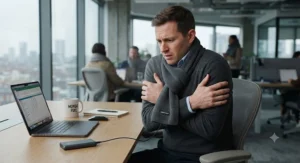
There’s a very specific kind of misery that only office workers know: the thermostat is set for the guy in the corner office who runs hot, and you’re three floors and one HVAC zone away from any warmth, wrapped in a cardigan that stopped helping around 10 a.m. A usb heated scarf for office use exists precisely because central heating was never designed with your desk in mind — it’s a lightweight, low-power neck wrap that plugs into a laptop, power bank, or wall adapter and delivers gentle, adjustable warmth exactly where cold hits first: your neck and shoulders. Unlike a space heater, it doesn’t trip the breaker or roast your cubicle-mate, and unlike a sweater, it actually does something.

We dug into the real product listings, specs, and aggregated review sentiment for seven genuine USB and rechargeable heated scarves currently sold for cold-office use, then broke down which ones actually make sense for a desk versus a commute versus a cross-country flight. This isn’t a rewritten spec sheet — it’s commentary on what those numbers mean once you’re the one shivering through a 9 a.m. stand-up. OSHA recommends indoor workplaces stay within 68–76°F, but plenty of offices run colder than that in practice, especially near windows, vents, or open floor plans — which is exactly the gap a heated scarf is built to fill.
Whether you’re hunting for office winter comfort, a genuine desk worker cold solution, or something you can toss in a laptop bag for travel, this guide covers real products, honest trade-offs, and the questions Amazon listings never quite answer.
Quick Comparison Table
| Product | Power Source | Heat Settings | Best For | Price Range |
|---|---|---|---|---|
| Comfheat USB Heated Scarf | USB cord (no battery) | 3 (94–140°F) | Budget desk warmth | Under $30 |
| ANA USB-Powered Heating Scarf | USB cord (no battery) | Fixed ~104°F | Laptop-tethered work | $25–$35 range |
| hYwecy Heated Scarf | USB via power bank | 3 (104–149°F) | Portable USB use | Under $30 |
| JOYTEK Heated Scarf | 5,000mAh battery | 3 settings | Budget cordless use | $30–$40 range |
| Kercky Heated Scarf | 5,000mAh battery | 3 settings | Commuting | $35–$45 range |
| Eventek Heated Scarf | 5,500mAh battery | 3 (106–131°F) | All-day desk + travel | $35–$50 range |
| Wulcea Graphene Heated Scarf | 6,000mAh battery | Single-touch | Fast heat, travel | $45–$60 range |
Reading across that table, the split that matters most isn’t price — it’s power source. The Comfheat USB Heated Scarf, ANA USB-Powered Heating Scarf, and hYwecy Heated Scarf are true USB devices with no internal battery, which makes them cheaper and lighter but chains you to a laptop, wall outlet, or power bank the entire time they’re running. The JOYTEK, Kercky, Eventek, and Wulcea models carry their own rechargeable battery, so they cost more but untether you completely — a meaningful difference if you’re walking between meeting rooms or catching a train. Neither approach is “better” in the abstract; it depends on whether your cold problem is a stationary desk or a moving day.
💬 Found the setup that matches your workday? Bookmark your top pick before the browser tabs multiply — you’ll thank yourself at 3 p.m.
Top 7 USB Heated Scarves for Office: Expert Analysis
1. Comfheat USB Heated Scarf — cheapest true plug-and-play option
The Comfheat USB Heated Scarf is about as no-frills as this category gets, and that’s exactly its appeal: no battery to charge, no proprietary power bank to lose, just a USB cord you plug straight into your laptop or a wall adapter. It runs three heat settings — low at 94–104°F, medium at 112–122°F, and high at 130–140°F — with a 45-minute auto shut-off and a max draw of just 10W, light enough that it won’t even register on a laptop’s battery life. Because there’s no internal cell, this is arguably the safest starting point for someone who’s never owned heated apparel and wants to test the waters before spending real money. Reviewers consistently note the plush, cotton-filled construction feels closer to a normal scarf than a piece of electronics, and that the auto-off is a genuine relief rather than an annoyance, since nobody wants to fall asleep in a hot scarf. What most buyers overlook is the small zippered pocket meant for a power bank — without one, you’re tied to an outlet, which is fine at a desk but useless on the move. Two cons show up repeatedly in review threads: the cord length can feel short at some desk setups, and the fixed 10W ceiling means it never gets aggressively hot, which is a feature for sensitive skin and a drawback if you want serious warmth fast.
Pros:
- ✅ No battery to charge or replace — plug and go
- ✅ 45-minute auto shut-off adds real peace of mind
- ✅ Soft, washable plush fabric feels like a real scarf
Cons:
- ❌ Requires constant USB connection to function
- ❌ 10W output tops out at moderate warmth only
At under $30, this is the low-risk entry point for testing whether a usb heated scarf for desk work actually fits your routine before committing to a pricier rechargeable model.

2. ANA USB-Powered Heating Scarf — lightest option for laptop tethering
If the Comfheat is the beginner’s choice, the ANA USB-Powered Heating Scarf is the one built for people who already know they want something minimal. It uses PI (Polyimide) heating film rather than a woven heating wire, which means it’s genuinely light — about 3.5 ounces — and thin enough to fold flat into a laptop bag pocket. Because it draws power directly from any standard USB-A port, it plugs into a laptop, a wall charger, a power bank, or even certain phone chargers without an adapter, which makes it one of the more literal interpretations of a usb heated scarf for laptop setups. On paper, a single fixed temperature around 104°F sounds limiting compared to scarves with three heat levels, but that steady, moderate warmth is actually what most desk workers report wanting — nobody’s trying to sweat through a spreadsheet. The scarf is also certified compliant with FCC Part 15 rules governing electromagnetic emissions, a detail that matters more than it sounds like if you’re sharing a desk with sensitive lab or broadcast equipment. The trade-off is that without adjustable heat, there’s no way to dial things down on a milder day, and the flat heating panel design runs narrower than some plush alternatives, so coverage across broader shoulders is thinner.
Pros:
- ✅ Ultra-lightweight PI heating film, barely noticeable
- ✅ FCC Part 15 compliant for low electromagnetic emissions
- ✅ Folds flat for a laptop bag or desk drawer
Cons:
- ❌ Single fixed temperature, no adjustability
- ❌ Narrower heating panel than plush-style scarves
Around $25–$35, it’s a smart pick for anyone whose main use case really is “plugged into my laptop, all day, every day.”
3. hYwecy Heated Scarf — most flexible USB power source
The hYwecy Heated Scarf splits the difference between the Comfheat and battery-powered models by running on USB power supplied through any power bank — meaning you get the lower price and lighter weight of a corded scarf, with the freedom to walk around as long as a power bank is tucked in a pocket. It heats within three seconds of being switched on, which reviewers flag as noticeably faster than several competing budget scarves, and it offers three temperature levels roughly spanning 104°F to 149°F, giving it the widest heat range of the corded options here. Based on the spec comparison, the DuPont cotton fabric is a genuine step up in insulation quality over generic acrylic fill, which explains why it’s also machine washable without the fabric degrading — a detail cheaper heated scarves often can’t claim. What the spec sheet won’t tell you, but reviewers note, is that battery bank compatibility varies: some low-output power banks (under 5W) struggle to keep the highest heat setting running consistently. The main drawback is that “USB via power bank” still means carrying a second device, which somewhat undercuts the portability pitch versus a scarf with its own built-in battery.
Pros:
- ✅ Fast three-second heat-up time
- ✅ Widest temperature range of the corded scarves
- ✅ Genuinely machine washable DuPont cotton shell
Cons:
- ❌ Needs a separate power bank for true portability
- ❌ High heat setting can strain low-output power banks
For a usb heated scarf portable enough to move between conference rooms without a wall outlet nearby, this is the corded option that comes closest to battery-free freedom.
4. JOYTEK 2024 Upgraded Heated Scarf — budget entry into battery-powered warmth
The JOYTEK 2024 Upgraded Heated Scarf is the cheapest way into this list’s other category: scarves with a self-contained, rechargeable battery instead of a permanent USB tether. It ships with a 5,000mAh power bank rated for up to nine working hours on lower settings, using a 3.7V UL/CE-certified cell, which matters because certification marks are one of the few objective safety signals available on a product you’re strapping to your neck for hours. Three temperature settings give you room to dial things down for a mild afternoon or crank up for a genuinely cold morning commute before you’ve even sat down at your desk. Aggregated review sentiment describes the heat-up time as quick and the battery life as accurate to the advertised range on medium settings, though — as with most budget electronics — a handful of reviewers report battery capacity fading noticeably after several months of daily use. Here’s what to weigh: at this price point, you’re trading long-term battery longevity for a genuinely low barrier to entry, which is a completely reasonable trade if you’re not sure heated apparel is going to become a daily habit.
Pros:
- ✅ UL/CE-certified 5,000mAh battery, up to 9 hours
- ✅ Fully cordless once charged — no outlet needed
- ✅ Three adjustable temperature levels
Cons:
- ❌ Battery capacity may fade with heavy daily use
- ❌ Charging cable and bank add bulk versus corded models
At roughly $30–$40, it’s the natural next step up from a USB-only scarf once you’ve decided cordless matters more than upfront cost.
5. Kercky Heated Scarf — hooded design built for commuting
The Kercky Heated Scarf stands out from the rest of this list because of one structural choice: a hidden hood, which shifts it from a purely desk-bound accessory to something genuinely useful for the walk between your front door and your desk. It runs on a 5,000mAh rechargeable battery, putting it in the same power class as the JOYTEK but aimed squarely at outdoor transitions rather than all-day office wear. Honest analysis here means being upfront that a hood adds bulk and isn’t something you’ll want bunched under a blazer in a meeting — this is a transitional-warmth product, not a permanent desk companion. Reviewers frame it as genuinely useful for commuters who walk, bike, or wait at a bus stop in cold weather before ever reaching a heated office, since the hood traps warmth around the ears and neck simultaneously rather than just the throat. Where it falls short of dedicated desk scarves is bulk: the hidden hood mechanism adds noticeable thickness compared to the flat, low-profile designs of the Comfheat or ANA, and it’s not something most people will want to wear through an eight-hour shift at their desk.
Pros:
- ✅ Hidden hood adds ear and head coverage outdoors
- ✅ 5,000mAh battery supports a full commute cycle
- ✅ Genuinely dual-purpose for outdoor-to-indoor transitions
Cons:
- ❌ Bulkier profile, less comfortable for all-day desk wear
- ❌ Hood mechanism adds weight versus flat scarf designs
Priced around $35–$45, this is the pick specifically for a usb heated scarf for commuting rather than for sitting still at a keyboard.
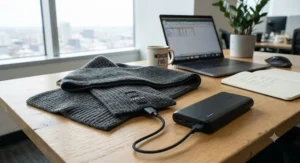
6. Eventek Heated Scarf — best all-day battery life for desk plus travel
Of the seven scarves here, the Eventek Heated Scarf offers the most granular battery-life data, and it’s worth walking through because the numbers actually change how you’d use it. Its 5,500mAh ternary lithium battery weighs about 0.2 pounds and delivers up to eight hours on low (106–109°F), six hours on medium (113–122°F), and four hours on the 131°F high setting — which means on a realistic office day you could run it at low heat literally from your morning commute through your entire shift without a midday recharge. The carbon-fiber heating element inside is a genuine upgrade over the resistive wire used in cheaper scarves, heating in three to five seconds and, per the manufacturer’s stated design, distributing warmth more evenly rather than creating hot spots near the wire path. Based on the spec comparison, this is the scarf best suited to someone who wants one device that works equally well plugged in at a desk and unplugged on a plane or train — which is exactly why it also earns a spot for anyone shopping specifically for a usb heated scarf for travel. Reviewers frequently mention the acrylic shell is friendlier to sensitive or wool-allergic skin than some of the wool-blend competitors, though a few note the battery pack, while light, adds a slight bulge if you’re wearing it under a fitted coat.
Pros:
- ✅ Up to 8 hours of runtime on the low setting
- ✅ Carbon-fiber element heats evenly in 3–5 seconds
- ✅ Hypoallergenic acrylic shell, gentle on sensitive skin
Cons:
- ❌ Battery pack creates a slight bulge under fitted coats
- ❌ Highest heat setting drains the battery fastest
At $35–$50, the Eventek earns its place as the most versatile pick on this list — equally credible as a desk companion and a travel neck warmer.
7. Wulcea Graphene Heated Scarf — fastest heat-up, premium build
The Wulcea Graphene Heated Scarf is the premium end of this list, and the case for it comes down to a single technical difference: graphene heating elements conduct and distribute heat faster and more evenly than the carbon-fiber or resistive-wire elements used in the other six scarves here. Paired with a 5V/2A 6,000mAh battery — the largest capacity on this list — it’s built as a puffer-style neck warmer rather than a flat scarf, trading some of the desk-discreet profile of the Comfheat or ANA for genuinely fast, consistent warmth and a design more suited to outdoor wear. Reviewers describe the single-button control as almost too simple at first, since there’s no multi-level display, but most come around to appreciating that there’s nothing to fumble with one-handed while holding a coffee. What most buyers overlook about graphene heating specifically is that its faster response time matters most in short bursts of cold exposure — think stepping outside to grab lunch or waiting for a rideshare — rather than for someone sitting at a desk in a stable 65°F office all day, where any of the cheaper scarves would perform nearly identically once warmed up. The puffer shape, while cozy, is also the least subtle option here, and it’s not the scarf you’d casually keep on through a video call.
Pros:
- ✅ Graphene element heats faster than carbon-fiber designs
- ✅ Largest battery capacity on this list at 6,000mAh
- ✅ Simple one-button operation, no fiddly settings menu
Cons:
- ❌ Puffer-style bulk less discreet for video calls
- ❌ Premium price versus flat, corded alternatives
Running $45–$60, it’s the splurge pick — best justified if cold outdoor commutes, not just a chilly desk, are your main problem.
Practical Usage Guide: Getting the Most From a Heated Scarf at Your Desk
Getting real value out of any of these seven products comes down to habits most listings never mention. First, resist the urge to start on the highest heat setting — every scarf on this list heats up within seconds, so there’s no reason to shock your skin with 130°F+ warmth when a 15-second climb from low to medium does the same job more comfortably. Second, if you’re running a USB-only model like the Comfheat or ANA, check your laptop’s USB-A output before assuming full performance; the USB Implementers Forum notes that standard USB ports without Power Delivery support are limited to lower baseline wattages, and older laptops or basic wall chargers may underpower a scarf’s highest setting even though it technically powers on. Third, for the battery-powered models — JOYTEK, Kercky, Eventek, and Wulcea — charge them the night before rather than topping off at your desk each morning; lithium batteries generally handle slow, complete charge cycles better than frequent partial top-offs, which also protects long-term capacity.
A common first-30-days mistake is leaving a scarf running unattended during back-to-back meetings, which is exactly what the built-in auto-off timers (most sit around 45 minutes) are designed to prevent — don’t override or bypass that feature even if it means reactivating the scarf more often. Wash cycles matter too: check whether your model separates the battery pack before washing (most do, and washing with the pack attached is the single most common way to damage a heated scarf). Finally, if you’re pairing a scarf with a usb heated scarf for car charger use during a commute, confirm your vehicle’s USB port outputs at least 5V/1A — most modern car USB ports handle this easily, but older factory USB-A ports in older vehicles sometimes cap lower, which can mean a scarf technically runs but never reaches its advertised top temperature.
Real-World Scenarios: Who Actually Needs Which Scarf
Picture three different people, because “office worker” covers a lot of ground. First, there’s the hybrid employee who’s at a desk four days a week in a building with unpredictable HVAC — for them, a corded, budget option like the Comfheat USB Heated Scarf or ANA USB-Powered Heating Scarf makes the most sense, since it stays plugged in at the desk all day and never needs charging, and the lower price reflects that it’s solving a stationary problem. Second, there’s the commuter who walks or bikes fifteen minutes to a transit stop before reaching a heated office — for that person, the Kercky Heated Scarf‘s hood or the Eventek Heated Scarf‘s eight-hour low-setting runtime does more real-world work, because the cold exposure starts well before they ever sit down. Third, there’s the frequent business traveler stacking flights and rental cars through winter — here the case for the Wulcea Graphene Heated Scarf or Eventek is strongest, since both run untethered for hours and the fast graphene heat-up on the Wulcea specifically shines during short, sharp cold exposures like walking across a parking structure or waiting at a gate.
None of these profiles is more “correct” than another — they’re just different cold problems wearing the same disguise. A budget-conscious grad student working part-time at a reception desk has more in common with the hybrid employee than with the road-warrior sales rep, regardless of what their bank account looks like, because their actual exposure to cold is the same: stationary, indoor, predictable.
✨ Not sure which profile fits you? Scroll back to the comparison table above and match your daily route, not just your budget.
Problem → Solution: Fixing the Most Common Heated Scarf Complaints
Cold hands but a warm neck: heating your neck doesn’t automatically fix cold fingers, since your neck and hands are on separate circulatory pathways — pairing a heated scarf with fingerless gloves or a small desk-side space heater aimed at your hands solves this more completely than cranking scarf heat higher. Scarf feels too hot within minutes: this usually means starting on high instead of low, or a battery pack pressed too tightly against skin under a fitted collar; switch settings down and loosen the wrap slightly rather than removing the scarf entirely, since temperature swings are harder on comfort than steady, lower warmth. Battery dies mid-afternoon: this is almost always a symptom of starting on the highest setting out of habit — the Eventek’s documented 8-hour low-setting runtime versus 4-hour high-setting runtime shows just how much heat level affects battery math, so defaulting to medium or low stretches any battery-powered scarf considerably further. Scarf won’t reach advertised temperature: check the power source before assuming a defective unit — a weak power bank, an old laptop USB port, or a low-output car charger can all under-power a USB-only scarf without triggering any error. Coworkers keep asking what it is: this isn’t really a technical problem, but reviewers across nearly every product mention it — a low-profile, flat scarf like the Comfheat or ANA draws far less attention on a video call than a bulkier puffer-style option like the Wulcea.
How to Choose a USB Heated Scarf for Office Use
- Match the power source to your actual routine. If you’re sitting at one desk all day, a corded USB scarf is cheaper and simpler; if you move between rooms or buildings, a battery-powered model is worth the extra cost.
- Check the wattage against your USB port. Most office laptops handle 5–10W heated scarves fine, but confirm before assuming maximum heat performance, especially on older machines.
- Prioritize adjustable heat over raw max temperature. A scarf you can dial down to low is more useful daily than one that only runs hot, since most office cold is mild, not extreme.
- Weigh fabric against your workwear. A flat, thin design layers under blazers and collared shirts far better than a puffer-style scarf, which matters if your office has a business-casual dress code.
- Look for stated safety certifications. UL, CE, or FCC compliance markers, like those found on the JOYTEK’s battery and the ANA’s PI heating film, are a genuine signal of manufacturing oversight, not just marketing language.
- Consider runtime at your typical setting, not the marketing headline. An “8-hour” battery claim usually applies to the lowest heat level; check whether the listing breaks down runtime by setting, the way Eventek’s does.
- Factor in washability. A scarf worn daily against skin needs to be genuinely machine washable, ideally with a removable battery pack, to stay hygienic through an entire winter.
Common Mistakes When Buying a USB Heated Scarf
The single most common mistake is buying based on battery capacity alone, treating “6,000mAh” as automatically better than “5,000mAh” without checking how that capacity is actually used — a scarf that’s less efficient at converting power to heat can burn through a bigger battery just as fast as a smaller one. A second mistake is ignoring return policies on heated apparel, which sometimes carry stricter return windows than standard clothing because of the electronics involved; always confirm before buying, especially from newer or lesser-known brands. Third, buyers frequently skip checking whether the heating element sits at the front (throat), back (neck), or wraps fully around — a scarf heating only the back of your neck feels very different from one heating your entire collar, and product photos don’t always make this obvious. Fourth, some shoppers assume any USB scarf works with any USB port at full power, when in reality older or lower-output ports can silently underpower the device. Finally, people often buy the flashiest, highest-wattage option without considering that most office environments only need mild, steady warmth — overshooting on power just means paying more for heat you’ll never use on “high.”
USB Heated Scarf vs Space Heater for Desk Warmth
The obvious alternative to a heated scarf is a small desk space heater, and it’s worth being honest about where each one wins. A space heater heats the air around your whole workstation, which helps cold hands and feet in a way no scarf can — but most office buildings restrict or outright ban personal space heaters over fire risk and circuit-load concerns, and even where they’re allowed, they draw far more power (typically 200–1,500W) than any scarf on this list, which runs at 5–22.5W. A heated scarf sidesteps both problems: it draws USB-level power, poses no realistic fire hazard at that wattage, and warms you directly rather than the room, which matters in open-plan offices where heating the air just helps everyone except the person paying for the heater. The trade-off is real, though — a scarf won’t touch your cold hands or feet, and if your actual problem is a walk-in-freezer office rather than a slightly chilly one, a scarf alone won’t fully solve it. For most people, the right answer isn’t either/or: a heated scarf covers the daily baseline discomfort, and a small USB-powered hand warmer or heated foot pad — which draws similarly low power — fills the remaining gap without tripping any office electrical policy.
What to Expect: Real-World Performance at Your Desk
Specs describe potential, not experience, so here’s the translation. A scarf’s “low” setting, generally landing in the mid-90s to low-100s°F, feels less like heat and more like the absence of cold — it’s the setting most people end up using for 80% of an office day, since it counteracts drafts without making you sweat under a sweater. “Medium,” usually 110–125°F, is where most users report actually feeling warmth, appropriate for a genuinely cold morning or a desk near a window. “High,” often 130°F or above, is rarely used for more than a few minutes at a time — reviewers across nearly every product in this category describe it as almost too intense for sustained wear, better suited to a quick warm-up before settling into medium or low. Heat-up time matters more than most buyers expect going in: the difference between a 3-second graphene response and a 10-second resistive-wire response is barely noticeable once you’re already wearing the scarf, but it matters a lot in the first thirty seconds after switching it on, which is exactly the window where impatience makes people crank the setting higher than they need.
USB Heated Scarves for Different Kinds of Office Workers
For the desk-bound remote or hybrid worker, the priority is a corded, low-profile scarf that can stay plugged in for eight hours without a second thought — the Comfheat and ANA both fit that brief, and neither requires managing a separate battery schedule. For open-plan or shared-office workers self-conscious about looking unusual on camera, a flat scarf under a collar reads far more normal on a video call than a visible puffer-style wrap, which pushes the ANA or ambient corded options ahead of the bulkier Kercky or Wulcea for that specific audience. For workers with diagnosed circulation issues — Raynaud’s disease causes blood vessels supplying the skin to narrow in response to cold, most often affecting fingers and toes — a heated scarf helps with core neck warmth but, per the honesty of what this product actually does, won’t resolve extremity-specific symptoms; pairing it with heated gloves is the more complete approach, and anyone managing a diagnosed condition should loop in their physician on heat therapy generally. For frequent business travelers, runtime and portability outrank price every time, making the Eventek or Wulcea the more sensible investment despite the higher upfront cost.
Long-Term Cost & Maintenance
Run the numbers honestly and the price gap between a $25 corded scarf and a $55 battery-powered one narrows fast. A corded scarf has no battery to degrade, so its functional lifespan is mostly limited to fabric wear and the heating element itself, which — barring damage — can realistically last several winters of daily desk use. A battery-powered scarf’s lithium cell will gradually lose capacity, the same as any rechargeable device, typically noticeable after 300–500 charge cycles, which for daily winter-season use might mean two to three years before runtime drops meaningfully. Replacement battery packs, where available, usually cost a fraction of the full scarf price, so the total cost of ownership on a rechargeable model isn’t necessarily higher — it’s just spread differently. Electricity cost across an entire winter is negligible either way; even the highest-draw scarf here at 22.5W, run for eight hours daily across a four-month cold season, adds up to only a few dollars in electricity at typical U.S. residential rates. The bigger long-term cost consideration is fabric maintenance: washing per manufacturer instructions (almost always with the battery removed) extends the life of any scarf on this list far more than the electronics do.
Safety, Certifications & Office Etiquette
Because these products sit directly against skin and draw electrical current for hours at a time, safety certifications are worth checking rather than assuming. Look for UL, CE, or equivalent marks on the battery pack specifically, not just the outer packaging — the JOYTEK’s stated 3.7V UL/CE-certified cell and the Eventek’s UN38.8-referenced battery testing are the kind of detail that separates a reputable listing from a generic one. Cold stress at work is a recognized workplace hazard, and prolonged cold exposure can lead to conditions ranging from mild discomfort to more serious cold-related illness, which is the underlying reason products like these exist — but a heated scarf is a comfort device, not medical equipment, and shouldn’t be treated as a substitute for adequate building heating or for addressing a genuinely unsafe workplace temperature through your employer. On etiquette specifically: most offices have no explicit policy on personal heated apparel the way they might for space heaters, since the power draw is negligible and there’s no exposed heating coil, but it’s still worth a quick check with facilities or HR before regularly charging a battery pack at a shared desk outlet, purely as a courtesy.
Frequently Asked Questions
❓ Is a USB heated scarf safe to wear all day at work?
❓ Can I plug a USB heated scarf directly into my laptop?
❓ How long does a battery-powered heated scarf last on one charge?
❓ Do heated scarves work with a car charger on the commute?
❓ Are heated scarves machine washable?
Conclusion
A usb heated scarf for office use solves a problem that’s genuinely annoying but rarely urgent enough for facilities to fix on your timeline: the gap between what a thermostat says and what your desk actually feels like. The seven products here span that gap in different ways — the Comfheat and ANA keep things simple and cheap for people who never leave their desk, the JOYTEK and Kercky add battery freedom at a moderate price, and the Eventek and Wulcea push into genuinely all-day, all-situation territory for commuters and travelers willing to pay for it. None of them replace a properly heated building, and none of them are a substitute for addressing a genuinely unsafe workplace temperature through the right channels. But as a low-power, low-cost way to make an ordinary cold desk bearable, this category earns its place — and honestly, once you’ve worn one through a January morning meeting, going back to a bare cardigan feels a little bit like giving up warmth on principle.
Whichever one you choose, match it to your actual day rather than the biggest number on the spec sheet — that’s the difference between a scarf you wear once and one you reach for every cold morning until spring.
✨ Ready to stop dreading the office thermostat? Pick the scarf that matches your commute, plug it in, and get back to actually enjoying your coffee.
Recommended for You
- USB Heated Scarf: 7 Warmest Picks Worth Buying in 2026
- Battery Heated Scarf vs USB Heated Scarf: 7 Best Picks (2026)
- 7 Best Heated Scarf for Winter Commuting Picks (2026)
Disclaimer: This article contains affiliate links. As an Amazon Associate, I earn from qualifying purchases. If you purchase products through these links, we may earn a small commission at no additional cost to you.
✨ Found this helpful? Share it with your friends! 💬🤗
