
In This Article
Somewhere around the third October evening you spent shivering under a string of patio lights, pretending the wine was warming you more than it actually was, you probably typed “best outdoor heater” into a search bar and landed on a brand you didn’t recognize: Bromic. Good instinct. This bromic patio heaters review exists because Bromic isn’t a seasonal big-box impulse buy — it’s the heater brand restaurants, rooftop bars, and serious backyard entertainers actually specify when the stakes (and the guest list) are higher than a single chilly dinner party.

Bromic is an Australian heating manufacturer, founded in 1978, that builds infrared radiant heaters for both commercial and residential outdoor spaces. Instead of warming the air around you — which wind promptly steals — Bromic’s Smart-Heat line radiates energy directly onto people and surfaces, the same way sunlight warms your skin on a cold day even when the air temperature hasn’t budged. That distinction is the whole reason this brand has a cult following among hospitality operators.
In this guide, we’re covering seven real Bromic models spanning entry-level electric units to five-figure restaurant installations, breaking down what the specs actually mean for your patio, what verified buyers report, and where the real value trade-offs live. No invented testimonials, no fabricated “we tested this for six months” stories — just honest analysis built on real product data and aggregated review sentiment, clearly labeled as such.
Quick Comparison Table
| Heater | Fuel / Type | Best For | Price Range |
|---|---|---|---|
| Bromic Cobalt Smart-Heat Electric | Electric, wall/ceiling | Budget-conscious first-timers | Under $850 |
| Bromic Tungsten Smart-Heat Electric (6000W) | Electric, wall/ceiling | All-around residential patios | $1,050-$1,300 |
| Bromic Platinum Smart-Heat Gas (500 Series) | Gas, wall/ceiling | Restaurant and commercial patios | $1,400-$1,800 |
| Bromic Tungsten Smart-Heat Portable Gas | Gas, freestanding | Renters and no-wiring setups | $2,000-$3,000 |
| Bromic Eclipse Smart-Heat Portable Electric | Electric, freestanding | Design-forward showpiece heating | $2,700-$5,500 |
If you only remember one thing from this table, remember this: the price gap between Bromic’s cheapest and most expensive heater isn’t really about how much heat you get — it’s about mounting flexibility, finish quality, and smart controls. A Bromic Cobalt Smart-Heat Electric unit and a Bromic Eclipse Smart-Heat Portable Electric can both throw serious warmth across a patio; one just does it with a lot more polish, portability, and price tag attached. Match the row to your installation constraints (wired vs. portable, budget vs. showpiece) before you match it to wattage.
💬 Found a heater you’re leaning toward already? Bookmark this page and keep scrolling — the pros, cons, and price context are below.
Top 7 Bromic Patio Heaters: Expert Analysis
1. Bromic Cobalt Smart-Heat Electric — the stripped-down budget entry point
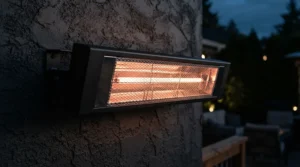
Bromic built the Bromic Cobalt Smart-Heat Electric by deliberately removing the premium trimmings from its other lines, and that’s precisely the point. Available in 4,000W and 6,000W configurations, it uses the same translucent fused-quartz element and steel coil found in pricier Bromic heaters, just without the ceramic fascia or slim-profile housing. In practice, that means you’re paying for heat output and 304-grade stainless steel durability, not for looks — the 6,000W version covers up to 144 square feet, which is plenty for a mid-size deck or covered porch.
Based on the spec comparison with Bromic’s other electric lines, the Cobalt is the clear pick for anyone who wants genuine Smart-Heat performance without financing a small vacation. It suits homeowners retrofitting an existing covered patio where aesthetics take a back seat to simply not freezing. Reviewers on retailer sites consistently note straightforward installation and reliable operation, though verified review volume for this specific model is thinner than for Bromic’s flagship lines — worth factoring in if extensive social proof matters to your decision.
Pros:
- ✅ Lowest entry price in the Bromic Smart-Heat lineup
- ✅ Same durable quartz element as premium Bromic models
- ✅ Minimal clearance requirements ease tight installs
Cons:
- ❌ No ceramic fascia, so the element glow is more visible
- ❌ Lacks built-in switches, requiring separate controls
Expect to pay in the $600-$850 range depending on wattage and retailer, making this the heater that gets skeptics to say yes to a Bromic purchase in the first place.
2. Bromic Tungsten Smart-Heat Electric (2000W) — the compact wall-mount for tight patios
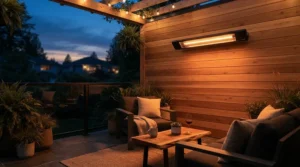
The 2,000W Bromic Tungsten Smart-Heat Electric is the smallest member of Bromic’s flagship Tungsten Electric family, and it’s built for exactly the kind of condo balcony or narrow townhouse patio where a full-size unit would look absurd. With a single heating element pulling 1,800-2,000 watts on a 230-240V hardwired circuit, it heats roughly 65 square feet — a footprint that suits a bistro table for two rather than a dinner party for twelve.
Here’s what most buyers overlook about this size class: the smaller wattage isn’t a compromise so much as a proportionality choice. Mounting a 6,000W heater over a two-person balcony wastes energy and creates an uncomfortably intense heat zone right underneath it. The 2000W’s 304 stainless-steel body and matte black or white finish were designed, per Bromic, to resemble mounted electronics rather than an industrial heat lamp — a detail apartment dwellers with HOA aesthetic rules will appreciate.
Pros:
- ✅ Discreet, TV-mount-style profile suits small spaces
- ✅ Hardwired 230V connection avoids extension cord clutter
- ✅ Available in both black and white to match trim
Cons:
- ❌ 65 sq ft coverage won’t heat larger seating areas
- ❌ Requires licensed electrician for hardwired installation
Price typically lands in the $650-$900 range. Given how compact outdoor spaces have become in urban housing, this is arguably the most underrated entry in Bromic’s catalog.
3. Bromic Tungsten Smart-Heat Electric (6000W) — the dual-element workhorse
This is the heater most people picture when they think “Bromic,” and for good reason. The Bromic Tungsten Smart-Heat Electric 6000W model runs two heating elements pulling 5,400-5,900 watts, warming up to 144 square feet — enough for a full outdoor dining set plus a lounge corner. Because it has two elements instead of one, you get more even heat distribution across a wider arc rather than a single hot column directly below the unit.
What the spec sheet won’t tell you, but installers consistently mention, is that the dual-element design lets you wire the two elements to separate controls — meaning you can run at half power on a mild evening and save on your electric bill without buying a second unit. The parabolic mirror-finish rear reflector redirects heat that would otherwise escape backward through the mounting wall, a small engineering detail that measurably improves output efficiency versus cheaper single-reflector competitors. For anyone comparing a bromic tungsten smart heat model against generic infrared heaters, this reflector design is one of the more meaningful, if unglamorous, differentiators.
Pros:
- ✅ Dual elements allow independently controlled zones
- ✅ 144 sq ft coverage handles full dining and lounge areas
- ✅ Parabolic reflector improves directional heat efficiency
Cons:
- ❌ Requires a dedicated 230-240V, 16.6-amp circuit
- ❌ Heavier unit demands sturdier wall or ceiling anchoring
Expect a price range of roughly $1,050-$1,300. If you’re only buying one Bromic heater for a mid-size backyard, this is the one most reviewers and installers point to first.
4. Bromic Platinum Smart-Heat Gas (500 Series) — the restaurant-grade heavyweight
Step up into gas, and you land on the Bromic Platinum Smart-Heat Gas 500 Series, a five-burner unit delivering roughly 43,000 BTU/hour and covering up to 215 square feet — nearly the size of a small studio apartment. This is squarely a restaurant patio heater brand play: the tinted ceramic-glass fascia that gives it a soft red ambient glow isn’t just cosmetic, it also helps the unit hold the highest wind rating Bromic offers on a gas model, rated for gusts up to roughly 8mph before performance degrades.
Reviewers consistently report that the Platinum Gas series feels noticeably more substantial in person than competing commercial heaters, largely due to its heavy-duty stainless-steel body. Based on the spec comparison with mushroom-style propane heaters common on hotel patios, the wall/ceiling-mounted Platinum design frees up floor space for actual seating — a meaningful commercial consideration when every square foot of patio equals potential table revenue. It runs on natural gas or propane, and the electronic ignition with automatic re-ignition and flame-failure shutoff meets the kind of safety redundancy commercial kitchens and fire inspectors expect.
Pros:
- ✅ 215 sq ft coverage suits large commercial patios
- ✅ Wall/ceiling mounting frees up valuable floor seating
- ✅ Flame-failure safety shutoff meets commercial code needs
Cons:
- ❌ Requires professional gas line installation
- ❌ Higher upfront cost than comparable electric coverage
Price generally runs $1,400-$1,800 depending on fuel configuration and finish. For restaurant and hospitality buyers, this is frequently the anchor purchase in a multi-unit Bromic order.
5. Bromic Platinum Smart-Heat Electric (Slim/Flush-Mount) — the low-clearance specialist
Available in 2300W, 3400W, and 4500W sizes, the Bromic Platinum Smart-Heat Electric slim series solves a very specific problem: what do you do when your covered patio ceiling is only a few inches deeper than the heater itself? Built from premium 304-grade stainless steel with a fully sealed, IP-rated body, this heater was engineered for flush or recessed mounting in semi-enclosed spaces where a bulkier unit simply wouldn’t fit.
On paper this means slightly lower wattage than the Tungsten line, but here’s what actually matters: because electric infrared heaters don’t produce combustion byproducts, they need no ventilation at all, which makes this the go-to premium outdoor heating brand choice for enclosed sunrooms, covered verandas, and marine-grade coastal installs where gas venting rules would otherwise disqualify a heater entirely. It’s also offered in a marine-grade finish for corrosion resistance near saltwater — a detail that signals Bromic is thinking about environments most competitors ignore.
Pros:
- ✅ Ultra-slim profile fits minimal-clearance ceilings
- ✅ No ventilation required, ideal for enclosed spaces
- ✅ Marine-grade option resists coastal corrosion
Cons:
- ❌ Lower peak wattage than comparable Tungsten models
- ❌ Premium finish commands a noticeably higher price
Budget $1,450-$1,900 depending on wattage and finish. If your patio is covered and low, this is the smart heat electric heater that actually fits the ceiling instead of fighting it.
6. Bromic Tungsten Smart-Heat Portable Gas (BHP180) — the no-wiring freestanding option
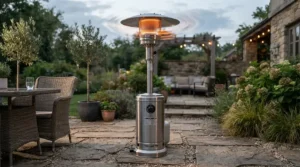
Not everyone owns their patio, and not everyone wants an electrician’s invoice before they can feel warm outside. The Bromic Tungsten Smart-Heat Portable Gas heater, model BHP180, solves that with a freestanding propane or natural gas unit delivering 38,500 BTU across up to 215 square feet of coverage — Bromic claims up to three times the efficiency of a traditional mushroom-style heater running on the same gas cylinder.
Aggregated retailer and buyer feedback frames this unit as the standout for its distinctive angular silhouette, which reads more like a modern sculpture than a patio appliance — a deliberate design choice, since it’s meant to anchor design-focused spaces rather than hide in a corner. Reviewers note roughly eight hours of run time on a single propane tank and built-in wheels with an anti-tilt base for maneuverability, addressing the classic complaint about traditional propane heaters tipping in wind. Its 8mph wind resistance rating matches the wall-mounted Platinum Gas series despite being fully portable, which is a genuinely impressive engineering feat for a freestanding unit.
Pros:
- ✅ No electrical or gas-line installation required
- ✅ Roughly 8 hours of runtime per propane tank
- ✅ Anti-tilt wheeled base improves wind stability
Cons:
- ❌ Requires manual propane tank swaps and storage
- ❌ Among the pricier portable options in Bromic’s catalog
Expect to pay in the $2,000-$3,000 range depending on retailer promotions. For renters, event planners, and anyone who wants restaurant-grade heat without permanent installation, this is the heater that makes the case for going portable.
7. Bromic Eclipse Smart-Heat Portable Electric — the design-forward showpiece
If the other six heaters are appliances, the Bromic Eclipse Smart-Heat Portable Electric is furniture. This 2,900W freestanding unit heats an 11-foot radius (about 121 square feet) and pairs its radiant heat with an integrated, dimmable 3,000K LED light producing up to 217 lumens — meaning it doubles as ambient lighting for evening entertaining, controlled via an included wireless remote and dimmer.
What most buyers overlook about the Eclipse is that its premium positioning isn’t just marketing fluff: the double-coated, corrosion-resistant steel construction and stable wheeled base are engineered for repeated repositioning around a space, which matters if you host frequently and rearrange furniture between events. Reviewers and dealers consistently describe it as the heater that gets noticed before it’s even turned on — an intentional design outcome for a brand competing in the premium outdoor heating brand tier, where aesthetics carry as much weight as BTUs. It’s the heater a boutique hotel rooftop or design-conscious homeowner buys specifically because it doesn’t look like a heater.
Pros:
- ✅ Integrated dimmable LED light adds ambiance and function
- ✅ Freestanding wheeled base allows easy repositioning
- ✅ Distinctive design doubles as a decor centerpiece
Cons:
- ❌ Among the most expensive heaters in Bromic’s entire lineup
- ❌ Lower coverage area (121 sq ft) than similarly priced gas units
Pricing varies widely by retailer and bundled mounting kit, generally landing between $2,700 and $5,500. This is a want, not a need — but for the right patio, it’s the Bromic that makes the whole space.
Practical Usage Guide: Setup, Maintenance & Optimization
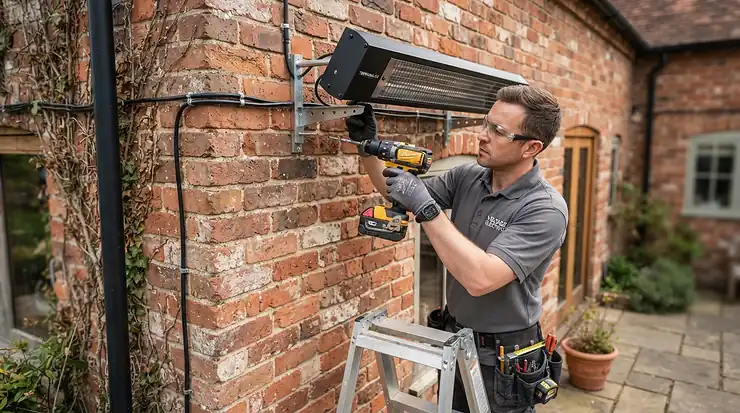
Getting the most out of any Bromic heater starts before installation. Mounting height matters more than most buyers expect — Bromic generally recommends around 8 feet from floor to the bottom of wall or ceiling-mounted units, and going lower concentrates heat too intensely on whatever’s directly underneath, while going higher spreads it too thin to feel effective. If your ceiling clearance is under 42 inches above the unit, Bromic’s heat deflector accessory becomes non-negotiable, not optional, since it protects the mounting surface from heat buildup.
In the first 30 days, the most common installation mistake is skipping the manufacturer’s clearance chart in favor of “it looks about right.” Electric models don’t need ventilation, but they do need the specified minimum floor and side clearances respected exactly, since Bromic’s warranty coverage typically hinges on documented, code-compliant installation by a licensed electrician for hardwired units. For gas models, schedule an annual inspection of burner ports and gas line connections before each cold season begins — dust and pollen buildup over a summer of disuse is a common cause of uneven ignition come autumn.
Optimization comes down to control accessories most buyers skip to save money, then regret. A Wireless Dimmer Switch lets you run any Smart-Heat electric heater at partial output on mild nights instead of cycling full power on and off, which both saves energy and extends element life. Pairing multiple heaters to a single Affinity smart controller — compatible with the Bromic Heating app over Wi-Fi or Bluetooth — turns a random collection of heaters into a zoned system you can adjust from your phone rather than walking around flipping switches in the cold.

Real-World Scenarios: Which Bromic Heater Fits Your Space
The apartment balcony owner. You’ve got maybe 60 square feet, a bistro table, and a landlord who’ll allow a hardwired fixture but not much else. The 2000W Bromic Tungsten Smart-Heat Electric is proportioned correctly here — enough heat for two people without turning your balcony into a sauna, and a design subtle enough not to draw complaints.
The backyard entertainer. You host regularly, have a covered patio seating six to eight, and want heat that reaches the whole group without babysitting a propane tank. The 6000W Bromic Tungsten Smart-Heat Electric or the slim Bromic Platinum Smart-Heat Electric (if ceiling clearance is tight) both fit this brief, giving you set-it-and-forget-it wall-mounted heat.
The restaurant or hospitality operator. Your patio is the difference between a table turning twice a night in October or sitting empty. This is where a restaurant patio heater brand decision gets serious: the Bromic Platinum Smart-Heat Gas 500 Series mounted along a covered perimeter, paired with a Bromic Tungsten Smart-Heat Portable Gas unit or two for open-air seating, gives you both fixed commercial-grade coverage and flexible placement for busy nights. According to the National Restaurant Association, full-service operators report roughly 44% of daily sales now come from on-premises outdoor dining, which makes heater downtime a direct revenue problem, not a comfort nicety.
How to Choose a Bromic Patio Heater
Choosing the right Bromic model comes down to answering a handful of questions honestly, in this order:
- Fuel access first. If you don’t have a gas line and don’t want one installed, that alone eliminates half the Platinum and Tungsten Gas lineup — start with electric options.
- Measure your actual seating footprint. Don’t buy for the patio you wish you had; buy for the square footage where people will actually sit, then match it to a model’s rated coverage.
- Check your ceiling and mounting clearance. Low, covered patios push you toward the slim Platinum Electric line rather than the bulkier Tungsten or Cobalt bodies.
- Decide if portability matters. Renters, event hosts, and anyone without a fixed installation budget should look at the portable Eclipse or Tungsten Gas units instead of wall-mounted fixtures.
- Set a real budget band, not a wish list. Entry Cobalt units solve the “I just need heat” problem; Platinum and Eclipse solve the “this needs to look intentional” problem.
- Factor in installation cost, not just sticker price. A hardwired electric or gas unit typically adds licensed installer labor on top of the unit price — budget for it upfront.
- Confirm local code and HOA rules before buying. Gas-fired heaters especially can trigger permitting or clearance requirements your electric options avoid entirely.
Bromic Tungsten vs Platinum vs Cobalt: Which Smart-Heat Line Fits You
Bromic’s three electric families exist to serve genuinely different buyers, not just different price points. The Cobalt line strips away styling in favor of raw value — you’re buying the same quartz-element heat technology at the lowest cost of entry, and that’s a legitimate strategy if warmth is the whole assignment. The bromic tungsten smart heat family sits in the middle: full stainless-steel construction, the parabolic reflector for efficiency, dual-element options at higher wattages, and a design language meant to blend in rather than stand out.
Platinum is where the calculation changes. You’re not paying more for more heat — a 4500W Platinum actually produces less peak output than a 6000W Tungsten — you’re paying for the slim, flush-mount body that fits low-clearance spaces the Tungsten physically cannot, plus a marine-grade option for coastal corrosion resistance. If your space constraints don’t require Platinum’s slim profile, the Tungsten line delivers more heat per dollar; if they do, Platinum is not a luxury, it’s the only line that will physically fit.
Smart Heat Electric Heater vs Gas Heater: Which Fuel Wins
The electric-versus-gas decision for a smart heat electric heater or its gas counterpart isn’t really about which heats better — both technologies, done well, deliver comparable radiant comfort. It’s about infrastructure and running cost. Electric Smart-Heat units need a dedicated circuit and, for higher wattages, licensed electrical work, but once installed they have no fuel storage, no cylinder swaps, and lower ongoing maintenance. Gas units like the Platinum and Tungsten Portable lines heat up faster and typically cover more square footage per unit, but require either a plumbed gas line (permanent installs) or propane cylinder management (portable units).
According to engineering references on how infrared radiant heating actually transfers energy, both electric and gas infrared sources work on the same physical principle — radiant energy traveling in straight lines and converting to heat only on contact with a solid surface — so the “which is more effective” debate is largely a red herring. The real deciding factor for most buyers is simpler: do you have gas service to the mounting location, and are you comfortable managing cylinder swaps if not?
What to Expect: Real-World Performance
Specs describe a lab condition; your patio is not a lab. Wind is the single biggest variable Bromic’s coverage figures don’t fully capture — a 6000W Tungsten Electric rated for 144 square feet in still air will feel noticeably weaker at the edges of that footprint on a breezy evening, which is exactly why Bromic’s gas heaters publish wind-resistance ratings (up to roughly 8mph) as a headline spec rather than an afterthought. Mounting height also compounds this: heaters installed higher than Bromic’s recommended range spread heat over a wider but thinner zone, trading intensity for coverage.
In practical terms, expect the area directly beneath a wall or ceiling-mounted unit to feel noticeably warmer than the stated coverage radius’ outer edge — that’s normal radiant heat physics, not a defect. For portable units like the Eclipse or Tungsten Portable Gas, repositioning closer to your seating group on colder nights compensates for this far more effectively than cranking the dimmer to maximum, since radiant intensity falls off sharply with distance.

Bromic Heater Price: What Drives the Cost
Every bromic heater price sits noticeably above generic big-box infrared heaters, and understanding why helps you judge whether the premium is justified for your situation. Three factors drive it: material grade (304 or 316 marine-grade stainless steel versus painted mild steel on cheaper competitors), engineering details like the parabolic reflector and dual-element zoning that improve efficiency rather than just raw wattage, and smart-control compatibility through the Affinity ecosystem that most budget brands simply don’t offer.
Looked at as cost-per-square-foot-heated rather than sticker price alone, the value picture shifts. A Bromic Cobalt Smart-Heat Electric at roughly $700 covering 130 square feet works out to about $5.40 per square foot of coverage, while a Bromic Platinum Smart-Heat Gas 500 Series at $1,600 covering 215 square feet is closer to $7.44 — more expensive per square foot, but delivering commercial-grade durability and gas heat output the Cobalt simply can’t match. Total cost of ownership should also weigh installation labor, since a hardwired or gas-plumbed unit adds a one-time cost that a portable model like the Eclipse or Tungsten Portable Gas avoids entirely.
Why Bromic Is a Premium Outdoor Heating Brand
Calling Bromic a premium outdoor heating brand isn’t just marketing language borrowed from a retailer’s product page — it reflects specific, verifiable engineering choices. The company’s use of 304 and 316 marine-grade stainless steel across its lineup, rather than the painted or lower-grade steel common in budget competitors, directly extends product lifespan in the exact environment — outdoor, weather-exposed, sometimes coastal — where cheaper heaters corrode fastest. The parabolic anodized reflectors used across the Tungsten and Cobalt electric lines exist purely to squeeze more usable heat from the same wattage, an efficiency-first engineering decision rather than a marketing checkbox.
That premium positioning also shows up in Bromic’s smart-control ecosystem: the Affinity On/Off and Dimmer controllers, Wi-Fi and Bluetooth connectivity through the Bromic Heating app, and expansion boards for direct ethernet integration in large commercial installations aren’t features most residential heater brands bother building. It’s infrastructure aimed squarely at hospitality clients running a dozen heaters across a property, which is a different design brief entirely from a single backyard unit — and it’s part of why Bromic heaters consistently carry a higher price than mass-market alternatives without necessarily producing dramatically more heat per watt.
Bromic as a Restaurant Patio Heater Brand: Commercial Considerations
For hospitality buyers, choosing a restaurant patio heater brand comes with considerations residential shoppers rarely face: code compliance, insurance requirements, and the ability to control a dozen units as one system rather than individually. Bromic’s Platinum and Tungsten Gas lines were clearly engineered with this in mind — the electronic ignition, automatic re-ignition, and flame-failure safety shutoff on gas models meet the kind of redundant safety systems fire marshals expect to see during a commercial patio inspection.
The Affinity Master Remote, which can control an effectively unlimited number of gas heaters from a single point, exists specifically for this use case — a restaurant manager shouldn’t need to walk a patio flipping individual switches before a dinner rush. Commercial buyers should also budget for professional installation as a fixed cost rather than an optional add-on; unlike a residential DIY-adjacent electric plug-in heater, Bromic’s commercial-grade units generally require licensed gas or electrical work to remain within both code and warranty terms.
Common Mistakes When Buying a Patio Heater
The most frequent mistake isn’t picking the wrong Bromic model — it’s skipping the clearance and voltage check before falling in love with a specific unit’s looks. A stunning Bromic Eclipse Smart-Heat Portable Electric does nothing for you if your outlet can’t handle a 2,900W draw without tripping a breaker. Second most common: underestimating wind exposure and buying based on square-footage ratings measured in still air, then wondering why an open, breezy rooftop doesn’t feel as warm as advertised.
Third, buyers frequently skip budgeting for installation labor entirely, treating the sticker price as the total cost, then getting surprised by an electrician or gas-fitter invoice that can add several hundred dollars to a hardwired unit. Fourth, and specific to commercial buyers, is under-provisioning: buying one large heater to cover an entire patio instead of multiple smaller units placed strategically, which typically produces uneven heat with cold pockets rather than the even coverage several distributed heaters would provide.
Safety, Clearance & Regulations Guide
Outdoor heater safety isn’t a formality — propane and natural gas units in particular carry real risks if clearance and ventilation rules are ignored. The National Fire Protection Association’s guidance, developed specifically because portable outdoor heaters saw a surge in restaurant and business use, recommends keeping combustible materials at least three feet from any heating element, never operating gas heaters in enclosed spaces due to carbon monoxide risk, and turning off portable units whenever the area isn’t actively occupied or monitored.
For Bromic specifically, that translates into concrete rules: fixed wall or ceiling-mounted electric and gas models must be installed by a licensed technician, both to meet warranty terms and local electrical or gas code. Minimum floor clearance for wall-mounted Tungsten and Platinum gas models typically runs around 96 inches unless a heat deflector accessory is added, which reduces required clearance to roughly 14 inches. Portable propane units need stable, level ground and adequate spacing from cylinder storage — don’t store spare propane tanks near an operating heater, and always inspect gas connections before the start of each outdoor season.
FAQ
❓ Are Bromic patio heaters worth the money?
❓ How much does a Bromic patio heater cost?
❓ Do Bromic electric heaters need a special outlet?
❓ Can Bromic gas heaters be used on a covered patio?
❓ What's the difference between Bromic Tungsten and Platinum lines?
Conclusion
If this bromic patio heaters review leaves you with one takeaway, let it be this: there’s no single “best” Bromic heater, only the right Bromic heater for your specific patio, budget, and installation constraints. Renters and apartment dwellers should look at the compact Tungsten Electric or portable gas options; homeowners with a real backyard and a covered patio are well served by the 6000W Tungsten or slim Platinum Electric; and restaurant or hospitality buyers should be building toward the Platinum Gas 500 Series backed by an Affinity control system.
What ties all seven models together is a consistent engineering philosophy — radiant heat that targets people rather than air, stainless-steel construction built to survive years of weather exposure, and smart-control options most competitors simply don’t offer at any price. That consistency is exactly what a premium outdoor heating brand is supposed to deliver, and across this lineup, Bromic largely does.
Whichever model fits your space, don’t skip the clearance check, don’t guess at your wattage needs, and budget realistically for installation. Get that right, and a Bromic heater should genuinely extend your outdoor season by months, not just make a single chilly evening marginally more bearable.
Recommended for You
- Best Outdoor Pellet Patio Heater: 7 Models Worth Your Patio Space In 2026
- Portable Pellet Patio Heater: 7 Best Picks For Cozy Nights (2026)
- 7 Best Ventless Propane Heaters For Safe Indoor Heat In 2026
Disclaimer: This article contains affiliate links. As an Amazon Associate, I earn from qualifying purchases. If you purchase products through these links, we may earn a small commission at no additional cost to you.
✨ Found this helpful? Share it with a friend who’s still shivering on their patio! 💬🔥
