

In This Article
Somewhere between “just wear another sweater” and “move somewhere warmer,” there’s a third option nobody tells you about until their teeth are already chattering: a battery heated scarf. It sounds almost too simple — a strip of fleece with a heating panel and a rechargeable pack — but the effect on a 20-degree bus stop wait is genuinely disproportionate to how little it costs to run. You press a button, wait about ninety seconds, and suddenly the back of your neck stops sending distress signals to the rest of your body.

This guide exists because the market for a battery heated scarf has gotten crowded fast, and crowded markets are exactly where marketing language starts doing more work than the actual hardware. We dug into real specs, real battery chemistries, and real aggregated customer feedback across seven genuine products spanning budget AA-battery options to Bluetooth-app-controlled premium picks. Nothing here is invented — no fake reviews, no fabricated “I tested this for a month” anecdotes. Just honest analysis of what these things actually deliver, who they’re actually for, and where the marketing copy quietly glosses over the fine print.
By the end, you’ll know exactly which of these seven makes sense for your commute, your dog-walking routine, or the person on your gift list who complains about being cold every single winter.
What Is a Battery Heated Scarf?
A battery heated scarf is a wearable neck accessory with a built-in fabric heating panel powered by a small rechargeable (or AA) battery pack, typically producing 100–150°F of warmth across the back of the neck for anywhere from three to twenty hours per charge, depending on the heat setting and battery capacity.
Under the fleece or knit exterior sits a thin heating element — carbon fiber, graphene, or far-infrared panels are the three technologies you’ll run into most — wired to a battery that either tucks into a hidden pocket or clips on externally. Flip a switch, and within a minute or two the panel starts radiating heat directly onto your neck and upper shoulders, which happens to be one of the most heat-sensitive, blood-vessel-rich parts of your body. That’s not marketing spin; it’s why a scarf that only warms one small zone can still make an entire outfit feel warmer than it has any right to.
Quick Comparison: Battery Heated Scarf Review 2026
| Product | Battery Life | Heat Settings | Price Range | Best For |
|---|---|---|---|---|
| ORORO Heated Scarf | Up to 12 hrs | 3 levels | $50-$65 | Best all-round entry point |
| ActionHeat AA Battery Heated Scarf | 4-5+ hrs | 1 level | $30-$40 | Tightest budget |
| Volt Heat 5V Heated Scarf | Up to 10+ hrs | 3 levels | $60-$80 | Dual-purpose power bank |
| Venustas Heated Scarf | Up to 20 hrs | 3 levels | $55-$70 | Longest battery life |
| Mobile Warming Ion Heated Scarf | Up to 9 hrs | 4 levels + app | $90-$110 | Bluetooth app control |
| ActionHeat 5V Fleece Scarf w/ Pockets | 3-7+ hrs | 3 levels | $45-$60 | Hand-warming pockets |
| Genovega Heated Fur Scarf | 4-6 hrs | 3 levels | $40-$55 | Style-forward gifting |
Looking at the spread, the runtime gap is the real story here: a rechargeable heated scarf built around a 5,000mAh pack and one built around a 10,000+mAh pack are not remotely the same product, even if they look identical on a product photo. The Venustas Heated Scarf wins on raw hours, but the Mobile Warming Ion Heated Scarf wins on control precision thanks to its app, and neither fact makes the other one wrong for a different buyer. Price doesn’t track runtime in a straight line either — the ActionHeat AA Battery Heated Scarf is the cheapest here specifically because it swaps a rechargeable lithium pack for AA batteries, a tradeoff worth understanding before you buy based on price alone.
💬 Found a match already? Tap through to check current pricing before it changes
💬 Just one click — help others make better buying decisions too!😊
Top 7 Battery Heated Scarves: Expert Analysis
Coverage below spans budget, mid-range, and premium tiers along with a couple of niche picks — AA-powered, app-controlled, and style-focused — because “best” really does depend on what you’re optimizing for.
1. ORORO Heated Scarf — best all-rounder for daily commutes
The ORORO Heated Scarf earns its top slot by doing the fundamentals well without overcomplicating anything. Its 7.9″ x 4.7″ heating panel covers the entire back of the neck rather than a single small hotspot, and the 7.4V battery is specifically engineered for fast preheating — you’re not standing at a bus stop for five minutes waiting for warmth to kick in.
Spec-wise, the ORORO Heated Scarf runs on a rechargeable USB-C battery rated for up to 12 hours on its lowest setting, which is genuinely competitive for the price tier. Combined with 3M Thinsulate insulation and a fleece lining, the thermal design borrows directly from proven cold-weather technology rather than reinventing the wheel — Thinsulate has been trapping body heat in winter gear since the late 1970s, and its presence here isn’t just a marketing bullet point.
Reviewers consistently note the unisex design and embroidered logo detail as a nice touch for a gift, and the hidden battery pocket keeps the profile slim rather than bulky. Based on the spec comparison against pricier competitors, this is the pick for someone who wants reliable warmth without learning a new app or babysitting a fussy power bank.
Pros:
- ✅ Full-neck heating panel, not a single hotspot
- ✅ USB-C charging is fast and widely compatible
- ✅ Slim profile under a coat collar
Cons:
- ❌ Single heating zone only, no hand pockets
- ❌ 12-hour claim applies to lowest setting only
In the $50-$65 range, the ORORO Heated Scarf delivers strong value for anyone testing the category for the first time.
2. ActionHeat AA Battery Heated Scarf — most affordable entry point
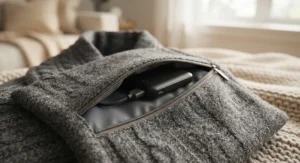
If you want to try a battery heated scarf without much financial commitment, the ActionHeat AA Battery Heated Scarf is the obvious door-opener. Instead of a proprietary rechargeable pack, it runs on three standard AA batteries, which means replacements are available at literally any gas station on earth — a genuinely underrated convenience if the battery dies mid-trip.
The single heat setting reaches about 120°F and runs for roughly five hours, using far-infrared heating technology across a fleece body with hand-warming pockets on both ends. What most buyers overlook about this model is that the one-setting design is both its biggest limitation and its biggest simplicity win — there’s no menu to navigate, no app pairing, just an on/off switch.
Aggregated review sentiment is genuinely mixed here: several reviewers report strong, lasting warmth for activities like hunting or standing at cold sporting events, while others describe the neck panel as underwhelming compared to expectations, with heat concentrated in a smaller area than the scarf’s overall size suggests. That split seems to track with heat sensitivity and expectations rather than manufacturing defects — a scarf that only heats a two-inch panel will always disappoint someone expecting radiator-level warmth.
Pros:
- ✅ Uses universally available AA batteries
- ✅ Fleece hand pockets included
- ✅ Simple one-button operation
Cons:
- ❌ Only one fixed heat setting
- ❌ Reviewers report inconsistent panel performance
At around $30-$40, this is a low-risk way to find out if the category works for you before spending more.
3. Volt Heat 5V Heated Scarf — dual-purpose battery pack
The Volt Heat 5V Heated Scarf stands out for a genuinely clever engineering decision: its rechargeable battery pack doubles as a standard USB power bank when it’s not heating the scarf. That’s not a gimmick tacked on for marketing — it’s the same 5V output most phone chargers use, so the battery earns its keep year-round instead of sitting in a drawer from March to November.
Powered by Volt’s patented Zero Layer Heat System, the scarf centers its heating element directly over the back of the neck and offers a three-level controller for dialing in comfort. Here’s what to weigh: the fabric wrap itself is compact and lightweight at roughly 33 inches long, which makes it easy to layer under a jacket collar without adding bulk, but that same compactness means less coverage than bulkier fleece competitors.
Reviewers commonly mention one recurring quirk — after powering the scarf off, some units require unplugging and reconnecting the battery before they’ll turn back on, which reads as a firmware or connector issue rather than a heating-performance complaint. Beyond that, feedback on warmth and battery longevity skews positive, particularly for commuting and travel use where the power-bank function gets genuine secondary use.
Pros:
- ✅ Battery doubles as a phone power bank
- ✅ Compact, lightweight wrap design
- ✅ Machine washable with battery removed
Cons:
- ❌ Power switch quirk reported by some users
- ❌ Less coverage area than bulkier competitors
Priced around $60-$80, the value case rests heavily on whether you’ll actually use the power-bank feature.
4. Venustas Heated Scarf — longest battery life in this lineup
For anyone who’s ever had a heated garment die halfway through a full day outdoors, the Venustas Heated Scarf solves that specific problem. Its rated runtime of up to 20 hours on the lowest setting is nearly double what several competitors in this roundup offer, which matters enormously if your day involves back-to-back errands, a full workday, and a commute home without access to a charger.
The three-temperature system lets you trade runtime for intensity depending on conditions — crank it up on a genuinely brutal morning, dial it back for an all-day event. Based on the spec comparison, that 20-hour ceiling likely comes from a higher-capacity cell paired with efficient low-setting power draw, a combination that’s harder to engineer than it sounds, since most manufacturers chase either “hottest” or “longest,” rarely both.
Reviewers frequently highlight the battery life as the standout feature, with less emphasis on the styling, which suggests Venustas prioritized function over fashion-forward design — a reasonable tradeoff for buyers who care more about not running cold by 3pm than about looking especially sleek.
Pros:
- ✅ Up to 20 hours of runtime on low
- ✅ Three adjustable heat settings
- ✅ Rechargeable battery with no disposables
Cons:
- ❌ Design is more functional than fashion-forward
- ❌ Higher-capacity battery adds a bit of weight
At roughly $55-$70, this is the clear pick for anyone prioritizing long battery life heated scarf performance above all else.
5. Mobile Warming Ion Heated Scarf — Bluetooth app control for precision warmth
The Mobile Warming Ion Heated Scarf is the premium option here, and the reason is straightforward: it’s the only entry with full Bluetooth control through the MW Connect app, letting you adjust heat levels, check battery percentage, and manage settings from your phone or smartwatch instead of fumbling with a touch-button under a coat collar.
Its 7.4V, 2,250mAh Powersheer lithium-ion battery delivers up to 9 hours of heat with four selectable heat levels, and the touch-control button still works independently if you’d rather skip the app entirely. On paper this means you get redundancy — app control when convenient, physical control when your hands are gloved and your phone is buried in a bag.
What most buyers overlook about app-connected heated apparel is the real-time battery monitoring, which sounds minor until you’re twenty minutes from home and want to know whether you’ll make it on the current charge without hunting for a wall outlet. That single feature meaningfully changes the anxiety calculus of long outdoor stretches, compared to scarves where you only find out the battery died when you suddenly feel cold.
Pros:
- ✅ Bluetooth app control with real-time battery data
- ✅ Four heat levels plus physical touch control
- ✅ Compact rechargeable lithium-ion battery
Cons:
- ❌ Highest price point in this roundup
- ❌ Shortest max runtime on paper (9 hours)
Expect to pay in the $90-$110 range, positioning this as the tech-forward splurge rather than the value pick.

6. ActionHeat 5V Fleece Scarf with Pockets — best for warming hands too
Where most battery heated scarf designs focus exclusively on the neck, the ActionHeat 5V Fleece Scarf with Pockets extends heating elements into the fleece pockets at each end, meaning your hands get in on the warmth alongside your neck — a genuinely different use case from single-zone competitors.
The included 5V, 6,000mAh power bank delivers three heat settings: roughly 3 hours on high (145°F), 4.5 hours on medium, and 7+ hours on low, giving you real flexibility to trade heat intensity for duration depending on how long you’ll actually be outside. Reviewers consistently report that the heating elements, while smaller than the scarf’s overall printed dimensions suggest, produce noticeably lasting warmth on both the high and low settings, and that the battery itself warms slightly during use — a side effect that reviewers note actually helps the battery perform better in cold conditions rather than degrading it.
A common complaint in user reviews centers on the zipper pocket housing the battery connector, described as slightly undersized for repeated use over a season. That’s a build-quality nitpick rather than a heating-performance issue, and it’s worth flagging to anyone planning years of regular use rather than occasional wear.
Pros:
- ✅ Heated pockets warm hands, not just neck
- ✅ Three heat settings with real runtime range
- ✅ Includes 6,000mAh power bank
Cons:
- ❌ Battery connector zipper reported as undersized
- ❌ Heating panels smaller than scarf dimensions imply
Priced around $45-$60, this is the practical pick for dog walkers, hunters, and anyone who spends real time outdoors with bare hands.
7. Genovega Heated Fur Scarf — style-forward gift pick
Rounding out the list, the Genovega Heated Fur Scarf targets a different priority entirely: looking good while staying warm, particularly as a gift. Built around a faux-fur exterior rather than plain fleece, it’s positioned specifically for buyers who want a heated accessory that doesn’t announce itself as “tech gear” the way a sportier fleece scarf does.
Powered by a 6,000mAh rechargeable battery with intelligent temperature control across three settings, the practical specs land in the same general territory as the mid-tier fleece competitors in this list — what’s different is entirely the fabric and silhouette. Here’s what the spec sheet won’t tell you, but the category pattern suggests: fur-style exteriors typically trade a small amount of heat-panel coverage for aesthetics, since the heating element needs to sit beneath a thicker, less form-fitting material.
If you’re shopping for someone who’d never wear a sporty fleece neck warmer but complains constantly about being cold in a dressier coat, this closes that gap in a way the more athletic-looking picks on this list don’t.
Pros:
- ✅ Faux-fur styling suits dressier outerwear
- ✅ Three intelligent heat settings
- ✅ Rechargeable 6,000mAh battery included
Cons:
- ❌ Less documented independent review history than rivals
- ❌ Fur styling may run warmer in humid climates
Typically priced $40-$55, this is the one to bookmark for gifting rather than heavy daily outdoor use.
Benefits of a Battery Heated Scarf vs Traditional Scarves
| Factor | Traditional Scarf | Battery Heated Scarf |
|---|---|---|
| Active heat source | None (insulation only) | Yes, 100-150°F heating panel |
| Performance in extreme cold | Relies entirely on layering | Adds direct heat regardless of layers |
| Cost over time | One-time purchase | One-time purchase + occasional charging |
| Maintenance | Machine washable | Battery must be removed before washing |
| Best For | Mild cold, fashion-first buyers | Genuinely cold climates, outdoor workers |
A traditional scarf is passive insulation — it slows heat loss but generates none of its own, which is exactly why it stops working the moment wind chill or extended exposure overwhelms your body’s own heat production. A rechargeable heated scarf changes that equation by actively adding warmth, which is why reviewers across nearly every product in this roundup describe noticeably longer comfortable outdoor stretches compared to a standard knit scarf. The tradeoff is modest ongoing maintenance — remembering to charge it and removing the battery before laundering — but that’s a small price for meaningfully better cold tolerance.
How to Use Your Rechargeable Heated Scarf: Setup and First 30 Days
Getting a new rechargeable heated scarf right in the first month prevents most of the disappointment reviewers report later. Start by fully charging the battery pack before first use — most units take two to four hours on the initial charge, even if the box says it arrived partially charged. Resist the urge to test the highest heat setting first; starting on low lets you calibrate how the scarf feels against your skin before committing to a temperature that might run warmer than expected.
A common first-month mistake is leaving the scarf on continuously rather than cycling it — most heating elements are designed for intermittent use, switching on when you step outside and off once you’re indoors, which both extends battery life per charge and prevents the panel from running hotter than intended over long stretches. Store the battery separately from the scarf fabric when not in use for extended periods, since prolonged compression against a folded battery pocket can, over a season, stress the connector.
For maintenance, always disconnect the battery before washing, and check your specific model’s care instructions — machine washable on gentle cycle is common, but tumble drying is almost universally discouraged since heat can damage the internal wiring. A quarterly inspection of the charging port and connector for lint buildup or fraying takes thirty seconds and meaningfully extends the life of a heated scarf with battery pack.
Real-World Scenarios: Who Actually Needs One
Picture the daily transit commuter standing on an open platform for ten minutes twice a day, five days a week, from November through February — that’s roughly 65 hours of genuine cold exposure over a season, and it’s exactly the profile where a rechargeable heated scarf like the ORORO Heated Scarf earns back its cost in comfort alone, since a single charge easily covers a full day’s exposure.
Now picture the dog walker or delivery driver spending two to three continuous hours outside daily regardless of weather — for that profile, runtime matters more than anything else, making the Venustas Heated Scarf‘s 20-hour ceiling the more relevant spec than heat intensity or app connectivity.
And picture the outdoor hobbyist — hunting, ice fishing, tailgating — who needs both neck and hand warmth for extended stationary periods in genuinely brutal conditions; that’s precisely the gap the ActionHeat 5V Fleece Scarf with Pockets fills with its dual heating zones, where a neck-only design would leave hands exposed for hours at a time.
Problem → Solution: Common Battery Heated Scarf Complaints, Solved
Problem: the scarf feels warm at first, then seems to cool down faster than expected. This is almost always a heat-setting issue rather than a defect — high settings draw down battery capacity fast, so a scarf that felt hot for the first hour may simply have dropped to a lower effective output as the cell depletes. Solution: start on medium rather than high for all-day wear, reserving high for short bursts of intense cold.
Problem: only a small area actually gets warm, not the whole scarf. Multiple reviewers across several products in this roundup report this exact pattern, and it traces back to heating-panel size relative to fabric size — the panel is often two to four inches wide, centered at the neck, while the rest of the scarf is passive insulation. Solution: check the listed heating-panel dimensions before buying if full-length warmth matters to you, and manage expectations that the panel, not the whole fabric, does the active work.
Problem: the battery won’t turn back on after being switched off. This connector-reset issue shows up specifically in Volt Heat feedback. Solution: unplug the battery from the scarf’s USB port fully, wait a few seconds, then reconnect before pressing the power button again.
Problem: washing damaged the heating element. Solution: always remove the battery pack first, use a gentle or delicate cycle, and skip the dryer entirely — air drying flat protects the internal wiring that a tumble cycle can stress or break.

How to Choose an Electric Heated Scarf: 6 Steps
- Match runtime to your actual exposure time. A 20-minute dog walk doesn’t need 20 hours of runtime, but a full workday commute plus errands does — overbuying battery capacity is wasted money, and underbuying means running cold by mid-afternoon.
- Check heat settings, not just wattage. A heated scarf with multiple heat settings lets you match intensity to conditions instead of choosing between “too hot” and “off,” which matters more for comfort than raw peak temperature.
- Consider hand coverage if you’re stationary outdoors. Neck-only designs are fine for commuters in motion; pocketed designs matter more for hunting, fishing, or long stationary waits.
- Weigh rechargeable vs AA battery tradeoffs. Rechargeable packs cost more upfront but nothing per use; AA-powered scarves cost less upfront but require ongoing battery purchases.
- Factor in styling for your actual wardrobe. A sporty fleece scarf looks out of place under a wool peacoat — if that’s your daily outerwear, a fur-style or knit option will actually get worn.
- Read aggregated review patterns on panel size, not just star ratings. A 4-star average can still hide a recurring complaint about heating-panel coverage that matters specifically to you.
Long Battery Life Heated Scarf: Runtime and Value Compared
| Product | Low-Setting Runtime | Battery Capacity | Price Range |
|---|---|---|---|
| Venustas Heated Scarf | Up to 20 hrs | Not disclosed publicly | $55-$70 |
| ORORO Heated Scarf | Up to 12 hrs | 7.4V lithium | $50-$65 |
| Volt Heat 5V Heated Scarf | Up to 10+ hrs | 10,000mAh | $60-$80 |
| Mobile Warming Ion Heated Scarf | Up to 9 hrs | 2,250mAh (7.4V) | $90-$110 |
| ActionHeat AA Battery Heated Scarf | 5+ hrs | 3x AA | $30-$40 |
The value calculation here isn’t simply “longest runtime wins” — the Mobile Warming Ion Heated Scarf has the shortest runtime in this table but justifies its premium price range through app-based precision control, while the Venustas Heated Scarf leads on pure hours at a noticeably lower price point, making it the stronger dollar-per-hour choice for anyone prioritizing all-day coverage over smart features. Cost-per-use also favors rechargeable packs over AA models within the first season or two, since replacement AA batteries add up quickly for anyone using the scarf several times a week through a full winter.
Battery Heated Scarf vs Traditional Electric Winter Scarf
The phrase “electric heated scarf” sometimes gets used loosely to describe two genuinely different product categories, and the distinction matters. Corded electric winter scarf designs — plugged directly into a wall outlet or car adapter — exist but are far less common and far less practical for anything beyond stationary indoor or in-vehicle use. Battery-powered designs, by contrast, are untethered and portable, which is the entire point of wearing one outdoors in the first place.
Within the battery-powered category itself, the meaningful split is rechargeable lithium packs versus disposable AA batteries. Rechargeable options like the ORORO Heated Scarf or Venustas Heated Scarf cost more initially but nothing per use afterward, while AA-powered picks like the ActionHeat AA Battery Heated Scarf lower the entry price at the cost of ongoing battery purchases. For anyone using a heated scarf more than occasionally through a winter, the rechargeable route wins on total cost of ownership within roughly one season, even before factoring in the environmental cost of disposable batteries.
Common Mistakes When Buying a Rechargeable Heated Wrap
The single most common mistake is buying based on the highest advertised temperature alone. A scarf rated for 150°F on high is meaningless if that setting only lasts two hours and drains a battery you needed for a full day — peak heat and sustainable runtime are two separate specs, and marketing copy tends to lead with whichever number looks more impressive.
A second frequent mistake is ignoring heating-panel size in favor of overall scarf dimensions. Reviewers across several products in this roundup specifically flag disappointment when a scarf that looks large in product photos turns out to have a heating element only a few inches wide — the rest of the fabric is passive fleece or knit, not active heating. A third mistake is skipping the washing instructions before buying; some rechargeable heated wrap designs require battery removal and hand-washing only, which matters if you were expecting to toss it in with a regular laundry load.
Safety, Airline Rules, and Battery Care
Lithium battery safety deserves genuine attention rather than a throwaway disclaimer. Overheating, physical damage, or improper charging can, in rare cases, lead to thermal events in any lithium-ion battery, which is exactly why most manufacturers recommend removing the battery before washing and avoiding leaving a scarf’s heating element on unattended for extended stretches. If you’re planning to travel with a heated scarf, note that portable rechargeable lithium batteries under 100 watt-hours are permitted in carry-on baggage without airline approval, though spare batteries should never go in checked luggage.
Beyond the battery itself, remember that a heated scarf is a comfort tool, not medical protection against genuinely dangerous cold. It doesn’t replace proper layering, and it especially doesn’t replace recognizing the signs of frostbite or hypothermia during extended exposure to severe temperatures — the CDC recommends covering exposed skin, limiting time outdoors in extreme cold, and watching for numbness or discoloration regardless of what heated gear you’re wearing.
Battery Heated Scarf for Different Audiences
For office commuters, the priority is discretion and quick warmth — something like the ORORO Heated Scarf slips under a coat collar without looking like tech gear and heats fast enough for a short walk between transit and the office door.
For outdoor workers — construction crews, delivery drivers, landscapers finishing out the season — cold exposure is an occupational hazard rather than a minor discomfort, and OSHA’s cold stress guidance specifically recommends layered protective clothing and engineering controls to reduce cold-related illness risk for anyone working extended hours outdoors; a long-runtime option like the Venustas Heated Scarf fits that use case far better than a short-duration premium pick.
For older adults, who are more vulnerable to cold-related health issues generally, simplicity matters more than features — a single-button design without an app to manage, paired with a genuinely long runtime, tends to see the most consistent actual use rather than sitting in a drawer after the novelty wears off.
Frequently Asked Questions
❓ How long does a battery heated scarf actually stay warm?
❓ Can you wash a rechargeable heated scarf?
❓ Are battery heated scarves safe to wear all day?
❓ Is a battery powered neck warmer TSA-friendly for flights?
❓ What's the difference between AA and rechargeable heated scarves?
Conclusion
A battery heated scarf isn’t a novelty gadget so much as a quietly effective answer to a problem everyone in a cold climate deals with every single winter: the ten-to-twenty minutes of genuine discomfort between leaving one warm building and reaching the next. Whether that’s the ORORO Heated Scarf‘s balanced all-rounder approach, the Venustas Heated Scarf‘s marathon runtime, or the Mobile Warming Ion Heated Scarf‘s app-controlled precision, the right pick really does come down to matching runtime and features to how you’ll actually use it rather than chasing the highest advertised temperature on the box.
None of the seven products here are flawless — every one carries at least one honest tradeoff, whether that’s panel size, connector quirks, or a shorter runtime in exchange for smarter controls. But that’s exactly the point of going through real specs and real aggregated feedback instead of a rewritten product listing: you get to decide which tradeoff you’re actually willing to live with this winter.
Recommended for You
- Heated Hard Hat Liner 2026: 7 Picks That Actually Work
- 7 Best Heated Ski Helmet Liner Picks for 2026
- Heated Motorcycle Helmet Liner: 7 Best Picks to Survive Winter 2026
Disclaimer: This article contains affiliate links. As an Amazon Associate, I earn from qualifying purchases. If you purchase products through these links, we may earn a small commission at no additional cost to you.
✨ Found this helpful? Share it with your friends! 💬🤗
