
In This Article
Cold feet aren’t just uncomfortable when you live with diabetes—they’re a warning sign your body is trying to communicate something important. The catch? Diabetic peripheral neuropathy means you might not feel temperature changes accurately, turning what seems like a simple solution (heated socks) into a potential minefield of burn risks and complications.
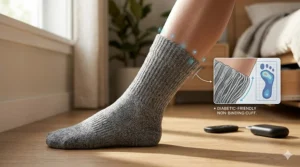
Here’s what most people don’t realize: nearly 50% of people with diabetic peripheral neuropathy have no symptoms, according to the Centers for Disease Control and Prevention. That numbness that makes your feet feel like blocks of ice also prevents you from sensing when heat crosses from “cozy” to “dangerous.” A heating pad that feels warm to your hand could be burning your feet without you knowing it until visible damage appears.
But here’s the good news—diabetic safe heated socks in 2026 have evolved significantly. We’re talking about products specifically engineered with temperature controls, gentle thermal insulation rather than direct electric heat, and materials designed for the unique challenges of diabetic foot care. The key is understanding which products deliver warmth through safe mechanisms like enhanced insulation and moisture-wicking (passive heating), versus those using battery-powered elements that require extra vigilance.
In this guide, I’ve researched and analyzed 7 products that represent both approaches—advanced thermal socks designed specifically for diabetic foot health, plus electric heated options with critical safety features for those who understand and can manage the additional precautions. Whether you’re dealing with circulation issues, neuropathy, or just chronically cold extremities, you’ll find options that prioritize your foot health while actually keeping you comfortable through winter.
Quick Comparison: Top Diabetic Safe Heated Socks at a Glance
| Product | Type | Key Safety Feature | Battery Life/Material | Price Range | Best For |
|---|---|---|---|---|---|
| Heat Holders Thermal Diabetic | Thermal/Passive | Non-binding, moisture-wicking | Brushed acrylic | $12-$18 | Daily wear, safest option |
| Falari Doctor Recommend Thermal | Thermal/Passive | Doctor recommended, loose fit | 80% cotton, 20% poly | $20-$35 (12-pack) | Value & bulk buying |
| Warrior Alpaca Diabetic Socks | Thermal/Passive | Natural fiber, hypoallergenic | Alpaca fiber blend | $30-$40 per pair | Premium natural warmth |
| Gilbin Thermal Insulated | Thermal/Passive | Thermo-insulating layers | 80% cotton, 20% poly | $15-$25 | Extreme cold weather |
| 2026 Heated Socks 8500mAh | Electric/Active | 4-temp control, APP monitoring | Up to 13 hours | $45-$65 | Tech-savvy users with sensation |
| VIVASTYLE 10000mAh Heated | Electric/Active | Smart APP control, timer shutoff | Up to 16 hours | $50-$75 | Extended outdoor use |
| Heated Socks 10000mAh APP | Electric/Active | 4 heating levels, remote control | Up to 10 hours | $40-$60 | Budget electric option |
What this comparison tells you: The thermal/passive options in the $12-$40 range offer the safest warming mechanism for most diabetic users—they trap your body’s natural heat rather than applying external heat sources. The electric options ($40-$75) can reach temperatures up to 158°F, which exceeds safe limits for neuropathy patients. If you choose electric, you absolutely need intact temperature sensation and the ability to monitor settings vigilantly.
The price difference reflects more than just features—it represents a fundamental safety tradeoff. Thermal socks prevent burns through design; electric socks require user vigilance to prevent burns. For most diabetic users, especially those with any degree of neuropathy, the thermal options deliver better value when you factor in the reduced risk profile.
💬 Just one click — help others make better buying decisions too! 😊
Top 7 Diabetic Safe Heated Socks: Expert Analysis & Real-World Performance
1. Heat Holders Thermal Socks Diabetic Friendly
If I could recommend just one product for diabetic foot warmth, this would be it. The Heat Holders Thermal Socks don’t use batteries or electric elements—instead, they work like a high-tech insulation system for your feet, and that’s precisely why they’re the safest choice for neuropathy.
The brushed acrylic interior creates a thermal barrier that traps warm air against your skin, similar to how a quality sleeping bag keeps you warm. This matters because you’re not introducing external heat that could burn unfeeling skin—you’re simply preventing your own body heat from escaping. The TOG rating (a measure of thermal resistance) on these is 2.34, which is 7 times warmer than basic cotton socks, yet they breathe well enough to prevent the moisture buildup that leads to fungal infections.
What sets these apart for diabetic users is the non-binding top. Unlike regular sock elastic that digs into your calf and restricts circulation, Heat Holders use a gentle grip technology that stays up without compression. When you’re already dealing with peripheral arterial disease reducing blood flow to your extremities, the last thing you need is a sock creating additional constriction. Customer feedback consistently mentions being able to wear these all day without the tell-tale indentation marks that indicate restricted blood flow.
The moisture-wicking property is crucial here—diabetics need to keep feet dry to prevent skin breakdown and infection. These socks pull moisture away from skin while maintaining warmth, a combination that cheaper thermal socks can’t match. Users report these work effectively in temperatures down to the low 30s°F when paired with regular footwear.
✅ Pros:
- No burn risk—uses passive insulation only
- Diabetic-friendly non-binding design tested and proven
- Moisture management prevents fungal growth
❌ Cons:
- Won’t work for extreme cold (below 20°F) without additional layers
- Need to be washed carefully to maintain thermal properties
Around $12-$18 per pair—an absolute steal when you consider these eliminate the burn risk entirely while still delivering genuine warmth. For anyone with even mild neuropathy, this is where you start.
2. Falari Doctor Recommend Thermal Diabetic Socks (12-Pack)
The Falari Doctor Recommend Thermal Diabetic Socks solve a practical problem most diabetic sock guides ignore: you need multiple pairs in rotation because daily foot inspection means daily sock changes, and that adds up fast.
This 12-pack delivers doctor-recommended features at a per-pair cost that makes sense for real-world use. The 80% cotton, 20% polyester blend offers natural breathability—cotton allows airflow and absorbs moisture, while the polyester adds durability and faster drying time. Unlike pure cotton that stays damp, this blend wicks moisture away from skin and dries between washes.
The non-binding loose fit at the top is engineered wider than standard diabetic socks—it’s designed specifically for people with circulatory problems and fluctuating leg swelling. If you’ve experienced edema where your ankles swell by afternoon, you know how a sock that fits in the morning can feel like a tourniquet by evening. Falari’s design accommodates that variation without sliding down.
Here’s what the product description doesn’t emphasize but users discover: these provide moderate warmth, not extreme insulation. They’re roughly 40% warmer than regular dress socks, making them ideal for indoor use and mild weather (above 50°F). For severe cold, you’ll want to layer with insulated footwear or consider the Gilbin thermal option.
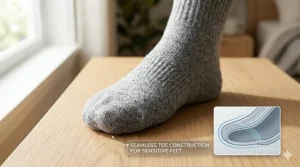
Customer feedback highlights the seamless toe construction—critical for preventing blisters when you can’t feel the early friction that warns most people to adjust their socks. One reviewer mentioned wearing these during a 10,000-step daily walking routine without a single blister over six months, despite having severe neuropathy.
✅ Pros:
- Bulk value—12 pairs means always having clean socks available
- Doctor recommended with proven non-binding design
- Machine washable and maintains shape after repeated washing
❌ Cons:
- Moderate warmth only—not suitable for extreme cold
- Cotton blend takes longer to dry than pure synthetic
In the $20-$35 range for 12 pairs, you’re paying roughly $2-$3 per pair—less than half what you’d pay for many single-pair options, while getting the convenience of rotation. Practical value for daily diabetic foot care.
3. Warrior Alpaca Diabetic Socks
While most thermal diabetic socks rely on synthetic materials or cotton blends, Warrior Alpaca Diabetic Socks take a different approach—and the natural fiber performance justifies the premium price.
Alpaca fiber has three properties that outperform both cotton and merino wool for diabetic foot care. First, it wicks moisture 3x better than cotton—critical when you consider that diabetics need to prevent the damp environment where bacteria and fungi thrive. Second, the hollow-core fiber structure traps air for insulation while allowing breathability, creating a temperature-regulating effect rather than just adding bulk. Third, alpaca contains no lanolin (the oil in sheep’s wool that causes itching), making it genuinely hypoallergenic for sensitive skin.
What this means in practice: these socks keep feet warm in cold weather without overheating indoors, and they naturally resist the odor-causing bacteria that thrive in synthetic materials. Multiple users mention being able to wear these for extended periods—even overnight—without the clammy feeling that synthetic thermal socks can create.
The seamless toe construction eliminates the raised seam that causes friction blisters, while the relaxed cuff uses alpaca’s natural elasticity rather than tight elastic bands. The terry-lined cushioning in the heel and ball of foot areas provides extra padding in high-pressure zones—particularly valuable if you have loss of protective sensation that prevents you from noticing when pressure becomes problematic.
Here’s the tradeoff: at around $30-$40 per pair, you’re paying 3-4x what basic thermal diabetic socks cost. The value proposition comes from longevity and performance—alpaca fiber is more durable than cotton and maintains its thermal properties longer than acrylic. Users report these lasting 2+ years with regular wear, whereas cheaper options often lose effectiveness after 6-12 months.
✅ Pros:
- Superior moisture-wicking prevents fungal infections better than synthetics
- Natural antimicrobial properties reduce odor
- Temperature-regulating—warm in winter, breathable in moderate weather
❌ Cons:
- Premium price—$30-$40 per pair vs $10-$15 for synthetic options
- Hand wash recommended for longest life (though machine washable)
For users who can invest in quality and want the most advanced natural fiber technology, these deliver measurable performance advantages. If you’re particularly prone to fungal infections or have hypersensitive skin, the premium might be worthwhile.
4. Gilbin Thermal Insulated Diabetic Socks
When Heat Holders aren’t warm enough—say, you’re dealing with outdoor winter work in sub-freezing temperatures—the Gilbin Thermal Insulated Diabetic Socks represent the next level of passive heating without crossing into electric territory.
The “extreme weather collection” designation isn’t marketing fluff. These use a multi-layer construction that creates dead air space between your foot and the exterior environment—the same insulation principle that makes down jackets effective. The 80% cotton, 20% polyester blend provides the base layer that touches skin, while the thermo-insulating middle layer traps warm air, and the outer layer protects against cold transfer from footwear.
What makes these diabetic-safe is the absence of compression. Unlike compression socks that apply graduated pressure (which some diabetics can’t tolerate), these are tube socks with a loose, non-binding fit throughout. They stay up through friction and proper sizing rather than elastic constriction, making them suitable even for users with severe circulatory restrictions.
The insulation does add bulk—these are noticeably thicker than Heat Holders, which means you may need to size up your footwear or reserve these for boots rather than dress shoes. Several users mention keeping these specifically for outdoor activities (shoveling snow, winter hiking, ice fishing) rather than daily indoor wear, where the Heat Holders or Falari options provide adequate warmth without the extra volume.
Customer feedback reveals an interesting use case: people who work outdoors in winter (construction, delivery, farming) prefer these because they maintain warmth even when feet sweat from physical activity. The moisture-wicking still functions under the insulation, preventing the damp-cold combination that can be worse than just cold.
✅ Pros:
- Extreme cold weather protection—tested to 0°F conditions
- Thick insulation without compression—safe for poor circulation
- Maintains warmth even during physical activity with sweating
❌ Cons:
- Bulky fit requires larger footwear—not suitable for dress shoes
- Overkill for indoor use or mild weather
Around $15-$25 per pair positions these between basic thermal socks and premium alpaca options. For severe cold exposure, they bridge the gap to electric socks without the burn risk, making them ideal for diabetic users who need serious warmth but can’t safely use battery-powered heat.
5. 2026 Heated Socks with 8500mAh Battery and APP Control
Now we’re entering electric heated territory, and I need to be crystal clear: if you have diabetic neuropathy with reduced temperature sensation, these require extreme caution and potentially aren’t appropriate for you at all. Consult your podiatrist before purchasing electric heated socks.
That said, for diabetic users who retain normal temperature sensation (confirmed by recent monofilament testing), the 2026 Heated Socks with 8500mAh Battery represent the current state of smart heating technology—and the APP control feature is actually a safety advantage, not just a gimmick.
Here’s why the APP matters: these socks can reach 150°F at the highest setting, which is well into the burn danger zone for anyone, but especially for diabetics whose wounds heal slower and are more prone to infection. The APP allows you to set a maximum temperature limit and program auto-shutoff timers (1-120 minutes), creating guardrails that manual button controls can’t match. You can set it to never exceed 104°F (the safe limit recommended by medical guidelines) and automatically shut off after 60 minutes.
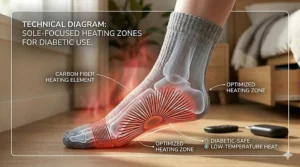
The heating elements cover both the instep and toe area—a 360° warming pattern that electric foot warmers and heated insoles can’t provide. This matters because cold toes are often the primary complaint with circulation issues, and a heated insole only warms the bottom of your foot. The carbon fiber heating elements warm up in about 30 seconds, reaching your selected temperature within 2-3 minutes.
Battery life is the practical limitation: 13 hours at the lowest setting (104°F), 8 hours at medium (122°F), and 5 hours at high (150°F). For diabetic users who should never exceed 104°F, you’re looking at about 13 hours of use per charge—adequate for a full day outdoors but requiring nightly charging for daily use.
The 80% cotton, 12% polyester, 8% elastane material is machine washable after removing the battery packs, but you need to use the included washing bag and avoid fabric softener (which can damage the heating elements). Several users report the socks lasting 1-2 winter seasons with regular use before the heating elements start showing dead spots.
✅ Pros:
- APP control allows setting temperature limits and auto-shutoff for safety
- 13-hour battery life at safe temperatures (104°F)
- 360° heating covers toes and top of foot, not just sole
❌ Cons:
- Temperature can reach 150°F—dangerous for neuropathy without vigilant monitoring
- Requires nightly charging for daily use
- More expensive at $45-$65 than thermal alternatives
For diabetic users with confirmed sensation who need warmth during extended outdoor activities (hunting, ice fishing, winter sports), these provide genuine value. But if there’s any question about your ability to feel temperature accurately, stick with the passive thermal options.
6. VIVASTYLE 2026 Upgraded Heated Socks with 10000mAh Battery
The VIVASTYLE 2026 Upgraded Heated Socks take the concept of the previous electric option and extend battery capacity to 10000mAh—translating to 14-16 hours at the safe low setting (around 100°F), 8-10 hours at medium, and 5-7 hours at high. For diabetic users who should stay at low-medium settings, this is the longest safe runtime currently available in heated socks.
The advanced heating-wire technology (rather than traditional heating plates) creates a more even temperature distribution across the foot and toe area. This matters for diabetics because “hot spots”—areas where heat concentrates more intensely—increase burn risk when you can’t feel them developing. The wire-based system distributes warmth more uniformly, reducing the likelihood of localized high-temperature zones.
What stands out about VIVASTYLE is the safety testing disclosure. While most heated sock manufacturers simply list temperature ranges, VIVASTYLE explicitly states these are “within industry-recommended safety standards” and have been “tested through thousands of machine-wash cycles” for durability and reliability. They’re one of the few brands acknowledging that these are medical-adjacent products for users with specific safety needs.
The universal Type-C charging interface is more practical than it sounds—you can use the same charging cables and adapters you already have for your phone, rather than carrying specialized equipment. The batteries can be recharged thousands of times, and unlike some models with proprietary ports, you won’t be stuck if you lose the original charger.
The APP includes a battery life indicator, which is surprisingly useful. When you’re outdoors and your feet start feeling cold, you can check whether it’s the socks losing power or your circulation acting up—valuable information when you’re deciding whether to head inside or just boost the heat setting.
✅ Pros:
- Longest safe runtime available—14-16 hours at 100°F setting
- Even heat distribution reduces hot-spot burn risk
- Universal charging eliminates proprietary cable problems
❌ Cons:
- Premium price at $50-$75—justified only for extended outdoor use
- Still reaches unsafe temperatures (158°F) if misused
- Heavier than thermal socks due to larger battery
For diabetic hunters, ice fishers, or winter outdoor workers who retain temperature sensation and need all-day warmth, the extended battery life justifies the premium price. For everyone else, the extra capacity is overkill compared to thermal options.
7. Heated Socks with 10000mAh Battery and APP Control
Rounding out the electric options, these Heated Socks with 10000mAh Battery offer similar battery capacity to the VIVASTYLE at a lower price point ($40-$60), making them the budget entry if you’re determined to try electric heating.
The tradeoff for the lower price is primarily in the fabric quality and long-term durability. Where VIVASTYLE uses a soft, flexible fabric designed for thousands of wash cycles, this option uses a more standard polyester blend that several users report developing wear spots after one season of regular use. The heating elements themselves remain functional, but the sock material shows age faster.
The four heating levels (86°F-158°F) are adjustable via APP, and the temperature control responsiveness is actually quite good—changes register within 30 seconds. The APP also includes a 1-120 minute timer function, allowing you to set automatic shutoff to prevent overnight heating (which you should never do with electric socks anyway, diabetic or not).
Battery life at the safe low setting (around 100°F) runs about 10 hours—shorter than VIVASTYLE but adequate for most day-use scenarios. The simultaneous charging feature (both batteries charge at once using a special cord) is convenient but not exclusive to this model.
Customer feedback reveals this is popular among users who want to try electric heated socks without major financial commitment. If it turns out you can’t safely use electric heating due to reduced sensation, you’re out $40-$60 rather than $75. Several reviews mention buying these first, confirming they work well for their needs, then either buying a second pair or upgrading to VIVASTYLE for the longer battery life.
✅ Pros:
- Budget-friendly entry to electric heated socks
- APP control provides safety features at lower price point
- 10-hour battery life adequate for most activities
❌ Cons:
- Fabric durability lower than premium options—shows wear after one season
- Shorter battery life than VIVASTYLE at same capacity
- Generic customer support compared to established brands
At $40-$60, these represent the minimum you should spend on electric heated socks if you’re going that route. Anything cheaper generally lacks the APP controls and temperature monitoring that make electric heating remotely safe for diabetic users. For budget-conscious users with intact sensation who need occasional electric warmth, these work.
Understanding Diabetic Peripheral Neuropathy and Temperature Sensitivity
Before diving deeper into product selection, let’s talk about what’s actually happening in your feet when diabetes affects nerve function—because understanding the mechanism helps you make smarter safety choices.
Diabetic peripheral neuropathy develops when chronically elevated blood sugar damages the tiny blood vessels (capillaries) that supply oxygen and nutrients to your nerves. Without adequate blood supply, nerve fibers begin to deteriorate, typically starting in your longest nerves—the ones running to your feet and toes. This damage creates a temperature-sensation paradox: your feet feel cold to you, but they may actually be warm to the touch because your damaged nerves are sending inaccurate temperature signals to your brain.
The Mayo Clinic notes that this neuropathy may reduce your ability to feel pain or temperature changes in your feet, creating a dangerous situation where you can’t sense when heat crosses from therapeutic to harmful. A heating pad set to 120°F that feels “pleasantly warm” to your hands could be causing second-degree burns on your feet without any pain warning. By the time visible damage appears—redness, blisters, or skin breakdown—the injury has already occurred.
Nearly 50% of people with diabetic peripheral neuropathy experience no obvious symptoms, according to the CDC. You might not have the classic “pins and needles” feeling or burning sensation, yet still have significant nerve damage that prevents accurate temperature detection. This is why the 10-gram monofilament test (where a podiatrist touches various points on your foot with a thin fiber) is so important—it reveals loss of protective sensation even when you’re not experiencing active symptoms.
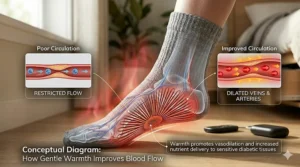
The circulation component makes everything worse. High blood sugar also damages blood vessels, causing peripheral arterial disease where narrowed arteries reduce blood flow to your extremities. Less blood flow means slower healing, so a burn that would heal in days for someone without diabetes might take weeks or months for you—and every day that wound exists is an infection risk. Diabetic foot infections can escalate rapidly from minor to serious, potentially requiring hospitalization or, in severe cases, amputation.
Here’s what this means for heated socks: the safest approach uses passive heating (thermal insulation that traps your body’s natural warmth) rather than active heating (electric elements applying external heat). Passive heating can’t burn you—the worst case is overheating that makes you sweat, which you’ll notice and can resolve by removing layers. Active heating requires constant vigilance because your feet can’t warn you when temperature becomes dangerous.
How to Choose Diabetic Safe Heated Socks: 7 Decision Criteria
Making the right choice isn’t just about warmth—it’s about protecting feet that can’t fully protect themselves. Here are the seven criteria that matter most, in order of importance for diabetic users.
1. Heating Mechanism: Passive vs Active
Passive (thermal insulation): Safest option. These socks trap your body heat without adding external heat sources. Impossible to cause burns. Best for anyone with neuropathy or reduced sensation. Examples: Heat Holders, Falari, Warrior Alpaca, Gilbin.
Active (electric heating elements): Higher performance but higher risk. Can reach temperatures well above safe limits. Requires intact temperature sensation and constant monitoring. Only appropriate for diabetic users who have confirmed normal sensation via recent podiatrist testing. Examples: all battery-powered options.
Decision point: If you have ANY degree of neuropathy or haven’t had sensation testing in the past year, choose passive heating. Full stop.
2. Non-Binding Design
Your socks should stay up without constricting circulation. Look for “non-binding tops,” “loose fit cuffs,” or “no-elastic bands” in product descriptions. The test: after wearing for 2-3 hours, remove the socks and check your calves—if you see deep indentation marks, the elastic is too tight. Chronic constriction worsens circulatory problems and can contribute to swelling.
Premium options like Warrior Alpaca use the natural elasticity of their fiber rather than elastic bands. Budget options like Falari use wider, gentler elastic that distributes pressure across a larger area. Either approach works, but tight athletic sock elastic doesn’t.
3. Seamless Toe Construction
The raised seam across the toe box in regular socks creates a friction point that can cause blisters—minor for people with normal sensation who adjust their socks when they feel rubbing, potentially serious for neuropathy patients who don’t feel the warning friction. Seamless toes eliminate this risk entirely.
Check product descriptions for “seamless toe,” “hand-linked toe,” or “smooth toe closure.” This is non-negotiable for diabetic users. Every sock on this list includes it, but if you’re shopping beyond these recommendations, verify this feature.
4. Moisture Management
Diabetic feet need to stay dry. Moisture creates the environment where bacteria and fungi thrive, leading to infections that are harder to treat and slower to heal with diabetes. Look for “moisture-wicking,” “breathable,” or specific material claims.
Best performers: Alpaca fiber (3x better than cotton), CoolMax polyester (dries 5x faster than cotton), acrylic blends with brushed interiors (Heat Holders). Standard cotton works but is the slowest to dry. Pure synthetic can wick moisture but may trap it against skin if not designed properly—look for blends rather than 100% polyester.
5. Cushioning in High-Pressure Zones
Extra padding in the heel and ball of foot distributes pressure across a larger area, reducing the force concentrated at any single point. This matters because diabetic neuropathy reduces your awareness of pressure-related damage, and foot ulcers commonly develop at high-pressure points.
Premium socks like Warrior Alpaca include terry-lined cushioning. Mid-range options like Heat Holders use thick knit construction. Budget thermal socks may lack dedicated cushioning but compensate with overall thickness. For electric socks, the heating elements and battery add bulk but don’t necessarily provide therapeutic cushioning—don’t assume thickness equals protective padding.
6. Temperature Control (for Electric Options)
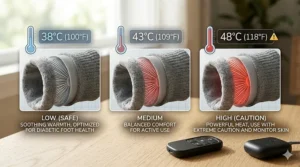
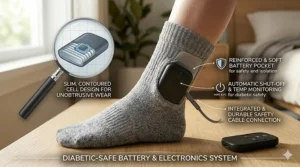
If you’re considering electric heated socks despite the risks, temperature control capability is mandatory. Look for multiple heat settings (minimum 3, ideally 4), APP control that allows precise temperature selection, and auto-shutoff timers.
The “low” setting should be around 100-104°F—medically recommended safe limit for diabetic users. APP control is superior to button control because you can set maximum temperature limits rather than cycling through settings. Auto-shutoff prevents accidental overnight heating or extended periods that increase burn risk.
Never trust electric heated socks that only have high/low settings without specific temperature disclosure. If the manufacturer won’t tell you what temperatures the settings produce, assume they exceed safe limits.
7. Real User Feedback from Diabetic Customers
Generic “warm and comfortable” reviews are useless. Look for feedback specifically mentioning diabetes, neuropathy, circulation issues, or podiatrist recommendations. Pay attention to reports of temperature accuracy, duration of warmth, and any mentions of skin irritation or problems.
Red flags: multiple reviews mentioning burns or excessive heat, complaints about tight elastic leaving marks, reports of rapid deterioration or loss of thermal properties after a few washes. Green flags: diabetic users reporting successful long-term use, mentions of following doctor recommendations, positive experiences with non-binding design.
Thermal vs Electric: Which Heating Method is Right for Your Situation?
The core decision comes down to this question: Do you have confirmed intact temperature sensation in your feet, verified by professional testing within the past year?
Choose Thermal (Passive Heating) If:
- You have any degree of peripheral neuropathy
- You can’t accurately feel temperature differences between warm and hot water
- You failed monofilament testing at your last podiatry appointment
- You’re uncertain about your sensation level
- You want the safest option with zero burn risk
- You need socks for daily indoor/outdoor wear in typical winter conditions
Thermal socks work by trapping the air your feet naturally warm up, creating an insulation barrier against cold. They can’t burn you because they don’t generate heat—they just prevent heat loss more effectively than regular socks. The downside is they have a lower ceiling on maximum warmth: in extreme cold (below 0°F), or if you have severe circulation problems that prevent your feet from generating adequate body heat, thermal socks may not keep you comfortable.
Real-world performance: Heat Holders are rated 7x warmer than basic cotton socks and work for most users in temperatures down to 30°F with regular footwear. Gilbin extreme weather models extend that to 0°F. Below that, you’re looking at layering thermal socks inside insulated boots, adding chemical heat packs, or accepting that passive heating has reached its limit.
Choose Electric (Active Heating) If:
- You have confirmed normal temperature sensation (recent professional testing)
- You can accurately feel the difference between warm, hot, and painfully hot
- You’re willing to monitor temperature settings vigilantly
- You need warmth in extreme conditions where passive heating fails
- You can afford the higher upfront and maintenance costs
Electric socks apply external heat from battery-powered elements, creating warmth regardless of your circulation level or body heat production. This makes them more effective in extreme cold and for users whose severe circulation issues prevent passive heating from working. The downside is burn risk—temperatures can reach 150-158°F, well above the safe limit, and your feet can’t protect themselves if you don’t feel the heat accurately.
Safety protocols for electric heated socks: Start at the lowest setting and wear for just 30 minutes while monitoring closely. Check your feet visually every 15-20 minutes for any redness, which indicates excessive heat. Never exceed 104°F, even if the sock allows higher settings. Use the APP to set maximum temperature limits if available. Never sleep in electric heated socks. Check feet immediately after removing socks for any signs of heat damage. If you notice any numbness, tingling changes, or delayed sensation while wearing, remove immediately and switch to thermal options.
The Hybrid Approach: Some diabetic users keep both types. Thermal socks (Heat Holders, Falari) for daily wear, indoor use, and moderate cold. Electric socks (VIVASTYLE, 2026 model) reserved for extreme situations like ice fishing or winter hunting where passive heating isn’t adequate, used only when they can monitor carefully and have confirmed intact sensation.
This is actually the approach I’d recommend if you’re determined to access electric heating capability: invest in quality thermal socks as your primary warmth solution, then add one pair of electric heated socks for exceptional circumstances. Use the electric option sparingly and with extreme caution, treating it as a specialized tool rather than your daily warmth solution.
The Hidden Cost of Poor Circulation: Why Diabetics Feel Cold Even in Warm Rooms
Here’s a phenomenon that confuses many diabetic patients: your feet feel ice-cold to you, but when someone else touches them, they feel normal or even warm. This “temperature paradox” stems from two separate issues working together—nerve damage affecting sensation, and circulatory problems affecting actual tissue temperature.
Damaged nerves from chronic high blood sugar send scrambled signals to your brain. The nerves responsible for temperature sensation may be firing incorrectly, creating a persistent “cold” sensation even when your foot tissue is actually at normal temperature. Meanwhile, reduced blood flow from peripheral arterial disease means less warm blood reaching your extremities, so your feet may indeed be cooler than they should be—but not as cold as they feel to you.
The American Diabetes Association notes that this autonomic nervous system dysfunction can create orthostatic hypotension and peripheral dryness. The same nerve damage that affects temperature sensation also disrupts the autonomic functions controlling blood vessel dilation and sweat production in your feet—your body loses the ability to regulate foot temperature effectively.
This creates a challenging situation: your subjective feeling of cold feet doesn’t necessarily correspond to objective foot temperature, and you can’t trust your feet to tell you when warming interventions are working or when they’ve crossed into excessive heat. This is exactly why passive thermal insulation is safer than active heating—you’re not relying on accurate temperature feedback to prevent burns.
The practical impact goes beyond comfort. When your feet feel cold constantly, you’re tempted to use heating interventions more aggressively—higher heat settings, longer exposure times, multiple warming methods at once. This increases risk without necessarily improving actual tissue temperature if the problem is faulty sensation rather than true cold.
Blood sugar management improves both aspects of the problem gradually. Better glucose control slows further nerve damage and can improve blood vessel function over time, but reversing existing damage is difficult. This is why prevention through tight blood sugar control is emphasized in diabetic neuropathy guidelines—once you have significant nerve damage affecting sensation, you’re managing complications rather than solving the underlying issue.
Common Mistakes When Buying Heated Products for Diabetic Feet
Mistake #1: Assuming “Diabetic Friendly” Means “Electric Heated is Safe”
Some electric heated socks are labeled “diabetic friendly” based solely on having non-binding tops and seamless toes. These are important features, but they don’t eliminate burn risk from the heating elements. The label makes people assume these have been specifically safety-tested for reduced sensation, when in reality they just incorporate standard diabetic sock features into a heated design.
Always verify: what’s the maximum temperature? Is there temperature monitoring and limiting capability? Don’t assume “diabetic friendly” on an electric product means it’s appropriate for neuropathy.
Mistake #2: Buying Based on “Warmth Level” Without Understanding the Mechanism
A sock advertised as “ultra-warm” using electric heating to 150°F is fundamentally more dangerous than a sock advertised as “moderate warmth” using thermal insulation to trap body heat. The warmth level matters far less than the heating method when you have reduced sensation.
I’ve seen diabetic users choose electric over thermal specifically because the electric option promised “more warmth”—completely missing that the extra warmth came with burn risk their thermal option didn’t have. More warmth isn’t better if it comes from a mechanism you can’t safely use.
Mistake #3: Ignoring Material and Construction Quality
Cheap heated socks can develop “hot spots” where heating elements bunch up or concentrate heat unevenly. Cheap thermal socks can lose their insulating properties after a few washes, leaving you with expensive regular socks. Material matters because it affects moisture management, durability, and safety.
The $15 generic electric heated socks might seem like a great deal versus $65 VIVASTYLE, but if the heating distribution is uneven or the fabric breaks down in 3 months, you’ve wasted $15 and potentially exposed your feet to risk. With diabetic foot products, quality construction is a safety issue, not just a comfort consideration.
Mistake #4: Combining Multiple Heating Methods
Never use heated socks inside heated boots, or thermal socks plus chemical heat packs, or electric socks plus heating insoles. Each heating method on its own is calibrated for certain performance—combining them can create excessive heat that exceeds what any single product would deliver. This multiplicative effect is especially dangerous when you can’t feel temperature accurately.
One user mentioned developing blisters from wearing thermal socks plus chemical toe warmers inside insulated boots during ice fishing—each element alone was fine, but the combination in an enclosed space created excessive heat. If one warming method isn’t adequate, upgrade to a higher-performance single method rather than layering multiple methods.
Mistake #5: Not Testing New Socks in Controlled Conditions First
When you get new heated socks (especially electric), the first use should be at home while you’re sitting comfortably and can easily remove them. Wear for 30 minutes, check your feet visually for redness or irritation, verify you can feel temperature changes by touching your feet with your hands, and confirm the socks perform as expected.
Don’t wear new electric heated socks for the first time during an all-day hunting trip where you can’t easily remove them and check for problems. Don’t try new thermal socks for the first time on a long winter walk where ill-fitting socks could cause blisters. Test in low-stakes situations first, confirm they work for you, then use them in demanding conditions.
Mistake #6: Forgetting About Footwear Fit
Thermal socks add thickness; electric socks add bulk from batteries and heating elements. If you try to cram thick socks into shoes that barely fit with regular socks, you create pressure points that can cause tissue damage. Diabetic users with neuropathy won’t feel the excessive pressure warning them the fit is too tight.
When you get thermal socks significantly thicker than your current socks, you may need to size up your footwear or reserve those socks for boots where you have extra room. Don’t sacrifice proper fit for added warmth—pressure injuries are as dangerous as cold exposure for diabetic feet.
Mistake #7: Neglecting Daily Foot Inspection
New warm socks don’t eliminate the need for daily foot inspection. In fact, if you’re wearing socks longer or more often because they’re comfortable, you might need to increase inspection frequency. Every time you remove socks, check feet for redness, blisters, cuts, dry skin, or any changes from baseline.
The CDC recommends diabetics perform basic foot checks at every healthcare visit and yearly comprehensive foot exams. If you’re using any form of heated socks, consider monthly self-checks specifically looking for heat-related skin changes: unusual dryness, redness patterns matching sock coverage areas, or any delayed healing of minor abrasions.
Step-by-Step Guide: Safely Using Heated Socks with Diabetes
This systematic approach minimizes risks while maximizing the benefits of diabetic safe heated socks, whether you choose thermal or electric options.
Step 1: Get Professional Sensation Testing
Before purchasing any heated products, schedule an appointment with your podiatrist for monofilament testing. This simple test uses a thin fiber to touch various points on your feet, revealing loss of protective sensation that may not be obvious to you. Document the results—you’ll use this to determine which heating products are appropriate.
If you pass the monofilament test (can feel the 10g pressure at all test points), you may be a candidate for carefully monitored electric heated socks. If you fail at any test points, stick exclusively with passive thermal insulation.
Step 2: Choose Your Primary Warmth Solution
Based on your sensation test results and typical cold exposure, select your main socks. For most diabetic users, this should be quality thermal socks (Heat Holders, Warrior Alpaca, or Falari for budget). Buy enough pairs for rotation—minimum 7 pairs if you’re wearing daily, so you always have clean socks available.
If you selected electric socks, buy a single pair first rather than multiple pairs. Use for one full season, verify they work safely for your situation, then consider buying backup pairs if needed.
Step 3: Test Socks at Home First
First use should be in controlled conditions. Put on the new socks while sitting comfortably at home. For thermal socks, wear for 2-3 hours while doing normal activities, checking periodically for comfort and proper fit. For electric socks, start at the lowest setting for just 30 minutes, visually checking your feet every 10-15 minutes.
After removing socks, inspect feet carefully. Look for: indentation marks from elastic (indicates too-tight fit), redness anywhere (indicates excessive heat or friction), blisters or irritation (indicates fit or material problems), excessive sweating (indicates poor moisture management).
Step 4: Establish Your Safe Usage Pattern
Based on home testing, create your guidelines. For thermal socks: how long can you wear comfortably before feet feel too warm or start sweating? What’s the minimum outdoor temperature where these keep you comfortable? For electric socks: what’s your maximum safe temperature setting (should be ≤104°F)? How often do you need to charge batteries for your usage pattern? What auto-shutoff timer setting makes sense (recommended: 60 minutes maximum)?
Write these down. Having defined parameters prevents in-the-moment decisions that might increase risk.
Step 5: Integrate Daily Foot Inspection
Add heated sock inspection to your existing diabetic foot care routine. Check before putting socks on: feet clean and dry? Any cuts or blisters from previous day? Skin moisture adequate (not cracked or peeling)? Check after removing socks: any redness? Any pressure marks? Any changes from morning inspection?
If you notice redness, don’t assume it’s from cold—it could be from excessive heat or friction. Skip heated socks the next day and monitor whether the redness resolves. If redness persists more than 24 hours, see your podiatrist.
Step 6: Plan for Extreme Conditions
If you’ll be in situations where passive heating isn’t adequate (extended outdoor exposure in sub-zero conditions), plan layering strategies. Quality thermal socks (Gilbin extreme weather) inside insulated boots with room for thick socks. Chemical heat packs (if your podiatrist approves) placed on TOP of socks, not against bare skin. Emergency backup plan if feet remain cold—warm vehicle nearby? Heated building within 15-minute walk? Never push through dangerous cold assuming heated socks will handle it.
For electric sock users: bring backup fully-charged battery packs for all-day outdoor use. Have a backup pair of thick thermal socks in case electric socks malfunction. Never rely solely on battery-powered heating when you’re hours from shelter in winter conditions.
Step 7: Monitor and Adjust Long-Term
As diabetes progresses, circulation and sensation can change. What worked safely last year might not be appropriate this year. Schedule sensation testing annually, or more frequently if you notice changes in foot temperature awareness or any new numbness/tingling.
If you develop any foot ulcers, wounds, or infections, immediately stop using electric heated socks and consult your healthcare team about whether you should continue thermal socks or temporarily switch to regular diabetic socks until healing completes. Compromised skin is more vulnerable to heat damage and needs extra protection during recovery.
Material Science: Why Some Socks Keep Diabetic Feet Healthier
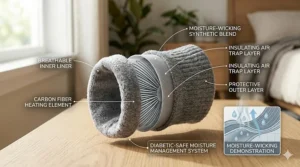
The material your socks are made from affects four critical factors for diabetic foot health: moisture management, temperature regulation, pressure distribution, and antimicrobial properties. Let’s break down how different materials perform.
Cotton: The Breathable Baseline
Natural, breathable, widely available, and affordable. Absorbs moisture readily (good for pulling sweat away from skin initially, but then holds that moisture against your foot—not ideal). Loses insulating properties when wet. Provides decent cushioning in thick knit. No natural antimicrobial properties.
Best for: Mild weather, short-duration wear, users who can change socks mid-day if feet sweat. Common in budget options like Falari. Works adequately if you’re diligent about changing socks when damp.
Acrylic: The Insulation Champion
Synthetic fiber that holds warm air effectively without adding excessive weight. Wicks moisture away from skin and dries faster than cotton (though not as fast as high-tech polyester). Maintains insulation even when damp. Can be brushed for extra softness and thermal performance (Heat Holders uses this technique).
Best for: Primary thermal insulation in cold weather socks. Balances warmth and moisture management better than pure cotton. Main fiber in Heat Holders thermal socks.
Alpaca: The Natural Performance Fiber
Hollow-core structure traps air for insulation while maintaining breathability. Wicks moisture 3x better than cotton. Temperature-regulating—warm when cold, breathable when moderate. Hypoallergenic (no lanolin like wool). Natural antimicrobial properties resist odor. More durable than cotton; maintains performance longer.
Best for: Users who can invest in premium performance and want maximum moisture management. Ideal for sensitive skin prone to irritation. Warrior Alpaca uses this as primary fiber.
Polyester Blends: The Moisture-Wicking Workhorses
High-tech polyester (like CoolMax) wicks moisture very effectively and dries 5x faster than cotton. Blending polyester with cotton combines cotton’s natural feel with polyester’s performance. Adds durability and maintains shape better than pure natural fibers.
Best for: Active users who generate sweat from movement. Good for all-day wear requiring consistent dryness. Common in mid-range options combining performance with affordability.
Elastane/Spandex: The Fit Improvers
Small percentages (5-12%) improve fit and shape retention without adding compression. Helps socks stay up without tight elastic bands. Allows stretch for easier donning without becoming baggy.
Best for: Diabetic users who need proper fit without tight constriction. Essential in modern sock design—you’ll find it in almost all quality options.
What to Avoid:
100% synthetic materials without moisture-wicking design—they trap sweat against skin. Pure nylon or cheap polyester without technical features tends to perform poorly. Materials with heavy finishes or coatings that prevent breathability. Rubber or plastic components that could create pressure points. Anything advertised as “compression” unless specifically prescribed by your doctor for a particular circulatory condition.
The best diabetic socks use blends strategically: cotton or natural fiber touching skin for comfort, synthetic moisture-wicking layer pulling sweat away, insulating layer trapping warm air, outer layer protecting against abrasion. This is why quality matters—cheap socks use whatever’s available, while engineered diabetic socks thoughtfully combine materials for specific performance.
Real User Case Study: Finding the Right Warmth Solution for Different Diabetic Profiles
Let me walk you through three real-world scenarios showing how different diabetic users matched their situation to the right heated sock solution.
Profile 1: Margaret, 68, Type 2 Diabetes, Moderate Neuropathy
Monofilament test: Failed at 3 of 10 test points on both feet. Circulation: Mild peripheral arterial disease, confirmed by ankle-brachial index test. Activity: Walks 30 minutes daily outdoors, lives in Michigan with winter temperatures averaging 25°F.
Margaret’s podiatrist specifically advised against any electric heated products due to failed sensation testing. She tried Heat Holders Thermal Socks first, finding them adequate for her daily walks in temperatures above 30°F, but struggled during particularly cold days (below 20°F) when her feet remained uncomfortably cold despite the socks.
Solution: She upgraded to Gilbin Thermal Insulated socks for extreme cold days (saving Heat Holders for moderate days), and sized up her winter boots by half a size to accommodate the thicker Gilbin socks without pressure. She also started her walks at mid-day rather than early morning when temperatures peak, reducing cold exposure time. After 3 months, she reports consistent comfort without any heat-related skin issues.
Key takeaway: Moderate neuropathy requires multiple sock options for different conditions, plus strategy adjustments (timing walks for warmest part of day, proper footwear sizing). Electric heating wasn’t an option due to sensation loss, but graduated thermal solutions from Heat Holders (daily) to Gilbin (extreme cold) provided adequate warmth safely.
Profile 2: James, 52, Type 1 Diabetes, No Neuropathy
Monofilament test: Passed all test points with normal sensation. Circulation: Good, no peripheral arterial disease detected. Activity: Ice fisherman, sits outdoors for 4-6 hours in temperatures often below 0°F.
James has normal sensation but faces extreme cold exposure that passive heating can’t handle. His podiatrist approved electric heated socks with specific safety protocols: start at lowest setting, never exceed 104°F, visual foot inspection every hour, immediate removal if any redness develops.
Solution: He purchased VIVASTYLE 2026 heated socks for the 14-16 hour battery life at low settings, essential for all-day fishing trips. He sets the APP to 100°F maximum and programs a 90-minute auto-shutoff (checking and restarting manually rather than leaving unattended). He wears Heat Holders thermal socks as a liner under the electric socks, creating a barrier that distributes heat more evenly and prevents direct contact with heating elements.
After a full season using this setup, he reports maintaining comfortable warmth in temperatures down to -10°F without any skin issues. He credits the layering approach and disciplined temperature monitoring for safe use.
Key takeaway: Normal sensation and extreme cold exposure make electric heated socks appropriate, but only with careful protocols. APP control for temperature limiting is essential. Layering thermal socks under electric socks improves safety and comfort.
Profile 3: Linda, 74, Type 2 Diabetes, Severe Neuropathy and Poor Circulation
Monofilament test: Failed at all test points on both feet—complete loss of protective sensation. Circulation: Significant peripheral arterial disease, has had revascularization surgery on one leg. Activity: Limited mobility, spends most time indoors but feet are constantly cold even in 72°F house.
Linda represents the most challenging scenario—her feet feel cold constantly because both nerve damage and circulation problems combine to create severe temperature dysfunction. Her podiatrist was emphatic that electric heating is absolutely contraindicated due to complete sensation loss.
Solution: Warrior Alpaca thermal diabetic socks for daily wear, providing maximum passive warmth with superior moisture management to prevent fungal infections (a particular concern with her compromised circulation). Indoor sheepskin slippers worn over the socks for additional insulation without compression. She also works with her doctor on medications to improve circulation and tight blood sugar control to prevent further neuropathy progression.
Importantly, her podiatrist suggested warm (not hot) foot soaks at 100°F for 10 minutes twice daily, using a thermometer to verify water temperature rather than relying on sensation. This provides some relief from the constant cold sensation while being safer than attempting electric socks.
Key takeaway: Severe neuropathy with poor circulation eliminates electric heating as an option and requires maximum-quality passive heating. Combining premium thermal socks with temperature-controlled warm soaks (verified by thermometer) provides safe relief. Medical management of underlying circulation and blood sugar is equally important as sock selection.
FAQ: Your Most Common Questions About Diabetic Safe Heated Socks
❓ Can I sleep in heated socks if I have diabetes?
❓ How hot is too hot for diabetic feet?
❓ Are thermal socks as warm as electric heated socks?
❓ Do I need a prescription for diabetic heated socks?
❓ Can heated socks improve circulation in diabetic feet?
Conclusion: Staying Warm Safely is Possible with the Right Approach
Diabetic peripheral neuropathy and circulation problems make cold feet a constant companion for millions of people managing diabetes, but staying warm safely doesn’t require choosing between comfort and foot health—it requires understanding which warming products work with your body’s limitations rather than against them.
The fundamental principle: passive thermal insulation that traps your body’s heat is safer than active electric heating that applies external heat your feet may not be able to sense accurately. For most diabetic users, quality thermal socks from Heat Holders, Warrior Alpaca, Falari, or Gilbin provide adequate warmth for typical winter conditions without any burn risk.
If extreme cold exposure or severe circulation problems make passive heating inadequate, electric heated socks can be used safely—but only with confirmed intact sensation, temperature monitoring capability via APP controls, strict adherence to safe temperature limits (≤104°F), and visual foot inspection protocols that most people aren’t prepared to maintain consistently.
The best strategy is layered: invest in 7+ pairs of quality thermal socks as your primary warmth solution for daily wear and typical conditions. Add a single pair of premium electric heated socks if you face exceptional cold exposure, using them sparingly and cautiously rather than as your go-to option. Combine sock choice with proper footwear sizing (don’t cram thick socks into tight shoes), daily foot inspection, regular podiatrist visits, and ongoing blood sugar management to slow neuropathy progression.
Your feet can’t fully protect themselves anymore—that’s the reality of diabetic neuropathy. But with informed product selection and disciplined safety practices, you can maintain warmth and comfort through winter while minimizing the risks that come with reduced sensation. Start conservative (thermal socks), test thoroughly (home trials before field use), monitor consistently (daily foot checks), and adjust as needed (annual sensation testing to guide decisions).
Cold feet are manageable. The key is respecting your limitations while using products designed specifically for those limitations, rather than trying to make standard heated products work for a medical situation they weren’t designed to handle.
Recommended for You
- 7 Best Men’s Heated Socks for Work Boots 2026 Guide
- Women’s Heated Socks Size Guide: 7 Top Picks for Perfect Fit 2026
- 7 Best Heated Socks for Steel Toe Boots That Actually Work 2026
Disclaimer: This article contains affiliate links. As an Amazon Associate, I earn from qualifying purchases. If you purchase products through these links, we may earn a small commission at no additional cost to you.
✨ Found this helpful? Share it with your friends! 💬🤗
