
In This Article
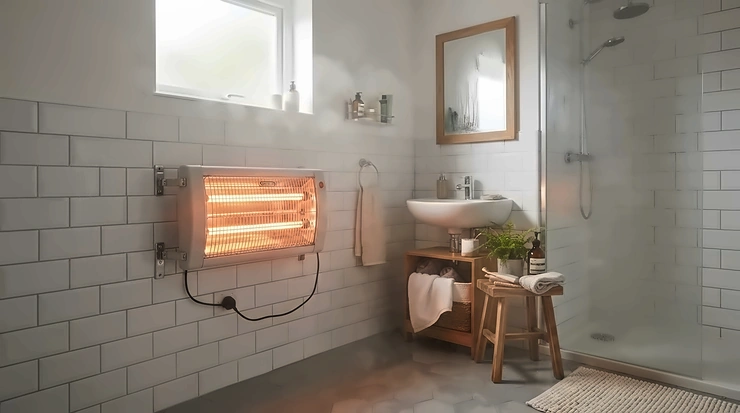
A bathroom heater for mobile home use is a small, safety-listed electric heater, usually a recessed wall unit or a ceiling heater, fan and light combo. It is sized for a compact bathroom, shaped to fit thin wall framing, and installed with manufactured home venting rules in mind. It delivers warmth in minutes, with no ductwork required.
Mobile home bathrooms are a special kind of cold. The walls are slimmer than in a stick-built house. The room is often a narrow rectangle at the far end of the floor plan. And the floor can feel like a hockey rink on a January morning. It’s mid-November 2026 right now, which is exactly when the first frosty shower sends people shopping. A well-chosen bathroom heater for mobile home bathrooms fixes that, provided it clears three hurdles. It has to physically fit, it has to respect your circuit, and it can’t undermine ventilation.
That last hurdle is regulated. Under HUD’s construction standards, each bathroom needs a local exhaust system that can move 50 cfm to the outside of the home, as spelled out in 24 CFR 3280.103. A heater that ignores moisture trades a cold bathroom for a mildewy one.
This guide compares seven real models across wall and ceiling formats. It leans toward any low profile bathroom heater for manufactured home walls and every compact heater for narrow mobile home bathroom layout. Everything here comes from published specs and aggregated retailer-review signals, not hands-on testing, so treat it as analysis rather than a lab report. Each pick gets a plain-English read on what the numbers mean for your wall, your breaker, and your morning routine.
Quick Comparison: 7 Bathroom Heater for Mobile Home Options at a Glance
Here is the whole field in one table, before we dig into each model.
| Model | Type | Output | Voltage | Key Fit Detail | Price Range | Best For |
|---|---|---|---|---|---|---|
| Cadet Com-Pak Plus CSC151TW | Recessed wall | 1500W / ~5,118 BTU | 120V | Com-Pak can, ~4″ rough-in | ~$130-$160 | Budget buyers with a strong circuit |
| Cadet Com-Pak Bath CBC103TW | Recessed wall | 1000W / ~3,415 BTU | 120/240V | ~4″ rough-in, 60-minute timer | ~$175-$200 | Small baths on shared circuits |
| Broan 174 | Recessed or surface wall | 750/1500W | 120V (convertible) | Surface-mount option | ~$200-$250 | Circuit-limited homes |
| Broan-NuTone BHFLED80 | Ceiling heater/fan/light | 1300W, 80 CFM | 120V | Fits 2×6 ceiling construction | ~$150-$200 | Replacing a tired exhaust fan |
| Broan-NuTone 9815WH | Recessed wall | 1500W / 5,120 BTU | 120/240V | 3-3/8″ housing depth | Mid-$100s to mid-$300s | Bigger or draftier bathrooms |
| Dimplex T23WH1511CA | Wall insert | 1500W | 120V | Made for 2×3 framing | Check current price | True 2×3 walls |
| Qmark SED1512 | Shallow wall | 1500W / ~5,118 BTU | 120V | Marketed for manufactured homes | Low-to-mid $300s | Tightest wall cavities |
Looking at the table, the Cadet Com-Pak Plus CSC151TW delivers the most heat for the least money, but its 12.5-amp draw demands a healthy circuit. The 1000-watt Cadet Com-Pak Bath CBC103TW gives up about a third of that output in exchange for friendlier amperage. If a true compact footprint inside thin wall framing is the priority, the Dimplex T23WH1511CA and Qmark SED1512 are the specialists. The Broan-NuTone BHFLED80 only makes sense when your ceiling cavity cooperates. Confirm every depth figure against the manufacturer’s current spec sheet, because retailer listings sometimes disagree.
💬 Just one click — help others make better buying decisions too!😊
Top 7 Bathroom Heater for Mobile Home Picks: Expert Analysis
Prices below are ranges from supplier listings at the time of research. They move constantly, so check current price before buying. Review notes are aggregated signals from retailer pages. Where a model has no verifiable review base, we say so instead of guessing.
1. Cadet Com-Pak Plus CSC151TW — budget workhorse with a familiar wall can
The standout is familiarity. This 1500-watt, 120-volt fan heater uses the same Com-Pak wall can Cadet has sold for years, so swapping an old unit rarely turns into a drywall saga.
It draws about 12.5 amps and puts out roughly 5,118 BTU. That is generous for a bathroom well under 100 square feet, and Cadet notes it can also be installed in a ceiling. The catch is your wiring. 12.5 amps sits above the 12-amp mark (80% of a 15-amp circuit) that electricians respect for long run times.
Based on the spec comparison, this model suits owners replacing an existing Com-Pak or running a new dedicated circuit. If you’re stuck on a shared 15-amp line, the Cadet Com-Pak Bath CBC103TW below is the calmer choice. What most buyers overlook is depth. The Com-Pak family lists a rough-in near 4 inches, so measure your cavity before cutting.
Reviewers on a supplier page (about a dozen ratings at the time of research) describe it warming a bathroom with no central heat. One notes an earlier identical unit’s thermostat failed before they bought another. That is a useful reminder that the built-in thermostat is the part to watch.
Pros:
- ✅ Familiar Com-Pak can simplifies like-for-like swaps
- ✅ 1500W heats small baths quickly
- ✅ Made in USA, with a ceiling-install option
Cons:
- ❌ 12.5A draw strains shared 15A circuits
- ❌ Roughly 4-inch rough-in is deep for slim walls
Price: around $130-$160. Strong value if your wiring can handle it.
2. Cadet Com-Pak Bath CBC103TW — bathroom-specific timer and rust-resistant element
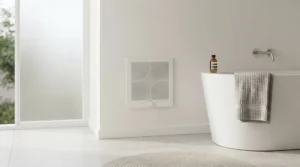
Unlike its siblings, this one was designed for steamy rooms. A built-in 60-minute auto-timer overrides the thermostat for instant warmth, then hands control back.
At 1000 watts it draws about 8.3 amps at 120 volts and makes roughly 3,415 BTU. Cadet’s own class rating is up to about 125 square feet. A typical 5×8 bathroom is 40 square feet, so this is a comfortable fit for a compact heater for narrow mobile home bathroom layouts. The painted heating element is designed to resist rust in damp air, and a high-temperature shutoff adds a safety net.
The honest take: it’s the sensible default for retirees, renters and anyone sharing a 15-amp circuit with a fan and light. Two details matter, though. Cadet says the unit should not be paired with a wall thermostat. Its rough-in is listed at 8″ wide by 10-1/8″ tall by 4″ deep, so verify the depth. Cadet also says wall heaters must be cleaned at least every six months.
On a supplier page, the sample is small (eight ratings at the time of research). One verified buyer replacing a 1950s-era heater said they liked it.
Pros:
- ✅ Timer delivers instant warmth, then thermostat resumes
- ✅ Only about 8.3 amps at 120V
- ✅ Painted element built for humid rooms
Cons:
- ❌ 1000W recovers slowly in very cold baths
- ❌ Can’t be paired with a wall thermostat
Price: around $175-$200. Fair value for a bathroom-specific design.
3. Broan 174 — switchable wattage for tight circuits
Flexibility is the headline. This fan-forced heater is factory-wired for 1500W at 120V, but it converts to 750W at 120V or 1500W at 240V.
Dropping to 750 watts cuts the draw to roughly 6 amps. That could be the difference between a clean install and a tripping breaker in an older home. It also mounts either recessed or surface-mounted (the latter needs the Model 84 kit). In thin wall framing, that surface option gives you a fallback when recessing is a no-go. Broan describes its alloy element as warming up in seconds, and the line is positioned as supplemental heat rather than a whole-room replacement.
For an older single-wide, that adjustability is the spec worth paying for. We couldn’t verify the unit’s rough-in dimensions from retailer listings, so pull the installation manual before purchasing. Treat any depth claim you see online as unconfirmed until you do.
The supplier page showed no ratings at the time of research, so there is no verifiable review sentiment here.
Pros:
- ✅ Choose 750W or 1500W at installation
- ✅ Recess or surface-mount flexibility
- ✅ Fast-warming alloy element
Cons:
- ❌ No verifiable review base yet
- ❌ Surface mounting needs a separate kit
Price: around $200-$250. Good value for circuit-limited homes.
4. Broan-NuTone BHFLED80 — heater, fan and light in one ceiling cut
Think of this as three jobs for one hole. It combines a 1300-watt heater, an 80 CFM fan at 1.5 sones, and a dimmable LED with three color temperatures (2700K, 3500K, 5000K).
Retailers cite coverage for bathrooms up to about 75 square feet, and it fits 2×6 ceiling construction with a 4-inch duct. Broan lists it as the suggested replacement for the discontinued 655. At 80 CFM it clears the 50 cfm federal baseline with room to spare, which makes it a neat answer to manufactured home venting if your old fan is dead. The heater warms from above, and Broan’s older 655 instructions advise aiming heat at the tub or shower area, away from walls.
The caution is the ceiling. Many manufactured home roofs have shallow cavities, so confirm clearance before ordering. The older 655 required a dedicated 20-amp circuit, so check this model’s manual for its circuit requirement too.
One retailer listing showed roughly 4.4 stars across nearly 2,000 reviews at the time of research. Buyers commonly mention quiet operation and a heater that works well. One suggests sealing the damper baffle with aluminum HVAC tape.
Pros:
- ✅ Heat, ventilation and light share one opening
- ✅ 80 CFM exceeds the 50 cfm federal minimum
- ✅ Quiet 1.5 sones operation
Cons:
- ❌ Needs ceiling depth many roofs lack
- ❌ Circuit and duct work can be more involved
Price: around $150-$200. Excellent value if the ceiling allows it.
5. Broan-NuTone 9815WH — high-output heat in a 3-3/8-inch housing
This is the muscle pick. A 1500-watt element sits inside a housing measuring 12-1/2″ tall by 10-1/2″ wide by 3-3/8″ deep.
That depth is a hair under the 3-1/2 inches in a true 2×4 wall, so it works with thin wall framing that cannot swallow a 4-inch can. It draws 13 amps at 120V or 6.5 amps at 240V, produces about 5,120 BTU, and includes an adjustable thermostat plus a thermal fuse. Broan sells a 1000W sibling, the 9810WH, for smaller rooms.
Broan pitches this one for lobbies, entryways and other high heat-loss areas. In a narrow bathroom it can overshoot, so it fits best in a larger, draftier bath, or one with an exterior door. If your panel allows 240V wiring, the amperage is cut in half. That is a job for a licensed electrician.
A supplier page shows nine ratings, but we could not verify written review content, so no sentiment summary is offered.
Pros:
- ✅ Slim 3-3/8″ housing suits standard 2×4 cavities
- ✅ Wires for 120V or 240V
- ✅ Thermal fuse backs up the thermostat
Cons:
- ❌ Overpowered for very small bathrooms
- ❌ Draws 13A at 120V
Price: sellers vary widely, from the mid-$100s to the mid-$300s, so shop carefully. Value is best at the lower end.
6. Dimplex T23WH1511CA — built for 2×3 stud bays
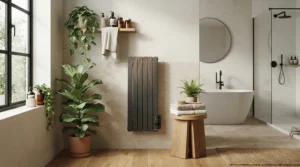
The headline is the framing. Retail listings describe this 1500W, 120V insert as a “small 2×3” wall heater, built for walls too slim for bulkier units.
It uses a finned tubular element, and the product page says a thermostat control, wall-mounted or built-in, is required to operate it. Dimplex’s 17-inch 1000W sibling, the T23WH1011CA, is described by one retailer as recessing into spaces as shallow as 3 inches. That makes the family a natural fit for a low profile bathroom heater for manufactured home walls that older units can’t enter.
The analysis comes with a caution. The “CA” suffix suggests a Canadian-market model, so confirm the listing’s US availability, voltage and safety markings before ordering. Also confirm whether your version includes the thermostat or needs one added.
We found no verifiable review content, so the real-world sentiment is simply unknown.
Pros:
- ✅ Designed around slim 2×3 framing
- ✅ Finned tubular element built for longevity
- ✅ 1000W sibling suits tiny baths
Cons:
- ❌ US availability and listing need checking
- ❌ Thermostat may be a separate purchase
Price: check current price, since we couldn’t verify a stable range. Worth it only if slim framing is your problem.
7. Qmark SED1512 — shallow-wall design aimed at manufactured homes
This is the specialist. Supplier listings describe the 1500W, 120V Qmark SED line as ideally suited to recessed, shallow-wall applications such as manufactured homes.
It draws 12.5 amps, makes about 5,118 BTU, and has a 14-1/2″ by 10-1/2″ grille. It uses a fast-response coil element, and both recess and surface kits are offered. Here’s the wrinkle: one supplier lists a 3-3/4″ depth, while listings for the 240V sibling and similar units show about 2-3/8″ to 2-1/2″. Measure against the manufacturer’s current spec sheet before you cut.
That ambiguity matters. This is the choice when thin wall framing is your binding constraint, and it costs more than the Com-Pak line because of it. The “manufactured homes” positioning is the maker’s own claim, so verify the fit.
A supplier page showed five ratings. A reviewer of the 240V sibling reported an easy install in a flat 2×4 wall.
Pros:
- ✅ Marketed for shallow manufactured home walls
- ✅ Fast-response coil element
- ✅ Recess or surface-mount options
Cons:
- ❌ Costs noticeably more than Com-Pak units
- ❌ Conflicting depth listings require measuring
Price: low-to-mid $300s. Premium value, justified only when depth rules out the others.
Side-by-Side Specs
| Model | Watts | Amps (120V) | Depth / Fit | Mount | Review Signal | Best For |
|---|---|---|---|---|---|---|
| Cadet Com-Pak Plus CSC151TW | 1500 | 12.5 | ~4″ rough-in | Wall / ceiling | ~12 ratings, small sample | Budget swaps |
| Cadet Com-Pak Bath CBC103TW | 1000 | 8.3 | ~4″ rough-in | Wall | ~8 ratings, small sample | Shared circuits |
| Broan 174 | 750/1500 | ~6.3 / ~12.5 (calculated) | Verify in manual | Wall (recess/surface) | None verifiable | Tight breakers |
| Broan-NuTone BHFLED80 | 1300 + fan | Verify in manual | 2×6 ceiling | Ceiling | ~4.4 stars, ~2,000 reviews (retailer) | Fan replacement |
| Broan-NuTone 9815WH | 1500 | 13 | 3-3/8″ | Wall | Content unverified | Larger baths |
| Dimplex T23WH1511CA | 1500 | ~12.5 (calculated) | 2×3 framing | Wall insert | None found | Slim walls |
| Qmark SED1512 | 1500 | 12.5 | 2-1/2″ to 3-3/4″ (conflicting) | Wall (recess/surface) | ~5 ratings, small sample | Shallow cavities |
The table makes one pattern obvious: amperage and depth are the real differentiators, not wattage. Anyone on a shared circuit should start with the Cadet Com-Pak Bath CBC103TW or the Broan 174 in 750W mode. Anyone fighting wall depth should start with the Qmark SED1512 or the Dimplex T23WH1511CA. Treat the “calculated” figures as arithmetic (watts divided by 120 volts), not manufacturer claims.
Manufactured Home Venting: What the Federal Rules Mean for Your Heater
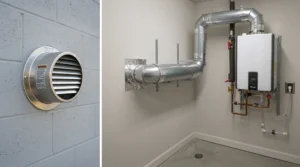
Manufactured home venting is the part of this purchase most people skip. It’s also the part that keeps your walls dry.
The 50 cfm baseline
HUD’s standard requires each bathroom and separate toilet compartment to have a local exhaust system capable of moving 50 cfm to the outside, per the Cornell Legal Information Institute’s copy of 24 CFR 3280.103. A wall heater doesn’t change that. It adds warmth but removes no moisture, so it works alongside your existing fan rather than replacing it.
Intake and exhaust separation
A 2013 GAO report on HUD Code ventilation noted that HUD’s rules required a minimum 3-foot separation between air intakes and exhaust vents. Industry standards for site-built homes had long required more, and updates were then under consideration. Rules can change, so confirm current requirements with your installer or local authority.
Where your heater fits in
If you choose a ceiling combo like the Broan-NuTone BHFLED80, the duct must terminate outdoors. Never terminate it into an attic or underfloor space, where it becomes a moisture trap. A wall unit such as the Cadet Com-Pak Plus CSC151TW needs no duct at all, which simplifies things. Keep the exhaust fan you already have, and run it during and after showers.
Thin Wall Framing: Will It Actually Fit?
Thin wall framing is the reason a perfectly good heater can become a perfectly useless one. Many manufactured homes use slimmer studs than conventional houses. Nominal 2×3 lumber is about 2-1/2 inches deep and nominal 2×4 about 3-1/2 inches. A heater with a 4-inch can simply won’t recess into either.
Run the numbers on our seven:
- The Broan-NuTone 9815WH at 3-3/8 inches clears a 2×4 cavity by a sliver.
- The Com-Pak family’s roughly 4-inch rough-in needs extra room or a surface-mount approach.
- The Dimplex T23WH1511CA is built for 2×3 walls.
- The Qmark SED1512 has conflicting listings, so measure.
Before you buy, cut a small inspection hole or use a stud finder. Check for plumbing, wiring and insulation in the bay. Cadet’s spec sheet adds one more tip: electric wall heaters work best on an inside wall, not an exterior one.
When recessing isn’t possible, surface mounting is the escape hatch. Cadet sells a Com-Pak surface-mount wall can, and the Broan 174 takes a Model 84 surface kit. Confirm compatibility with your exact model, because accessory fitment varies.
How to Choose a Bathroom Heater for Mobile Home Bathrooms
Choose by fit first, circuit second, and wattage last. A heater that doesn’t fit your wall or breaker is wasted money, however well it heats. Here are the steps, in order.
- Measure the cavity. Record depth, width and height of your stud bay. Compare against the rough-in for any model, especially for thin wall framing.
- Check the circuit. Confirm the breaker size and what else shares it. A 1500W heater draws 12.5 amps; 1000W draws about 8.3.
- Size the wattage. A 5×8 bathroom is just 40 square feet. For a compact heater for narrow mobile home bathroom layouts, 1000W is usually ample.
- Pick wall or ceiling. Wall units are simpler. Ceiling combos solve manufactured home venting if you need a new fan too.
- Confirm listings. Look for UL/ETL markings, a thermal cutoff, and a built-in thermostat or timer.
- Plan the venting. Keep an exhaust path that meets the 50 cfm baseline and discharges outdoors.
- Verify the footprint. A compact footprint matters more than extra watts when space is tight.
Low Profile Bathroom Heater for Manufactured Home: Wall vs Ceiling vs Portable
A low profile bathroom heater for manufactured home walls usually means a recessed or surface-mount wall unit. But a ceiling combo or portable heater can also work. Here’s how the three compare.
| Option | Footprint | Install Effort | Moisture Handling | Best For |
|---|---|---|---|---|
| Recessed wall heater | Very small | Moderate (cut and wire) | Heat only; keep your fan | Permanent upgrades, like the Cadet Com-Pak Bath CBC103TW |
| Ceiling heater/fan/light | Small | Higher (ducting, joists) | Heat plus exhaust | Fan replacements, like the Broan-NuTone BHFLED80 |
| Portable heater | Floor space | None | Risky in wet rooms | Short-term, supervised use only |
Reading the table, wall units deliver the best balance of simplicity and compact footprint. Ceiling combos deserve the extra effort only when your fan is failing anyway. Portable heaters sound easy, but cords, tip-overs and water make a bathroom a poor home for them, so follow each product’s instructions closely.
For most owners, a recessed wall unit is the smartest low profile bathroom heater for manufactured home construction. If you can’t recess, a surface-mount heater is the next best low profile bathroom heater for manufactured home walls, and it’s still far safer than a floor-standing space heater.
Compact Heater for Narrow Mobile Home Bathroom: Layout and Placement Guide
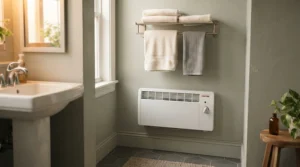
A compact heater for narrow mobile home bathroom use lives or dies on placement. In a room barely wider than a tub, a few inches decide whether heat reaches you or just your towel.
Aim heat where you stand. Broan’s older 655 instructions recommended directing a ceiling heater’s heat toward the tub or shower area, away from walls and windows. The same logic applies to wall units. Place them where air can sweep across the space you actually use, not into a corner.
Mind the mounting height. The Cadet Com-Pak Bath CBC103TW lists a minimum mounting height of about 4-7/16 inches from the floor. Keep towels, curtains and bath mats clear of any grille.
Stay out of the splash zone. Follow each manual’s clearance rules, and never install a heater in a tub or shower enclosure. Broan’s older 655 manual says this explicitly.
Use the inside wall. Cadet notes wall heaters work best on interior walls. In a narrow mobile home bathroom, that often means the wall shared with a closet or hallway.
Think in layers. A compact heater for narrow mobile home bathroom use shouldn’t fight the fan. Run the exhaust to clear steam, and run the heater on a timer to take the chill off.
Practical Usage Guide: Installing and Maintaining Your Heater
Installation is where a good heater becomes a safe one. Hire a licensed electrician if you’re unsure. This is hardwired equipment, and manufactured home wiring has its own quirks.
Before you start:
- Switch off the breaker and verify with a tester.
- Confirm the circuit size and what else is on it.
- Check your park or HOA rules.
- Read the installation manual. Voltage settings matter, and the Cadet Com-Pak Bath CBC103TW must be configured for the correct voltage before it’s installed.
First-use tips:
- Expect a faint “new heater” smell the first time, and ventilate the room.
- Run it briefly, then check the grille and wall for unusual heat.
- Set the thermostat low and raise it gradually.
Maintenance schedule: Cadet says its Com-Pak Bath heater must be cleaned at least every six months. Put a reminder on your phone. Vacuum the grille with the power off, and check for rattles or odd smells.
Common mistakes in the first 30 days:
- Draping towels near the grille.
- Leaving the unit running for hours.
- Ignoring a warm breaker panel, which signals an overloaded circuit.
Real-World Scenarios: Matching Heaters to Your Home
Specs only matter in context. Here are three profiles with a budget, an environment and a usage pattern.
Scenario 1: The retiree in a 1990s single-wide. A 5×8 bath sits on a shared 15-amp circuit. The budget is modest, and the heater runs about 20 minutes a day. The Cadet Com-Pak Bath CBC103TW fits well. Its 8.3 amps leave headroom, and the timer prevents forgetting it on.
Scenario 2: The family of four in a double-wide. The second bath has an exterior wall, a dying fan and a free 20-amp line. Showers happen four times daily. The Broan-NuTone BHFLED80 gives them heat and 80 CFM of ventilation in one cut, if the ceiling cooperates. If it doesn’t, the Cadet Com-Pak Plus CSC151TW is the fallback.
Scenario 3: The renovator with 1970s 2×3 walls. Every recess option is too deep, but the budget is flexible. The Dimplex T23WH1511CA or Qmark SED1512 solves the geometry, provided you verify listings and depth first.
✨ Ready to Warm Up That Chilly Bathroom?
🔍 Click any highlighted product name to check current pricing and availability. Pick the heater that matches your wall, your breaker and your routine, and make winter mornings something you don’t dread! 🛁
Compact Footprint Features That Actually Matter (And Those That Don’t)
A compact footprint is only useful if the features packed inside it do real work. Here’s how to filter marketing from substance.
Features that matter:
- Thermal cutoff or fuse. The Broan-NuTone 9815WH uses a thermal fuse, and the Cadet Com-Pak Bath CBC103TW has a high-temperature shutoff. This is your safety net.
- Built-in timer or thermostat. A timer prevents “I forgot it was on” moments.
- Voltage flexibility. 120/240V wiring (the Broan-NuTone 9815WH) or selectable wattage (the Broan 174) lets you fit older circuits.
- Rough-in depth. Honestly the most important spec for thin wall framing.
- A rust-resistant element. A painted element like the Cadet Com-Pak Bath CBC103TW is built for humid air.
Features that matter less:
- Color-adjustable LED lighting. Nice on the Broan-NuTone BHFLED80, but it won’t change how warm you are.
- Bigger BTU numbers. A 1500W heater in a 40-square-foot bathroom is more than most people need.
- Fancy grilles. Choose the heater for how it fits, not how it looks.
Common Mistakes When Buying a Bathroom Heater for Mobile Home Bathrooms
Most buyers don’t get the heater wrong. They get the context wrong.
- Buying by wattage alone. More watts isn’t better if the circuit can’t carry it. A 1000W unit often outperforms a 1500W unit that trips the breaker.
- Ignoring can depth. A 4-inch rough-in won’t recess into 2×3 framing. Measure first.
- Assuming a heater replaces the fan. Wall heaters add warmth only. HUD’s 50 cfm requirement for manufactured home venting still applies.
- Forgetting the circuit. Check what else shares the breaker before installing anything.
- Using a portable heater as a shortcut. Water, cords and tip-overs make this a poor trade.
- Skipping the electrician. Voltage settings, wire gauge and breaker sizing aren’t DIY guesswork.
- Trusting a single listing. Depth and spec figures conflict between retailers. Always check the manufacturer’s spec sheet.
Long-Term Cost and Maintenance
The sticker price is the smallest part of owning a heater. Operating cost is tiny, and maintenance is cheap, so the real expense is a bad fit.
Running cost, as an illustration. Suppose you run a 1000W heater for 30 minutes a day, or a 1500W heater for 20 minutes. Either uses about 0.5 kWh daily, or roughly 15 kWh a month. At an assumed 17 cents per kWh, that’s around $2.50 a month. Plug in your own rate, because utility prices vary by state.
Maintenance. Cadet requires cleaning its Com-Pak Bath heater at least every six months. Dust is the enemy of every fan-forced unit. Thermostats are the most common failure point, as one reviewer of the Cadet Com-Pak Plus CSC151TW noted.
Warranty. Supplier listings show about three years on the Cadet Com-Pak Bath CBC103TW and one year on the Broan-NuTone 9815WH. Verify the warranty at purchase.
Right-sizing is the saving. Cadet’s guidance on electric heating for tiny homes and RVs suggests treating spots like the bathroom as places for temporary heat boosts. A timer-equipped heater lets you do exactly that, instead of heating the whole house to chase one cold room.

FAQ
❓ How many watts do I need for a bathroom heater for mobile home use?
❓ Can a ceiling heater fan replace my mobile home bathroom fan?
❓ Is a recessed wall heater safe near a shower in a manufactured home?
❓ Will a 1500 watt heater trip my mobile home breaker?
❓ How often should I clean a bathroom wall heater?
Conclusion
Choosing a bathroom heater for mobile home bathrooms comes down to three questions. Does it fit your wall? Does it respect your circuit? Does it leave your ventilation intact?
For most owners, the Cadet Com-Pak Bath CBC103TW is the sensible default. It draws just 8.3 amps, has a bathroom-specific timer, and suits a compact heater for narrow mobile home bathroom layouts. If your wiring is strong and you want faster warmth, the Cadet Com-Pak Plus CSC151TW is the budget heavyweight. The Broan 174 helps when breakers are tight, and the Broan-NuTone BHFLED80 makes sense when you need a new fan anyway.
When thin wall framing is the obstacle, the Broan-NuTone 9815WH, Dimplex T23WH1511CA and Qmark SED1512 are worth the extra money. Whichever you choose, measure twice, verify specs against the manufacturer’s sheet, and keep your manufactured home venting working. A low profile bathroom heater for manufactured home walls only pays off when it also respects the room’s moisture. And a compact footprint is a feature, not a compromise, so pick the one that fits.
Recommended for You
- Bathroom Heater For Seniors With Fast Warm Up: 7 Safe Picks 2026
- Heated Seat Cushion For Sciatica Relief: 7 Best Picks (2026)
- Heated Stadium Seat Cushion For Outdoor Games: 7 Best Picks For 2026
Disclaimer: This article contains affiliate links. As an Amazon Associate, I earn from qualifying purchases. If you purchase products through these links, we may earn a small commission at no additional cost to you.
✨ Found this helpful? Share it with your friends! 💬🤗
