
In This Article
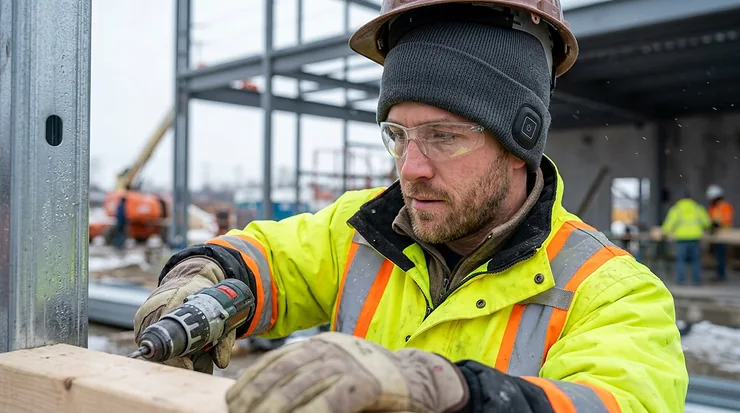
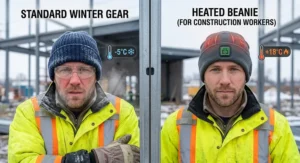
Standing on a half-built frame at 6 a.m. in January, the cold doesn’t politely wait for your coffee to kick in — it goes straight for your ears. A regular knit cap helps, but if you’ve ever pulled your hood up over a beanie just to make it through a four-hour pour, you already know passive insulation has a ceiling. That’s where a heated beanie for construction workers earns its keep: a thin battery pack, a couple of carbon-fiber or conductive-thread panels over the ears, and suddenly your 20-minute warmup at the truck turns into actual comfort by minute two.
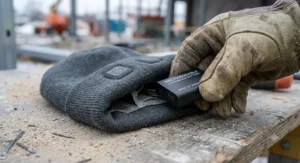
A heated beanie is a knit or fleece-lined cap with a small rechargeable battery (usually 5V or 7.4V) wired to thin heating panels positioned over the ears or across the back of the head, typically offering two to three adjustable heat settings. It’s a category built mostly for skiers, hunters, and dog walkers — which matters, because almost none of them were designed with a hard hat in mind. That’s the first thing worth knowing before you buy, and we’ll get into exactly why below.
This guide compares seven real heated beanies currently sold on Amazon, what their actual customer reviews say (good and bad), and — more usefully — how to figure out which kind of jobsite cold-weather setup will actually work for you instead of ending up balled up in your truck’s glove box by February.
💬 Just one click — help others make better buying decisions too!😊
✨ Don’t Miss These Exclusive Deals!
🔍 Check current pricing and availability on any of the picks below — Amazon prices shift often, so it’s worth a quick look before you decide.
Quick Comparison Table
| Product | Battery | Heat Settings | Heat Zone | Best For | Approx. Price Range* |
|---|---|---|---|---|---|
| ActionHeat 5V Heated Winter Hat | 5V, swappable power bank | 3 (Low/Med/High) | Ears | Budget warmth, non-hard-hat work | $30–$45 |
| Gobi Heat Summit 2-Zone Beanie | 7.4V 3000mAh, doubles as phone charger | 3 | Ears | All-day premium comfort | $55–$70 |
| ARRIS Heated Hat with LED Light | 7.4V 2500mAh | 3 + 3 light modes | Ears | Pre-dawn/dusk visibility | $30–$40 |
| SVPRO Rechargeable Heated Beanie | 7.4V 2200mAh | 3 | Ears | First-time buyers, light cold | $20–$30 |
| Autocastle 7.4V Heated Hat | 7.4V 2200mAh | 3 | Ears (dual-layer) | Value pick, longer low-setting runtime | $20–$30 |
| Rabbitroom Heated Beanie Hat | 7.4V 2200mAh | 3 | Ears | Larger heads, occasional use | $20–$30 |
| DUKUSEEK Heated Hat | 7.4V (1 Li-Po cell) | 3 | Ears | No-frills backup or gift | $20–$28 |
*Prices fluctuate constantly on Amazon — treat these as rough positioning, not quotes, and check the current listing before buying.
Looking at the table, the split is pretty clean: five of these seven sit in a tight budget cluster built around the same 7.4V/2200mAh battery platform, which tells you that battery capacity alone won’t differentiate your choice — fit, ear coverage, and how the battery pack sits against your head matter more. The Gobi Heat Summit is the outlier on price, but it’s also the only one using conductive thread instead of a rigid panel, which is the difference between “I can feel a hard patch by my ear” and “I forgot I’m wearing a heated hat.” If budget is the only filter, Autocastle edges out SVPRO and Rabbitroom slightly on documented low-setting runtime, but realistically any of the five budget options will perform similarly.
Top 7 Heated Beanies for Construction Workers — Expert Analysis
1. ActionHeat 5V Battery Heated Winter Hat
ActionHeat is one of the more established names in battery-heated apparel, and their hat uses thin carbon-fiber panels over each ear powered by a separate 5V power bank rather than a battery sewn into the hat itself. In practice, that detachable power bank is a real advantage: you can swap a depleted bank for a charged spare mid-shift without taking the hat off, something none of the sewn-in-battery options on this list let you do. It heats up in under 10 seconds and tops out around 130°F on high, dropping to roughly 95°F on low for longer runtime.
Here’s the catch construction buyers specifically need to know: real Amazon buyer feedback reports this hat does not fit under a standard hard hat — it was bought for jobsite use and didn’t work for that purpose. That doesn’t make it a bad hat; it makes it the wrong hat for under-hardhat wear, and a fine one for off-hardhat tasks, tailgate breaks, or supervisory roles that aren’t under a hard hat full-time. One review also flagged a noticeable chemical odor when the heat is running, which seems to fade with use but is worth airing the hat out before first wear.
✅ Swappable battery means no mid-shift dead zone, fast heat-up, well-known brand with parts support
❌ Not hard-hat compatible per buyer reports; some units have a break-in odor
Price range: roughly $30–$45. Good value if you’re not wearing a hard hat continuously.
2. Gobi Heat Summit Men’s 2-Zone Heated Beanie
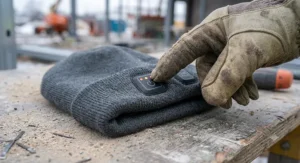
Gobi Heat is a smaller, husband-and-wife-founded heated-apparel company, and the Summit is their flagship beanie. The standout engineering choice here is conductive thread woven directly into the fabric instead of a separate heating pad — there’s no stiff patch to feel against your skull, which matters more than it sounds once you’ve worn a hat for ten hours straight. The 3000mAh battery is rated for up to 7.5 hours of heat and doubles as a USB power bank for your phone, though pulling double duty will eat into your heating runtime.
What most buyers overlook with this one: because the heating elements are woven in rather than glued on, the hat machine-washes (battery removed) without the heating performance degrading the way bonded-panel hats can over repeated washes. That’s a genuine durability edge for a hat that’s going to get sweaty and dirty on a jobsite. It’s also the most expensive hat on this list, which is the tradeoff for comfort and longevity.
✅ No bulky heating panel, washable without performance loss, doubles as a power bank
❌ Highest price point here, not marketed as hard-hat compatible either
Price range: roughly $55–$70. Best for someone who wants one good beanie and is willing to pay for comfort and durability over years of winters.
3. ARRIS Heated Hat with LED Head Light
This is the one product on this list that’s genuinely built with a non-skiing use case in mind. Along with the standard 7.4V 2500mAh battery and 3 heat settings, it has a built-in, removable LED headlamp with three brightness modes. For anyone clocking in before sunrise or working a late pour, that hands-free light is a real, practical feature most heated beanies simply don’t offer — you’re not juggling a separate headlamp on top of your hard hat.
The tradeoff is that it’s doing two jobs (heating and lighting) off one small battery system, so don’t expect marathon runtime if you’re running both functions on high simultaneously. The LED module is detachable for washing, which keeps the practical washability most of these knit hats need.
✅ Hands-free LED light for early/late shifts, detachable components for washing, mid-range price
❌ Running heat + light together will drain the battery faster than either alone
Price range: roughly $30–$40.
4. SVPRO Rechargeable Heated Beanie
SVPRO sits squarely in the budget tier: a 7.4V 2200mAh battery, three heat settings, and a knit-and-fleece shell that’s genuinely warm even with the heat switched off. One real buyer review specifically mentioned buying it for a family member who works outdoors, who reportedly uses the on/off cycling approach — heating up, then switching off once warm to stretch the battery — which is a smart way to extend a 7.4V battery through a full outdoor shift.
This is a reasonable first heated beanie if you’re not sure the category is for you yet and don’t want to spend $50+ to find out. Don’t expect premium comfort touches like Gobi’s woven-in elements; this is a standard glued-panel design, which is fine but means avoid pulling it down hard over the panels repeatedly.
✅ Low price point, warm base fabric even without the heat on, easy on/off cycling for battery management
❌ Standard panel construction, no swappable battery for mid-shift recharge
Price range: roughly $20–$30.
5. Autocastle 7.4V Heated Hat
Autocastle’s hat uses the same 7.4V 2200mAh battery platform as several others here but spreads it across what the company describes as a three-layer heating system. Reported runtimes are roughly 3–4 hours on high, 4–5 on medium, and up to 7 hours on the lowest setting — that low-setting number is genuinely longer than most competitors at this price, which matters if your shift runs long and you’re keeping the hat on low all day rather than blasting high heat in short bursts.
It’s a wind-resistant acrylic-and-fleece build, and like the other budget options here, the heating is concentrated over the ears rather than across the whole scalp — don’t expect your entire head to feel “heated,” just the ear zones.
✅ Strong low-setting runtime, wind-resistant shell, same reliable battery platform as competitors
❌ Heat only covers ear zones, takes up to 7 hours to fully recharge
Price range: roughly $20–$30.
6. Rabbitroom Rechargeable Heated Beanie Hat
Rabbitroom is worth including specifically because its real customer Q&A gives an honest, mixed picture for outdoor workers. Multiple buyers reported purchasing it for a family member who works outside, including one for someone with a larger head size, and both reported it fit and performed as expected through a workday. That’s useful, specific confirmation that the one-size design can work for bigger heads, which isn’t something every listing tells you.
On the other hand, at least one detailed review pushed back hard: the heated zones are small and sit right at the edge of the ears, so if you have thicker hair the heat barely registers, and the bright power-indicator light on the front was called out as both uncomfortably visible at night and a battery-anxiety trigger for workers worried about running out of charge before a shift ends in the dark. If ear coverage and a subtle indicator matter to you, weigh that review carefully against the brand’s “lifetime guarantee” policy, which is a genuine point in its favor if you do have an issue.
✅ Confirmed fit for larger heads in real reviews, lifetime guarantee policy, budget price
❌ Some buyers report heating zones are too small/positioned oddly, bright indicator light can be distracting at night
Price range: roughly $20–$30.
7. DUKUSEEK Heated Hat
DUKUSEEK is the least-documented brand on this list, which itself is useful information: it’s a simpler, more generic option built around the same 7.4V single-cell battery platform as most of the others here, without the brand history, customer support reputation, or detailed reviews that the bigger names have built up. If you want a backup hat, a gift for occasional use, or simply the cheapest functional option to try the category, it fills that role fine. If you’re betting your entire winter on one heated beanie holding up through a full construction season, you’re better served by a brand with a longer track record, like ActionHeat or Autocastle.
✅ Lowest price point on this list, straightforward 3-setting design
❌ Limited track record and reviews compared to other entries here
Price range: roughly $20–$28.
How to Choose a Heated Beanie for Construction Work
- Check hard-hat compatibility first, not last. This is the single biggest gap in the category — most heated beanies are built for skiing and hunting, not for sitting under a hard hat’s suspension all day. If you wear a hard hat continuously, look for a low-profile, thin-knit design and be ready to test fit before committing to a full shift in it.
- Decide if you need swappable battery power. Hats with a detachable power bank (like ActionHeat’s) let you carry a charged spare and never go cold mid-shift. Sewn-in battery hats are simpler but mean you’re done heating once that one battery dies.
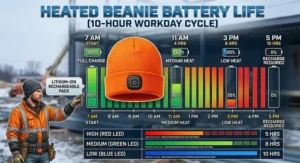
- Match heat settings to your actual exposure, not the marketing number. “Up to 7 hours” almost always means the lowest setting. If you need real warmth in single-digit temps, plan around the 3–4 hour high-setting runtime instead.
- Look at where the heating elements actually sit. Ear-only heating is standard across this category — if you want broader coverage, you’ll be disappointed by every option here, heated beanies included.
- Factor in washability. Jobsite use means sweat and grime. Confirm the battery is removable and the heating elements survive a wash cycle before buying.
- Consider added features only if they solve a real problem you have. A built-in headlamp is genuinely useful for pre-dawn shifts; it’s dead weight if you already carry a headlamp or work daylight hours.
- Buy from a brand with documented reviews and a return policy. Several of these companies are small importers — a visible track record and a real warranty (like Rabbitroom’s lifetime guarantee or ActionHeat’s parts support) matters more here than with mainstream apparel brands.
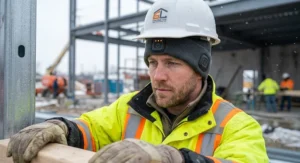
The Hard Hat Problem: Why Most Heated Beanies Don’t Work on the Jobsite
This is the gap nobody selling these hats wants to advertise. Heated beanies are designed almost universally for activities where headwear sits loosely under a hood or helmet liner — skiing, hunting, dog walking. A hard hat’s suspension system, by contrast, needs to clamp snugly against the skull for the hat to do its actual job of absorbing impact, and a beanie with battery bulk or a stiff heating panel can throw that fit off or simply not physically fit underneath.
The practical fix construction crews tend to land on: a thin, low-profile heated skull cap (not a thick cuffed beanie) worn under the hard hat for the commute and breaks, paired with a separate insulated hard-hat liner or winter hard-hat shell for continuous wear during active work. None of the seven products above are marketed specifically as hard-hat liners, so if you need heat while the hard hat is on, test the fit before relying on it for a full shift — and have a backup unheated liner for days the beanie just won’t fit.
Common Mistakes When Buying a Heated Beanie for Work
- Assuming “heated” means your whole head warms up. Every product on this list heats the ears specifically, not the scalp or forehead. If that’s not enough coverage for your conditions, you’ll need to pair it with a heavier outer layer.
- Ignoring battery chemistry warnings. Lithium batteries shouldn’t be left in a hot truck cab or charged unattended overnight — a few real reviews flagged anxiety about leaving these charging, and that caution is reasonable.
- Buying the cheapest option without checking ear-zone placement. As Rabbitroom’s reviews show, a hat that runs slightly large or positions its heating pads oddly can leave you no warmer than an unheated knit cap.
- Skipping the size/fit check for a “one size fits most” claim. Buyers with larger heads have had it work out and not work out across different brands — sizing is genuinely inconsistent in this category, so check head-circumference specs if the listing provides them.
- Forgetting hard-hat compatibility entirely until the first cold morning on site. Test it before the season starts, not on the coldest day of the year.
Heated Beanie vs. Heated Hard Hat Liner vs. Heated Balaclava
A heated beanie covers the ears and sits like a normal knit cap — comfortable, familiar, and easy to wear during breaks, but it’s the format least likely to fit cleanly under a hard hat’s suspension. A heated hard-hat liner is purpose-built to sit between your scalp and the hard hat shell, trading some standalone style for guaranteed compatibility — if your job is 100% under-hardhat, this is usually the better-engineered choice even though it’s a smaller, more specialized market. A heated balaclava goes further, covering the lower face and neck as well as the ears, which is worth considering if wind exposure (not just cold) is your bigger problem — for example, working at height or near open framing where wind chill outpaces still-air cold. None of these formats solve every problem at once, so the right call depends on whether your real enemy is cold ears, an exposed face, or a hard hat that won’t accommodate extra bulk.
Real-World Scenarios: Matching the Beanie to the Job
The framer who’s rarely under a hard hat: Spending most of the day on open framing without continuous hard-hat wear, the ActionHeat’s swappable battery setup is a strong fit — carry one charged spare bank in a jacket pocket and never lose heat over a 10-hour day.
The site supervisor doing pre-dawn walkthroughs: Out before sunrise checking equipment and staging, the ARRIS LED-light model solves two problems with one purchase: warmth and hands-free visibility, without juggling a separate headlamp.
The crew member layering under a hard hat for short breaks only: If the hard hat stays on most of the shift and the beanie is really for the truck ride in and tailgate breaks, any of the budget options (SVPRO, Autocastle, Rabbitroom) will do the job fine, since hard-hat compatibility isn’t a daily requirement in this scenario.
Long-Term Cost & Maintenance
Most of these hats use a 7.4V lithium-polymer battery rated for several hundred charge cycles before noticeable capacity loss — roughly translating to a couple of winters of regular use before you’d consider a replacement battery, which most brands (including ARRIS and Rabbitroom) sell separately rather than forcing you to replace the whole hat. Budgeting for one replacement battery over the hat’s lifetime is a realistic expectation, and it’s a far cheaper fix than buying a new heated jacket or vest when a single cell wears out. Always remove the battery before washing — every product reviewed here requires this — and avoid leaving batteries charging unattended for long stretches, particularly in a hot vehicle cab, which several manufacturer FAQs specifically warn against.
Safety, Compliance & Cold Stress on the Jobsite
Cold isn’t just uncomfortable on a job site — it’s a recognized occupational hazard. The Occupational Safety and Health Administration notes that anyone working outdoors in winter conditions, construction crews very much included, faces real risk of cold stress, and recommends layered clothing along with a hat that covers the ears, since a significant share of body heat escapes through an uncovered head (OSHA Cold Stress Guide). A heated beanie doesn’t replace proper layering, warming breaks, or supervisor monitoring for cold-stress symptoms — it’s one tool in a broader cold-weather safety plan, not a substitute for one (OSHA Winter Weather Preparedness).
It’s also worth noting OSHA does not currently mandate that employers supply ordinary cold-weather clothing like hats and gloves as standard PPE, even though many do anyway — so if you’re buying your own heated beanie, you’re in good company, but it’s worth asking your safety lead whether your site has any restrictions on battery-powered apparel near specific equipment or hazard zones before wearing one.
FAQ
❓ How long does a heated beanie battery last per charge?
❓ Can you wear a heated beanie under a hard hat?
❓ Are heated beanies machine washable?
❓ What's the difference between a 5V and 7.4V heated beanie?
❓ Do heated beanies work well with thick hair?
Conclusion
There’s no single best heated beanie for construction workers, because the category wasn’t really built with construction in mind — every option here is adapted from ski, hunting, or general outdoor gear, not engineered around a hard hat suspension. What that means practically: if you’re rarely under a hard hat for long stretches, ActionHeat’s swappable battery or Gobi Heat’s washable, woven-in heating elements are the strongest picks on this list. If hard-hat compatibility is non-negotiable for your whole shift, plan on testing fit carefully or pairing a thin heated skull cap with a separate insulated hard-hat liner rather than expecting any single beanie to solve both jobs at once. Either way, a heated beanie is a genuinely useful layer against cold-induced ear pain and lost focus on site — just go in knowing exactly what it will and won’t cover.
✨ Don’t Miss These Exclusive Deals!
🔍 Take your cold-weather gear to the next level — check current pricing and availability on the picks above before the next cold front rolls in.
Recommended for You
- Heated Beanie for Seniors: 7 Best Picks for Lasting Warmth in 2026
- 7 Best Heated Beanies for Skiing in 2026
- Heated Beanie Buying Guide 2026: 7 Proven Picks That Work
Disclaimer: This article contains affiliate links. As an Amazon Associate, I earn from qualifying purchases. If you purchase products through these links, we may earn a small commission at no additional cost to you.
✨ Found this helpful? Share it with your crew! 🤗
