

In This Article
There’s a very specific kind of cold that lives in your ears. Not your fingers, not your toes — your ears, and sometimes the strip of forehead that your hat forgot to cover. You can layer your torso like a Russian nesting doll and still walk around feeling like someone left a window open inside your skull. That’s the problem a heated beanie is built to solve, and it’s also why this heated beanie buying guide exists: there are dozens of nearly identical-looking knit caps on Amazon right now claiming “7 hours of warmth,” and exactly none of them tell you what that actually feels like at hour five, in twenty-degree wind, with your hands full of grocery bags.
I’ve spent a chunk of this winter doing the unglamorous work — reading spec sheets until my eyes crossed, cross-referencing battery chemistries, and digging through the kind of customer reviews that mention things manufacturers never put in the bullet points. What I found is that “heated beanie” is a deceptively wide category. Some are basically knit hats with a hidden hand-warmer sewn in. Others come with smartphone apps. A couple don’t even use a battery pack you have to think about. None of them are one-size-fits-all in the way the product listings want you to believe.
This guide walks through seven real, currently available options — budget, mid-range, and a couple of genuinely clever outliers — with the actual tradeoffs spelled out. We’ll cover how the heating elements work, what battery life numbers really mean once you’re outside in real wind, whether these things are safe to wear all day, and how to pick the right one for your specific brand of cold. No fluff, no recycled spec sheets. Let’s get you a warm head.
What Is a Heated Beanie, and How Does It Actually Work?
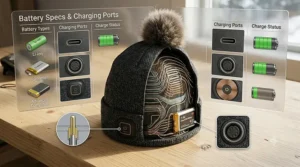
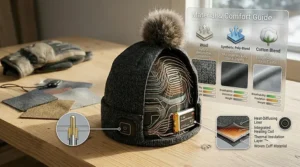
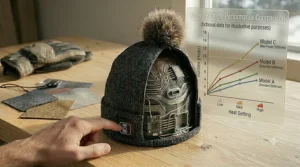
A heated beanie is a knit winter hat with a thin battery-powered heating element — usually carbon fiber or infrared fiber threads — woven into the lining near the ears and sometimes across the forehead. A small rechargeable battery, typically tucked into a hidden pocket, powers the element through 2–3 adjustable heat settings. Picture a heating pad that got a haircut and decided to become a hat.
The heating elements themselves are nothing exotic. As Wikipedia’s overview of heated clothing explains, heated clothing has tiny wires sewn into a layer of the fabric, usually made of carbon fiber or a metal composite like nickel-chromium that holds up well through repeated heating and cooling. Run a small current through them and they warm up in seconds — that’s why most heated beanies claim a 30–60 second warm-up time. The battery (almost always a 3.7V or 7.4V lithium-polymer cell) sits in a soft pocket sewn into the fabric, connects through a small port, and gets charged via USB between wears.
What separates a good one from a forgettable one isn’t really the heating technology — it’s everything around it. Battery placement, fabric quality, how evenly the heat spreads instead of creating one hot spot behind your ear, and whether the company stands behind the thing when the battery inevitably degrades after a couple of winters.
Quick Comparison: 7 Best Heated Beanies at a Glance
| Product | Battery | Max Runtime | Heat Settings | Best For | Price Range |
|---|---|---|---|---|---|
| Autocastle Heated Skull Beanie | 7.4V 2200mAh | ~7 hrs | 3 | Best overall value | $25–$35 |
| SVPRO Heated Beanie Hat | 7.4V 2200mAh | ~7 hrs | 3 | Budget daily wear | $25–$40 |
| QILOVE 7.4V Heated Knit Hat | 7.4V Li-Po | 3–7 hrs (varies by level) | 3 | Precise temp control | $30–$45 |
| QILOVE Teen Heated Beanie | 2x AA (included) | Varies | 3 | Kids & teens | $20–$30 |
| Dr.Warm App Control Hat | 7.4V 2200mAh | ~5 hrs | 3 (app-adjustable) | Tech-forward users | $45–$60 |
| FNDN Heated Knit Beanie | BEGO 3,350mAh | ~6 hrs | 3 | Style-conscious commuters | $70–$90 |
| Peabownn USB Heated Beanie | External USB power bank | Depends on bank | 3 | No-battery-hassle budget pick | Under $25 |
Looking at the table, the split is really between “set it and forget it” hats in the $25–$40 range and a smaller tier of feature-driven picks above $45 that add either app control, a noticeably bigger battery, or a workaround that skips the dedicated lithium pack entirely. If you just want warm ears for a daily commute, the budget tier covers you fine. If you’re outside for six-plus hours at a stretch — hunting, ice fishing, working a job site — the runtime differences between settings start to matter a lot more than the marketing copy suggests.
💬 Just one click — help others make better buying decisions too! 😊
✨ Don’t Miss These Exclusive Deals!
🔍 Take your winter gear to the next level with these carefully selected heated beanies. Click on any highlighted item to check current pricing and availability. These picks will help you (and the cold-weather people in your life) actually enjoy being outside this winter!
Top 7 Heated Beanies: Expert Analysis
1. Autocastle Rechargeable Heated Skull Beanie
The Autocastle Rechargeable Heated Skull Beanie has been a fixture in this category since 2019, and there’s a reason it keeps showing up near the top of search results years later: it just works, without asking you to think about it too much.
Under the fabric sits a 7.4V 2200mAh lithium-polymer battery feeding heating elements concentrated around the ear area — which matters more than it sounds, because ears are usually the first thing to go numb on a cold walk, not the crown of your head. The company claims up to 6–7 hours on the lowest of three settings, and in practice that tracks reasonably well as long as you resist the urge to leave it on high the whole time. What most buyers overlook is that the outer shell itself (acrylic with a polyester lining) holds in a surprising amount of warmth even with the heat switched off, so the battery becomes a boost rather than your only source of warmth.
Customer feedback leans heavily toward “warmer than expected” and praises the snug, stretchy one-size fit, though a handful of reviewers note the battery indicator light isn’t always reliable about showing remaining charge. This one’s best suited to someone who wants a no-fuss daily driver for dog walks, commutes, or snow shoveling — not someone chasing app integration or premium materials.
✅ Pros: Long-running, well-reviewed listing · Genuinely warm fleece lining even unpowered · Simple 3-setting control
❌ Cons: No app or fine-grained temperature display · Battery sold separately if it ever needs replacing
Price sits in the $25–$35 range, and for a hat you’ll wear daily, that’s a strong value-to-warmth ratio.
2. The SVPRO Rechargeable Heated Beanie Hat
The SVPRO Rechargeable Heated Beanie Hat is Autocastle’s closest sibling in this lineup, sharing a near-identical 7.4V 2200mAh battery and three-setting heat control, but with its own spin on construction — a velcro-secured battery pocket and a knit shell that several reviewers describe as slightly softer against bare skin.
In practice, this is the beanie I’d point a first-time buyer toward if they’re nervous about spending money on something untested. It’s earned Amazon’s Choice status in this category at various points, which generally signals consistent sales and review volume rather than lab-tested superiority — but it does mean a large pool of real-world feedback to draw from, and that feedback is reassuringly boring in the best way: people charge it, wear it, and it heats up.
One detail worth knowing: like most hats in this price bracket, you need to remove the battery before machine washing. Skip that step once and you’ll learn why the manual mentions it twice. SVPRO suits the buyer who wants a “set it on medium and forget it” experience for winter sports, fishing trips, or standing around outside at kids’ sporting events.
✅ Pros: Strong, consistent review history · Comfortable fleece-lined knit · Easy USB charging
❌ Cons: Battery life drops noticeably on the highest setting · Limited color/pattern variety compared to competitors
Expect to pay in the $25–$40 range depending on color and current promotions.
3. QILOVE 7.4V Rechargeable Electric Heated Knit Hat
The QILOVE 7.4V Rechargeable Electric Heated Knit Hat stands out for one reason: it’s the only hat in this roundup that publishes specific temperature ranges per setting instead of vague “warm/warmer/warmest” language. Low sits around 68–86°F for 6–7 hours, medium climbs to 86–102°F for 4–5 hours, and high pushes 102–115°F but burns through the battery in 3–4 hours.
That transparency is genuinely useful. It means you can match the setting to the actual weather instead of guessing — low for a brisk 35°F walk, high reserved for the kind of cold where your eyelashes start collecting frost. The heating area concentrates around the ears, paired with a plush interior that several reviewers compare favorably to higher-priced competitors. The tradeoff for that runtime flexibility is a fairly plain knit-and-fleece construction; this isn’t a hat that’s trying to look expensive.
This is the pick for someone who actually wants to think about thermal management — hunters sitting in a blind for hours, or anyone who’s been burned before by a “7 hour battery life” claim that quietly meant “7 hours on the setting that barely does anything.”
✅ Pros: Published, specific temperature/runtime data per setting · Comfortable ear-focused heating · Reasonable mid-range price
❌ Cons: Basic styling · High setting drains battery noticeably fast
Price typically falls in the $30–$45 range.
4. QILOVE Heated Beanie Hat for Teenagers/Youth
The QILOVE Heated Beanie Hat for Teenagers and Youth solves a problem parents run into constantly: most heated beanies are sized and priced for adults, and handing a kid a hat with a lithium battery you have to monitor feels like one more thing to worry about.
This version sidesteps that by running on two included AA batteries instead of a built-in lithium-polymer pack. That’s a real tradeoff — you’ll get less runtime per charge than the adult lithium models, and “charge” here actually means “swap batteries” — but for a lot of parents, that’s a feature, not a flaw. AA batteries are replaceable at any gas station, there’s no lithium cell to monitor for swelling or degradation over a few seasons, and a 12-year-old isn’t going to forget to plug in a USB cable the night before a ski trip. The 60-second warm-up and 3-temperature adjustment carry over from QILOVE’s adult line, so the actual warming experience doesn’t feel like a watered-down version.
Best suited to younger riders, students walking to school in the cold, or as a lower-stakes gift for a teenager who’s notoriously bad about charging things.
✅ Pros: No lithium battery to manage · Easy battery swaps · Same 3-setting control as the adult version
❌ Cons: Shorter, less predictable runtime than rechargeable lithium models · Ongoing AA battery cost adds up over a season
Price generally lands in the $20–$30 range.
5. Dr.Warm APP Control Electric Heated Hat
The Dr.Warm APP Control Electric Heated Hat is the gadget-lover’s pick in this lineup, and it earns that label legitimately. Instead of a button you fumble for through gloves, you control temperature and check battery percentage through a companion smartphone app — genuinely handy when you’re wearing thick mittens and don’t want to dig under a hood to find a tiny button.
Under the merino wool, acrylic, and polyester blend sits a 7.4V 2200mAh battery powering far-infrared fiber heating elements rated for roughly 5 hours of continuous warmth. That runtime is shorter than several budget competitors, and that’s the honest tradeoff for app connectivity and a touch of merino in the fabric blend — you’re paying for convenience and material quality, not for battery capacity. What most buyers overlook is that the app also displays real-time battery percentage, which is a small thing that solves a recurring annoyance with the other entries on this list: most of them give you nothing more than a vague indicator light.
This is the right choice for someone who already lives in their phone’s ecosystem of connected gadgets and wants their winter hat to fit that pattern, or for anyone who’s been frustrated by guessing at battery life with cheaper hats.
✅ Pros: Real-time battery and temperature monitoring via app · Comfortable wool-blend fabric · Wide, even heating coverage
❌ Cons: Shortest runtime of the rechargeable options here · Requires a smartphone and app setup, which some buyers will see as overkill
Price generally runs $45–$60, reflecting the added tech and material blend.
6. FNDN Heated Knit Beanie
The FNDN Heated Knit Beanie is the premium outlier here, and it looks the part — this is a hat you could wear into a coffee shop without anyone clocking it as “the one with the battery in it.” It’s available through FNDN’s official Amazon storefront alongside the rest of their heated apparel line.
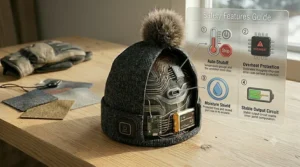
The standout spec is the BEGO 3,350mAh battery, noticeably larger than the 2200mAh packs used by most of the competition on this list, feeding three heat levels (high, medium, low) indicated by a small color-coded light rather than a numbered display. Real-world runtime lands around 6 hours on medium, though customer feedback flags one quirk worth knowing before you buy: switching directly to the highest setting sometimes auto-steps the hat down to medium after a few minutes, apparently as a battery-protection measure. It’s a minor inconvenience dressed up as a safety feature, and a few reviewers found it mildly annoying the first time it happened without warning.
This is the pick for someone prioritizing how the hat looks and feels over squeezing out maximum runtime — daily commuters, anyone buying it as a higher-end gift, or buyers who’ve been burned by flimsy fast-fashion knit hats and want something that feels durable.
✅ Pros: Larger 3,350mAh battery than most competitors · Genuinely stylish, low-profile knit design · Premium acrylic/polyester construction
❌ Cons: Highest price point in this roundup · Auto step-down from high setting can surprise first-time users
Expect a premium price range of roughly $70–$90, often discounted from a higher list price.
7. Peabownn USB Heated Beanie (No Internal Battery)
The Peabownn USB Heated Beanie takes a different approach entirely, and it’s worth understanding before you buy: it doesn’t ship with — or rely on — its own internal rechargeable battery pack. Instead, it plugs directly into any USB power source you already own: a phone charger, a laptop port, or a portable power bank in your coat pocket.
That single design choice changes the whole value proposition. You’re not managing a dedicated lithium-polymer cell that ages and loses capacity over a couple of winters — you’re using whatever battery you’re already carrying, and runtime becomes a function of your power bank’s capacity rather than a fixed number on a spec sheet. The hat offers three heat settings (113°F, 131°F, and 149°F) across an expanded heating zone that covers more of the upper skull and ears than some of the ear-only designs on this list. The tradeoff, obviously, is that you need to actually have a power bank with you for it to do anything — this isn’t a grab-and-go hat in the way a self-contained rechargeable model is.
Best suited to budget-conscious buyers who already carry a power bank for their phone anyway, or anyone who’d rather not think about lithium battery degradation in a garment they’re washing and stretching over a helmet all winter.
✅ Pros: No internal battery to degrade or replace · Specific, clearly labeled temperature settings · Lower price point than most rechargeable competitors
❌ Cons: Requires carrying a separate USB power bank · Cable management can feel clunky under a jacket hood
Typically priced under $25, making it the cheapest functional entry on this list.
Practical Usage Guide: Getting the Most Out of Your Heated Beanie
Buying the right hat is half the equation. The other half is using it in a way that doesn’t quietly wreck the battery by March.
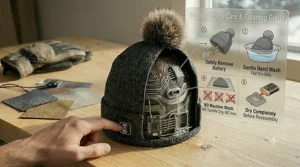
First, resist the urge to blast the highest setting the second you step outside. Most manufacturers (Autocastle included) actually recommend a short burst on high for the first 5–10 minutes to get warm fast, then dropping to medium or low once you’ve stabilized — this conserves battery and, per most far-infrared and carbon-fiber heating designs, doesn’t meaningfully sacrifice comfort once you’re already warm. Second, always remove the battery before machine washing. It sounds obvious until you’re rushing to do laundry and forget; a battery that goes through a wash cycle is a battery you’ll be shopping to replace. Third, charge fully before first use and let lithium-based batteries rest at room temperature before charging in extreme cold — charging a freezing-cold lithium cell is one of the more common ways people shorten its lifespan within a single season. Finally, store the hat with the battery removed during the off-season; leaving a lithium cell sitting at full charge for six warm months is harder on its long-term capacity than most people realize.
Real-World Scenarios: Which Heated Beanie Actually Fits Your Life
The daily commuter walking eight blocks to the train or scraping ice off a windshield doesn’t need maximum runtime — they need fast warm-up and a hat that looks normal at a desk an hour later. The Autocastle or SVPRO budget pick handles this fine, and the lower price means less guilt if it gets left in a coat pocket through summer.
The all-day outdoor worker — ice fishing, deer stand, snow removal crew — lives and dies by runtime numbers. This is where QILOVE’s published temperature-and-hour breakdown earns its keep, letting you actually plan around a known low-setting runtime instead of hoping the marketing copy was honest.
The parent buying for a teenager wants something durable that survives being thrown in a backpack and doesn’t require monitoring a lithium battery’s health. The AA-powered QILOVE youth version, or the no-battery Peabownn paired with a power bank the teen already has for their phone, both sidestep that specific anxiety.
Problem → Solution: Fixing the Most Common Heated Beanie Headaches
Problem: The battery dies faster than advertised. Solution: check which setting you’re actually using. The gap between “low” and “high” runtime claims is often 2–3x, and most reviewers who complain about short battery life turn out to have been running the highest setting the whole time. The QILOVE adult model’s published temperature ranges make this easiest to plan around.
Problem: One ear feels warmer than the other. Solution: this is usually a fit issue, not a defect — heating elements concentrated near the ears need the hat snug against your head to transfer heat evenly. A looser fit creates air gaps that one side ends up filling more than the other.
Problem: You forgot to remove the battery before washing — again. Solution: get in the habit of washing on the same day you charge. If the battery’s already out and charging, there’s no temptation to toss the whole hat in the machine with it still inside.
How to Choose a Heated Beanie: 6 Things That Actually Matter
- Battery chemistry and capacity. A 2200mAh lithium-polymer cell is the rough baseline for this category; anything noticeably lower will show up as disappointing runtime regardless of what the listing promises.
- Heating zone placement. Ear-focused heating (most budget options) versus full-skull coverage (Peabownn’s expanded zone) — match this to where you personally feel cold first.
- Control method. A physical button is fine for most people; app control (Dr.Warm) only matters if you’re already managing other connected gear and want one more thing to sync.
- Battery dependency. Decide whether you want a self-contained rechargeable pack or you’re fine relying on an external power bank you already carry.
- Fit and machine-washability. Confirm the battery is removable before you commit — a heated hat you can’t wash easily is a heated hat that smells bad by February.
- Realistic runtime for your use case. Don’t buy based on the highest advertised number; buy based on the lowest setting’s runtime, since that’s the number you’ll actually live with on long days.
Common Mistakes People Make When Buying a Heated Beanie
The single biggest mistake is buying based on the “up to 7 hours” headline number without reading which setting that applies to. As QILOVE’s own published breakdown shows, that 7-hour figure usually belongs to the lowest, weakest setting — useful information, but easy to miss if you’re skimming.
A close second: assuming “one size fits most” actually means it’ll fit snugly. Heated elements need head contact to transfer warmth efficiently, and a baggy fit on someone with a smaller head shape can leave the heating zone sitting an inch away from where it needs to be, quietly cutting effectiveness.
Third, people underestimate how often these batteries need replacing. Lithium-polymer cells in this price category typically hold a meaningful charge for one to two full winters of regular use before capacity noticeably drops — budget for that rather than being surprised by it.
Heated Beanie Battery Life: What the Numbers Really Mean
Every listing in this guide advertises a “best-case” runtime number, and every single one of them means the lowest heat setting, often in mild outdoor conditions rather than genuine sub-freezing wind. Real-world heated beanie battery life runs noticeably shorter on the highest setting — frequently half the advertised maximum or less, based on the pattern across QILOVE’s published 3–4 hour high-setting figure versus its 6–7 hour low-setting claim.
How long does a heated beanie last in terms of total lifespan, rather than per-charge runtime? Most lithium-polymer packs in this category are rated for somewhere around 300–500 full charge cycles before capacity drops meaningfully — roughly translating to one to two winters of regular use for someone wearing it most cold days. After that point, you’re not necessarily replacing the whole hat; several brands, including Autocastle, sell replacement batteries separately, which is worth checking before you assume the entire product is disposable.
Heated Beanies vs. Traditional Wool and Fleece Hats
| Factor | Heated Beanie | Traditional Wool/Fleece Hat | Best For |
|---|---|---|---|
| Active warmth source | Battery-powered heating element | Passive insulation only | Cold below ~30°F → heated |
| Upfront cost | $20–$90 | $10–$50 | Budget-only → traditional |
| Maintenance | Battery charging, careful washing | Simple machine wash | Low-maintenance → traditional |
| Weight/bulk | Slightly heavier, battery pocket | Lightweight | Packability → traditional |
| Best for extreme cold | Strong advantage | Limited | Extended outdoor exposure → heated |
The honest read on this table is that a heated beanie isn’t a strict upgrade — it’s a different tool. According to CDC/NIOSH guidance on cold-related illness, hypothermia affects the brain and can make a person unable to think clearly or move well, and frostbite commonly affects fingers, toes, the nose, and the ears — exactly the vulnerability a heated beanie targets that a wool hat can’t. OSHA’s winter weather guidance adds that wind speed and dampness both accelerate heat loss from the body, which is worth remembering if you’re judging “how cold is too cold for a wool hat” purely by the thermometer and ignoring wind chill. But if you’re mostly walking between a heated car and a heated building, the maintenance overhead of a battery probably isn’t worth it over a $15 wool beanie. Save the heated option for genuine extended exposure — standing outside, working outdoors, or activities where you can’t just duck inside to warm up.
Are Heated Beanies Safe? A Practical Look at Battery and Burn Risk
Short answer: generally yes, when used as intended, but lithium-ion and lithium-polymer batteries deserve a level of respect that a lot of buyers skip past. Per the CPSC’s own guidance on battery hazards, staff has received consumer complaints involving hazards associated with batteries and battery chargers, including overheating, fire, and thermal burns — battery-powered wearables aren’t exempt from that risk category just because they’re marketed as cozy winter gear. In fact, the CPSC has issued direct warnings about battery-related fire risk in other battery-heated wearables sold on Amazon, including a 2025 warning about heated insoles whose internal lithium-ion battery could ignite even while turned off — a useful reminder that “it’s just a hat” doesn’t mean the battery inside it gets a pass.
The practical safety habits that matter most: never charge the battery unattended overnight, inspect it periodically for swelling, cracking, or an unusual smell, and stop using it immediately if you notice any of those signs. The NFPA’s lithium-ion battery safety guidance recommends sticking to the manufacturer’s charging cable rather than a random USB cord pulled from a junk drawer, since cheap cables and chargers are a disproportionate source of overheating incidents. Used this way, the risk profile on a heated beanie is low — broadly comparable to any other small lithium-powered wearable you already trust, like a fitness tracker or wireless earbuds.
Features That Actually Matter (And Those That Don’t)
Matters: Battery capacity and published runtime-per-setting, ear-zone heating placement, and whether the battery is removable for washing. These three things determine whether you’re actually warm and whether the hat survives a season of normal use.
Doesn’t matter as much as it sounds: the number of “heat settings.” Three settings versus five settings rarely makes a meaningful difference in practice — most people gravitate to one low setting and one high setting and ignore everything in between. Similarly, app control (as nice as it is on the Dr.Warm pick) is a convenience feature, not a performance one; it doesn’t make the hat warmer, just easier to manage.
Long-Term Cost & Maintenance: What You’ll Really Spend
Factor in more than the sticker price. A $25 budget pick that needs a $12 replacement battery after eighteen months of regular use still comes out well ahead of a $90 premium hat over a three-year span, assuming both keep you equally warm. The real ongoing cost driver is usage intensity — someone wearing a heated beanie daily through a harsh winter will burn through battery cycles roughly twice as fast as someone reaching for it occasionally on the coldest days, which shifts the math meaningfully toward investing in a hat with a larger battery capacity if you’re a daily user.
What to Expect: Real-World Performance
Translating specs into lived experience: on a 25°F day with light wind, the budget tier (Autocastle, SVPRO) on medium setting keeps ears comfortably warm for a 30–45 minute walk without needing to touch the controls. Drop into the teens with real wind chill, and you’ll want high for the first ten minutes before settling into medium — exactly the usage pattern most manufacturers recommend. The premium FNDN pick’s larger battery shows its advantage specifically on multi-hour outings rather than short walks, where the gap between a 2200mAh and 3,350mAh pack barely registers over 30 minutes but becomes obvious by hour four.
Frequently Asked Questions
❓ Can you wash a heated beanie in a washing machine?
❓ Do heated beanies fit comfortably under a bike or ski helmet?
❓ How do you charge a heated beanie?
❓ Are heated beanies good for people with poor circulation or Raynaud's?
❓ What's the difference between a heated beanie and a heated headband?
Conclusion
There’s no single best heated beanie buying guide pick here, and that’s sort of the point. If you want the safest, most boring, most reliable option, Autocastle or SVPRO will not let you down for the price. If you’re outside for hours at a stretch and want runtime numbers you can actually trust, QILOVE’s published temperature breakdown removes the guesswork. If you’re buying for a kid, skip the lithium battery anxiety entirely with the AA-powered youth model. And if you just want to feel a little bit like you’re wearing the future, the Dr.Warm app-controlled pick or FNDN’s bigger battery and better looks are worth the extra spend.
What matters more than any single spec is matching the hat to how cold you actually get, and where. Buy for your real winter, not the one in the product photos.
✨ Don’t Miss These Exclusive Deals!
🔍 Take your winter comfort to the next level with these carefully selected heated beanies. Click on any highlighted item above to check current pricing and availability — your ears will thank you.
Recommended for You
- Best Heated Beanie 2026: 7 Picks That Actually Work
- Heated Socks vs Heated Insoles: 7 Best Picks Compared (2026)
- Heated Gloves Buying Guide: 7 Best Picks for Winter 2026
Disclaimer: This article contains affiliate links. As an Amazon Associate, I earn from qualifying purchases. If you purchase products through these links, we may earn a small commission at no additional cost to you.
✨ Found this helpful? Share it with your friends! 💬🤗
