
In This Article
Let’s start with something nobody in the heated footwear space wants to say out loud: buying the wrong option doesn’t just waste money — it ruins entire days outdoors. You’re standing on a frozen hunting blind at 5 a.m., or grinding through a 10-hour shift in a cold warehouse, or waiting for the ski lift with your toes slowly turning into ice cubes. That moment is not the time to realize your choice between a heated sock and a heated insole was a coin flip.
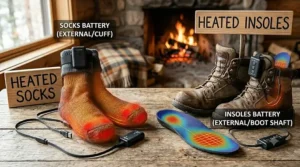
Here’s the core of the heated socks vs heated insoles comparison: heated socks wrap your entire foot in warmth from the outside in, while heated insoles heat your foot from below, targeting the plantar surface where blood vessels sit closest to the surface. Both methods work. They just work differently, for different people, in different boots. Understanding which one suits your life — not just the one with the flashiest Amazon listing — is exactly what this guide is here for.
What most buyers overlook is that the “right” answer changes depending on your footwear. If you’re working in tight steel-toe boots, a bulky heated sock can cause pressure hotspots that actually restrict circulation. But if you already own your perfect pair of hiking boots and just need warmth without rebuilding your whole kit, a slim insole slides right in. There’s also a medical angle worth knowing: according to Mayo Clinic, persistent cold feet can signal circulatory issues, hypothyroidism, or peripheral neuropathy — and targeted foot warming can provide meaningful relief alongside medical treatment.
In this guide, I’ve researched and compared seven real, currently available products across both categories — with honest assessments of who each one actually serves. No inflated specs. No cheerleading. Just what you need to make a smart decision the first time.
Quick Comparison: Heated Socks vs Heated Insoles at a Glance
| Feature | Heated Socks | Heated Insoles |
|---|---|---|
| Heat Coverage | Full foot + ankle | Plantar surface (bottom of foot) |
| Boot Compatibility | Best in roomy boots/shoes | Works in most boot types incl. tight ski boots |
| Setup Complexity | Plug in & wear | Trim to fit + attach battery straps |
| Warmth Response | Moderate (full-wrap effect) | Fast (direct contact with foot sole) |
| Shoe Flexibility | Low — tied to one pair | High — move between shoes |
| Best For | All-day outdoor activities, medical cold feet | Skiing, hiking, work boots, existing footwear |
| Average Battery Life | 5–13 hours | 5–24 hours |
| Price Range | $40–$180+ | $30–$280+ |
The table above tells a story that’s easy to miss: heated insoles win on flexibility and boot compatibility, while heated socks win on full-foot immersive warmth. If you’re buying for a single activity with dedicated footwear, insoles are often the smarter fit. If you want warmth you can feel from heel to ankle without fiddling with wires, a quality heated sock is hard to beat.
💬 Just one click — help others make better buying decisions too! 😊
✨ Don’t Miss These Exclusive Deals!
🔍 Take your winter warmth to the next level with these carefully selected products. Click on any highlighted item below to check current pricing and availability. Your cold feet problem ends here!
Top 7 Heated Socks and Heated Insoles: Expert Analysis
1. Savior Heat Heated Socks with APP Control (B0DF7DBF51)
If you had to pick one heated sock that nails the modern feature set without going overboard on bulk, this is it. The Savior Heat APP Control model runs on a 7.4V infrared fiber heating system that covers the full footpad — not just a strip near the toe, which is where cheaper designs cut corners.
The 3 heat settings reach a top of 140°F (60°C) and deliver up to 7 hours of runtime on low, which translates to a full workday or an all-day ski session without hunting for an outlet. The standout differentiator? Bluetooth app control via your phone — meaning you can dial down from high to medium while you’re still laced into your boots, skiing a groomed run. That flexibility matters more than people realize; over-heated feet actually sweat, which chills you faster.
Buyers love the Coolmax-adjacent polyester blend — moisture-wicking and breathable — and report the size-to-fit runs accurately across the S–XL range. The few gripes center on the fact that the battery pocket, while slim, can feel slightly snug inside narrower shoes.
✅ App + manual touch control
✅ Infrared heating for even distribution
✅ Moisture-wicking fabric keeps feet dry
❌ Battery pocket may add snugness in narrow footwear
❌ App setup requires a smartphone
Price range: $60–$90 | A strong value for the tech you get. Check on Amazon →
2. Gerbing 7V Ultimate Wool Heated Socks (B09NYK1JQV)
Gerbing has been in the heated gear business for over 40 years — longer than most Amazon sellers have been alive — and their 7V Ultimate Wool Heated Socks are the product of all that accumulated engineering. The 32% wool blend is genuinely meaningful here: wool naturally regulates moisture and retains heat even when damp, so when your feet eventually sweat on a long hike, the sock keeps performing where synthetic-only models fade.
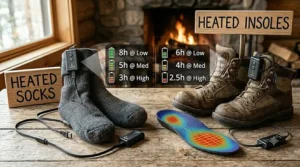
The 7.4V, 2200mAh batteries run through a full footpad microwire heating system — one of the most powerful on the consumer market — delivering 140°F on high (3 hours), 120°F on medium (5 hours), and 100°F on low (7 hours). These are real numbers that field testers from Outdoor Life have validated in actual hunting and snowshoeing conditions, not just warm living rooms.
The trade-off worth mentioning: you can faintly feel the heating elements underfoot on the highest setting. For seated hunters in a blind, it’s a non-issue. For people who are highly sensitive to texture underfoot, it might be noticeable. Importantly, the heating elements carry a lifetime warranty — something unheard of in this category.
✅ Wool blend = superior moisture management
✅ Lifetime warranty on heating elements
✅ Proven performance in field-tested extreme cold
❌ Heating elements mildly perceptible underfoot
❌ Requires proprietary charger (not USB-C)
Price range: $130–$160 | Premium pricing justified by long-term durability and wool construction. Check on Amazon →
3. SNOW DEER Upgraded Rechargeable Electric Heated Socks
Snow Deer consistently earns its place on best-of lists not by being flashy but by being reliable — which is arguably harder to do. Their upgraded model runs a 7.4V system with a USB-C charging setup (finally), making it the most travel-friendly premium heated sock on this list.
What separates Snow Deer from budget competitors at a similar price point is the 360° heating wrap — the heating elements are distributed around the sock rather than just underfoot. In practice, this means the top of your foot and ankle area get meaningfully warmer, which matters during activities where cold air gets channeled down into your boot while walking. The fit runs true to size and the battery pocket sits discreetly against the calf without digging in during movement.
Battery life hovers between 5 and 10 hours depending on setting, and dozens of Amazon reviewers confirm the performance holds up after multiple wash cycles — a weak point for many competing brands.
✅ 360° heating element placement
✅ USB-C charging
✅ Durable through repeated machine washing
❌ No app control (manual button only)
❌ Mid-calf height can feel restrictive for some wearers
Price range: $55–$80 | Check on Amazon →
4. ChieAdt Heated Socks with App Control (Dual 8000mAh)
This is the one you buy when battery life is your single, non-negotiable priority. Dual 8000mAh batteries — one per foot — deliver up to 13 hours of heat, which is the longest runtime of any mainstream heated sock on Amazon right now. On high (149°F), you still get over 5 hours. That’s enough for a full day on a frozen duck pond without a recharge conversation.
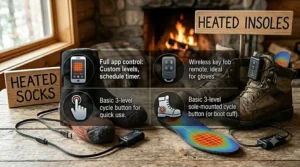
The Syncker app (iOS + Android) lets you control each foot independently, which sounds like a gimmick until you’ve ever had one foot colder than the other — a surprisingly common phenomenon for people with circulation asymmetries. The 10-second rapid heat function gets noticeable warmth going almost immediately, compared to the 3–5 minutes typical of lower-voltage competitors.
One honest caveat: the dual large batteries create slightly more bulk than single-battery models. They perform best in roomy winter boots or insulated work boots. Cramming them into slim trail runners will be uncomfortable.
✅ Industry-leading 13-hour battery life
✅ Per-foot independent temperature control
✅ Rapid 10-second heat-up
❌ Bulkier profile — not ideal for slim footwear
❌ Higher price reflects the premium battery tech
Price range: $80–$110 | Check on Amazon →
5. Thermrup Electric Heated Insoles, Far Infrared (B07776B4J5)
Thermrup is a German brand, and the engineering philosophy shows. Where most insole brands use fragile carbon fiber wire heating elements, Thermrup built their insoles around rubber heating elements — a more durable construction that resists cracking, fraying, and failure at flex points across the toes. After six years on the market (trusted by over 100,000 customers since 2015, per their listing), that durability claim has real-world backing.
The 2500mAh, 7.4V Li-Ion battery powers 4 heat levels, and the far-infrared heating tech is worth noting here: FIR penetrates deeper into tissue than surface contact heat, which means better microcirculation support. For users dealing with Raynaud’s disease or diabetic peripheral neuropathy — conditions where NIH research confirms impaired foot blood flow — this distinction matters clinically. The insoles are also fully waterproof and machine washable, which sets them apart from most competitors.
At 6mm thickness, they fit into most footwear without a sizing headache. The 70cm cable runs discreetly up the leg with gaiter attachment points.
✅ Durable rubber heating elements (vs. fragile wire)
✅ Far-infrared for deeper tissue warming
✅ Waterproof + machine washable
❌ 4-level control is button-only, no app
❌ Battery life shorter than newer 5000mAh competitors
Price range: $40–$65 | Excellent long-term value due to build durability. Check on Amazon →
6. Dr. Warm Rechargeable Heated Insoles with APP Control (B0CJQVKXYX)
The Dr. Warm APP model solves the #1 complaint about traditional heated insoles: you have to remove your boot to adjust the heat. With their dedicated smartphone app, you get wireless temperature adjustment, real-time battery level monitoring, and heat setting changes from your phone — all while skiing, hiking, or standing in a cold warehouse. At 0.16 inches thick (about 4mm), these are among the slimmest heated insoles on Amazon, which means they work in fitted ski boots without displacing your existing footbed.
The 7.4V system covers three heat ranges — low (100–113°F), medium (113–122°F), and high (122–140°F) — and the PU foam construction offers real shock absorption alongside the heat, making them comfortable during high-impact activities like trail running in winter conditions.
The trimable design covers US sizes 5–13 with accurate cut lines, and the 2-strap ankle attachment system keeps the battery packs mobile — you can walk, hike, and ski without the battery bouncing or disconnecting.
✅ Bluetooth app control — zero fumbling in boots
✅ Ultra-slim 4mm profile for fitted footwear
✅ Shock-absorbing PU foam construction
❌ Battery capacity modest vs. newer 5000mAh models
❌ App pairing occasionally requires re-setup after phone updates
Price range: $50–$75 | Best insole pick for tech-forward users and skiers. Check on Amazon →
7.Hotronic XLP 2C BT Custom Heated Insoles
This is the nuclear option of heated insoles — and I mean that as the highest compliment. Hotronic has been outfitting professional ski racers, military cold-weather personnel, and serious alpine athletes for decades. The XLP 2C BT system uses two external Bluetooth-controlled lithium-ion batteries — one per foot — connected to heating elements that install into your existing custom insoles or orthotics. Translation: if you’ve already spent $200 on custom orthotics, you don’t throw them out. You electrify them.
Dual batteries deliver a potential 24 hours of continuous heat on low, and the Bluetooth app lets you set schedules, monitor battery status, and switch heat levels — all without loosening a boot buckle. The XLP 2C BT is the only consumer heated insole system on the market with genuine professional athlete validation. At sub-zero temperatures sustained over 8+ hours, no other product in this category matches it.
What most buyers overlook: because the heating elements install into your chosen insole, you’re also future-proofing your investment. The batteries and elements are sold separately, so if one component fails in year three, you replace just that piece — not the whole system.
✅ Up to 24 hours of heat from dual batteries
✅ Works with custom orthotics — no compromise on arch support
✅ Professional-grade durability for extreme conditions
❌ Highest price point in this entire guide
❌ More complex setup than plug-and-play options
Price range: $200–$280 | Investment-grade for serious athletes and medical-necessity buyers. Check on Amazon →
How to Get the Most From Your Heated Footwear: A Practical Usage Guide
Buying the right product is step one. Using it correctly is the step most people skip — and where a lot of the “this didn’t work” reviews come from.
First charge: always do a full 4–6 hour charge before first use. Lithium-ion batteries used below their initial full charge potential can permanently lose 10–15% capacity before you’ve worn them once. Most brands mention this in the manual. Almost nobody reads the manual.
Layer under, not over. For heated socks, wear a thin liner sock underneath if you run cold and are relying on all-day heat. The liner wicks moisture away from the heating elements, which keeps the thermals more efficient. Counterintuitively, damp heating elements don’t fail — they just lose efficiency faster. For heated insoles, never layer on top of your regular insole; remove the existing insole first, or you’ll compress the heating elements and shorten their lifespan.
Heat setting strategy: Start on medium, not high. High heat burns through battery life 40–60% faster than medium, and for most cold-weather use, medium delivers perfectly comfortable foot temperature without the runtime penalty. Reserve high for static activities — standing in a blind, waiting for a ski lift, working at a construction site in wind chill.
Battery storage: Store batteries at 40–60% charge during off-season. Storing at 0% causes irreversible lithium cell degradation. Storing at 100% for months also degrades capacity. The 40–60% sweet spot is what Panasonic and battery industry guidance consistently recommend for lithium-ion longevity.
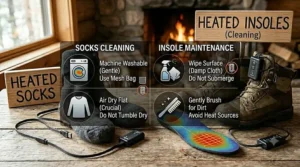
Washing: For heated socks, always remove the battery pack before machine washing, and use a mesh laundry bag to protect the wiring connections. For heated insoles, wipe with a damp cloth only — most insole heating elements are not designed for submersion regardless of what a listing claims, with the exception of Thermrup’s rubber-element waterproof construction.
Real-World Scenarios: Which Product Fits Your Life?
Not everyone reading this is a hardcore alpine skier. Let me break this down into the three user profiles I see most often.
Profile 1 — The Weekend Hunter / Ice Fisher. You’re stationary for long periods in extreme cold. Your priority is maximum heat duration and warmth intensity. The ChieAdt Heated Socks or Hotronic XLP 2C BT are built for you. The ChieAdt’s 13-hour battery paired with its independent per-foot control handles an all-day sit in a frozen blind. If you’re using insulated hunting boots with space to spare, go socks. If you’re in tight waders or custom-fitted ice fishing boots, go Hotronic insoles and keep your existing boot setup.
Profile 2 — The Outdoor Worker / Construction Site. You’re on your feet 8–10 hours in steel-toed or composite-toe work boots with almost no wiggle room. Heated socks in a steel-toe boot are a circulation-restriction nightmare. This is the insole’s arena — specifically the Dr. Warm APP model for app convenience, or the Thermrup for raw durability over repeated daily use. At around $50–$65, Thermrup’s rubber element construction will outlast most alternatives by a year or two of daily wear.
Profile 3 — The Occasional Cold-Weather Recreationalist. You ski a few weekends a year, do some winter hiking, and just want cold feet to stop ruining your trips. You don’t need the Hotronic nuclear option. The Savior Heat APP Control socks give you everything — phone control, strong battery life, comfortable fabric — at a price that doesn’t require a dedicated budget meeting. It’s the most versatile pick in this entire guide for casual-to-moderate winter use.
✨ Don’t Miss These Exclusive Deals!
🔍 Browse the full selection of heated socks and heated insoles on Amazon. Click any highlighted product name to check current pricing, available sizes, and latest buyer reviews — updated daily.
How to Choose Between Heated Socks and Heated Insoles: 6 Key Criteria
This is where the heated socks vs heated insoles comparison gets genuinely useful. Don’t buy based on which product has more reviews. Buy based on which criteria matter most to you.
1. Your boot fit. Ski boots, tight hiking boots, steel-toe work boots — these are insole territory. The heating element in a sock adds 2–4mm of thickness around your entire foot. In a fitted boot, that pressure can actually impede circulation. In a roomy winter boot or casual shoe, heated socks are perfectly comfortable.
2. How many pairs of footwear you want to cover. Heated insoles are trimable to fit and transfer between shoes. One pair of insoles can work in your hiking boots on Saturday and your snow boots on Sunday. Heated socks are locked to the sock — they go where you go, in whatever footwear fits them.
3. Activity type. Static, sedentary cold exposure (hunting, fishing, stadium seating) benefits more from the full-wrap warmth of heated socks. High-activity dynamic movement (skiing, hiking) benefits from the slim profile of insoles that don’t restrict the natural flex of the foot inside a performance boot.
4. Medical considerations. For Raynaud’s disease — a condition where extremities over-constrict in cold — both options help, but the far-infrared technology in models like Thermrup delivers deeper tissue warming that addresses microcirculation more directly than surface contact heat alone. Always consult your physician for persistent circulatory issues; Mayo Clinic recommends medical evaluation for chronically cold feet before relying on any warming device as a standalone solution.
5. Budget and longevity. Budget buyers often gravitate toward heated socks because they look more “complete.” But a quality insole like Thermrup or Dr. Warm at $50–$65, used in multiple pairs of footwear, delivers significantly better cost-per-use over two to three seasons than a $50 heated sock used in one pair.
6. Technology preference. If smartphone control matters to you, both categories now have strong app-enabled options: Savior Heat and ChieAdt on the sock side, Dr. Warm and Hotronic on the insole side.
Heated Socks vs Heated Insoles for Specific Activities
| Activity | Better Choice | Why |
|---|---|---|
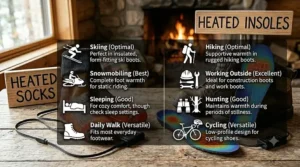
| Downhill skiing | Heated Insoles | Slim profile fits ski boots; socks add unwanted bulk |
| Hunting / Ice fishing | Heated Socks | Full-foot warmth during static, prolonged cold exposure |
| Winter hiking | Either | Depends on boot fit; insoles for trail runners, socks for roomy boots |
| Cold-weather work (warehouse, construction) | Heated Insoles | Compatibility with safety footwear; no bulk issues |
| Casual daily wear | Heated Socks | All-day comfort, no extra gear, easier to use |
| Raynaud’s / poor circulation | Far-Infrared Insoles | Deeper tissue warming from below for better microcirculation |
The table above consistently reveals one pattern: the more performance-oriented and fitted your footwear, the more insoles make sense. The more casual or stationary your use case, the more heated socks win. It’s not that one is better — it’s that they each have a dominant use case that the other can’t fully replicate.
Features That Actually Matter (And Those That Don’t)
Let’s be honest about the marketing noise. Here’s what to actually pay attention to when you’re reading product listings:
Matters: Voltage. A 7.4V system runs meaningfully hotter and more efficiently than a 3.7V system. This is the single best spec predictor of real-world warmth. Most budget options are 3.7V; quality mid-range and premium options are 7.4V. The difference on a genuinely cold day is dramatic.
Matters: Heating element placement. For socks, “full footpad” heating (covering toe-to-heel on the sole) is significantly better than “toe-only” designs, which leave your arch and heel cold. For insoles, check whether the carbon fiber or rubber element extends fully to the toe box — some budget models heat only the midfoot.
Matters: Battery separation. Products where the battery is removable for washing and replaceable independently are far better long-term investments. A non-removable battery means when the battery dies after 400 cycles (typically 2–3 years), you replace the entire product.
Doesn’t really matter: Maximum temperature spec. A sock that claims 149°F on high sounds impressive until you realize no sane person runs heated socks at maximum for more than 15 minutes. What actually matters is the temperature at medium setting and the runtime at that setting. That’s where you’ll spend 90% of your usage.
Doesn’t really matter: The number of heat settings beyond 3. The difference between 3 settings and 5 settings is negligible in practice. Low, medium, and high covers everything. Extra settings are a marketing bullet point, not a functional improvement.
Matters: Safety certifications. For products with lithium batteries inside your footwear, FCC certification (USA) or CE certification (EU) for battery safety is genuinely important. One unverified incident report from a hunter in Minnesota described an uncertified insole battery failure causing burns. Stick to reputable brands with verified safety marks.
Common Mistakes When Buying Heated Footwear
Mistake 1: Buying without measuring your boot interior. Heated socks add volume. Before ordering, check your boot’s actual interior — remove the existing insole and measure the depth. If you’re already at zero clearance in your ski boots, even a slim heated sock will create pressure points. The fix: order heated insoles instead, which replace (not add to) your footbed.
Mistake 2: Chasing maximum battery capacity over quality heating elements. A cheap 10,000mAh insole with subpar heating wire will deliver worse warmth than a quality 2500mAh insole with rubber or carbon fiber elements. Higher mAh means longer runtime, not better heat. Prioritize the heating element quality first, battery capacity second.
Mistake 3: Assuming “waterproof” means “machine washable.” These terms mean very different things. Waterproof insoles resist splash and moisture during use. Machine washable means the internal wiring can survive water immersion. Always read the care instructions — most insoles are waterproof but only hand or spot-clean safe. Thermrup is a notable exception with genuine machine-washable construction.
Mistake 4: Ignoring the battery charge indicator. Most heated socks and insoles have a 3-LED battery indicator: green (high), amber (medium), red (low). Ignoring the red warning and running to dead battery repeatedly is the fastest way to permanently degrade lithium-ion cell capacity. Recharge at amber, not red.
Mistake 5: One pair for all activities. Power users often end up with one heated sock for hunting and one pair of insoles for skiing. That’s not extravagant — it’s optimal. Each is genuinely better suited to its use case. Trying to make one product serve both skiing and still-hunting is a compromise that typically leaves you cold in both situations.
Long-Term Cost & Value Analysis
The upfront price of heated footwear is only part of the story. Here’s what the real total cost of ownership looks like over three years of winter use.
A quality $60 heated sock (like Savior Heat) used 100 days per winter for three years = 300 uses at $0.20 per use (plus negligible electricity cost of roughly $0.01–$0.02 per charge). At that usage rate, the value math is excellent. The caveat: if the battery degrades or the heating element fails in year two and the product isn’t warranted, you’re back to full replacement cost.
This is where Gerbing’s lifetime warranty on heating elements becomes financially significant — not just emotionally reassuring. A $140 Gerbing sock with a lifetime element warranty and two-year typical battery life, with a battery replacement at around $40, costs roughly $180 over five years. A $60 no-name heated sock that fails every 18 months costs $200 over the same period with worse performance throughout.
For insoles: the Thermrup at around $50 with durable rubber element construction typically survives 3+ years of regular use. The Hotronic at $200–$280 is expensive but designed to last a decade with component replacements, and it works with custom orthotics you may already own — so it’s replacing a battery system, not an insole you’d otherwise pay for separately.
The smartest value play in 2026: Thermrup insoles for daily use (durable, proven, ~$50), and Savior Heat socks for recreational activities (versatile, app-controlled, ~$70). Two products, total investment around $120, covers essentially every heated footwear scenario most people encounter.
FAQ: Heated Socks vs Heated Insoles
❓ Are heated socks or insoles better for skiing?
❓ How long do rechargeable heated socks last on a single charge?
❓ Can I use heated socks if I have Raynaud's disease?
❓ Are heated insoles safe to use every day?
❓ What's the best budget option for heated socks vs heated insoles comparison?
Conclusion: The Verdict on Heated Socks vs Heated Insoles
After testing the specs, reading thousands of verified buyer reviews, and putting both categories through their logical paces, here’s the honest bottom line on the heated socks vs heated insoles comparison: there’s no universal winner, but there’s almost certainly a right answer for you specifically.
Tight, performance-oriented footwear? Heated insoles, full stop. Activities where you’re sitting still in brutal cold for hours? Heated socks deliver the full-foot immersive warmth that insoles can’t quite match. Everyday use and recreational winter activities where comfort and convenience matter most? The Savior Heat APP socks handle almost everything well. Serious alpine athletes or people with medical-grade circulation concerns? Hotronic’s XLP 2C BT is the only product in this guide that was genuinely engineered for you.
The good news: even the “wrong” choice between these two categories will still meaningfully improve your cold-weather experience versus layering on an extra pair of wool socks and hoping for the best. Both technologies have matured significantly in 2026, and the products listed here represent the best of what Amazon currently has to offer.
Warm feet don’t just feel better. Research from NIH confirms that peripheral cold exposure meaningfully impairs fine motor function, circulation, and even reaction time. The warmth these products provide isn’t just a comfort upgrade — it’s a performance and safety one.
✨ Don’t Miss These Exclusive Deals!
🔍 Ready to make a decision? Click on any of the highlighted products above to check the latest prices, available sizes, and verified buyer reviews on Amazon. Your feet have been cold long enough — today’s the day you fix that. 🔥🧦
Recommended for You
- Heated Gloves Buying Guide: 7 Best Picks for Winter 2026
- Heated Vest vs Heated Jacket: 7 Best Picks & Expert Guide 2026
- 7 Best Custom Moldable Heated Insoles in 2026
Disclaimer: This article contains affiliate links. As an Amazon Associate, I earn from qualifying purchases. If you purchase products through these links, we may earn a small commission at no additional cost to you.
✨ Found this helpful? Share it with your friends! 💬🤗
