
In This Article
✨Was this helpful? Spread the word! 🚀
I’ll be honest with you—when I first encountered a direct vent water heater during a home renovation project, I was skeptical. How could something that pulls air from outside actually be more efficient than traditional water heaters? But after installing one in my own home and seeing the energy bills drop by 20%, I became a true believer.
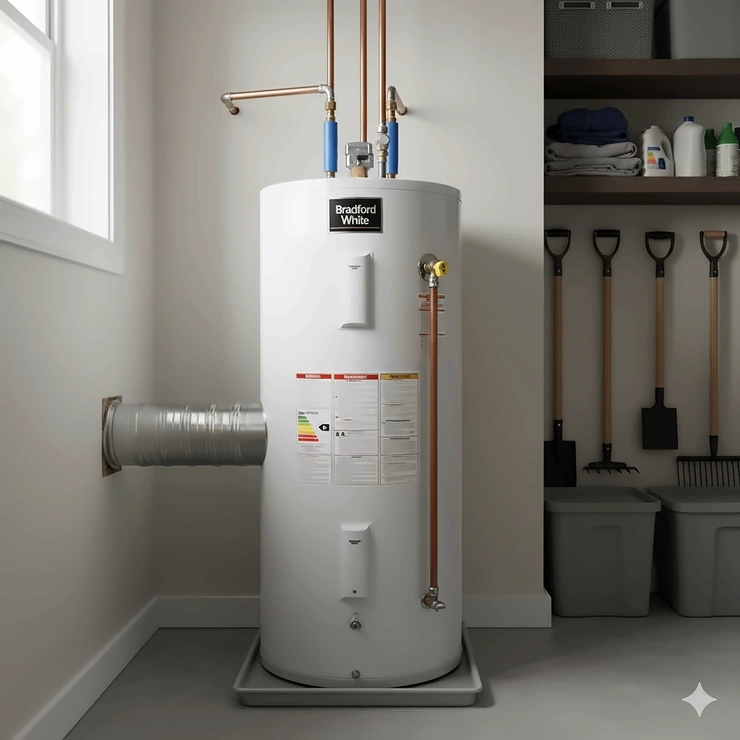
A direct vent water heater represents one of the smartest investments you can make for your home’s comfort and efficiency. Unlike conventional atmospheric vent units that draw air from inside your home, these innovative systems use a sealed combustion chamber that pulls fresh air directly from outside. This clever design eliminates backdrafting concerns, improves indoor air quality, and delivers consistent hot water performance even in tightly sealed modern homes.
What makes a direct vent water heater particularly appealing in 2025 is its versatility. Whether you’re building a new home, renovating a basement, or replacing an aging unit in a manufactured home, these heaters offer installation flexibility that traditional models simply can’t match. The dual-pipe venting system handles both air intake and exhaust through a single wall penetration, making installation cleaner and often more cost-effective.
Throughout this guide, I’ll walk you through everything you need to know—from understanding how direct vent water heaters work to choosing the perfect model for your household. We’ll explore seven top-rated options currently available, compare their specifications, and help you make an informed decision that’ll serve your family for years to come.
Quick Comparison Table
| Model | Type | Capacity | Efficiency | BTU | Price Range | Best For |
|---|---|---|---|---|---|---|
| Rheem Performance XG50T06DV36U0 | Tank | 50 gal | 0.63 UEF | 36,000 | $1,200-$1,400 | Budget-conscious homeowners |
| A.O. Smith ProLine GDVT-50 | Tank | 50 gal | 0.66 UEF | 47,000 | $1,400-$1,700 | Mid-range reliability |
| Bradford White RG2DV50S6N-FLX | Tank | 50 gal | 0.66 UEF | 40,000 | $1,500-$1,800 | Families needing durability |
| A.O. Smith Vertex GDHE-50 | Tank | 50 gal | 0.88 UEF | 100,000 | $2,800-$3,200 | High-efficiency seekers |
| Bradford White RG2PDV50H6N | Tank | 50 gal | 0.72 UEF | 60,000 | $1,900-$2,300 | ENERGY STAR compliance |
| Rheem RTG-70DVLN-1 | Tankless | N/A | 0.82 UEF | 160,000 | $1,600-$2,000 | Endless hot water |
| Rinnai RUCS75IN | Tankless | N/A | 0.91 UEF | 160,000 | $1,800-$2,200 | Premium performance |
💬 Just one click – help others make better buying decisions too!😊
🎯 Expert’s Quick Pick
For most households, I recommend the A.O. Smith ProLine GDVT-50. It strikes the perfect balance between price, performance, and reliability, with excellent warranty coverage and proven durability.
Top 7 Direct Vent Water Heaters: Expert Analysis
1. Rheem Performance XG50T06DV36U0 – Best Budget-Friendly Option
If you’re working with a tighter budget but still want quality performance, the Rheem Performance XG50T06DV36U0 delivers exceptional value. This 50-gallon tank model features a 36,000 BTU burner that provides reliable hot water for families of 3-4 people.
Key Specifications:
- First hour rating: 79 gallons
- Recovery rate: 43 gallons per hour
- 6-year limited warranty on tank and parts
What Customers Say: Homeowners consistently praise this unit’s straightforward installation and reliable performance. One verified buyer mentioned, “We’ve had ours for three years now, and it’s never let us down—even during those back-to-back showers on busy mornings.”
✅ Pros:
- Affordable entry point into direct vent technology
- Compact 22-inch diameter fits most spaces
- Self-diagnostic electronic gas control
❌ Cons:
- Lower BTU rating means slower recovery
- Basic efficiency compared to premium models
Price Range: $1,200-$1,400
2. A.O. Smith ProLine GDVT-50 – Best Overall Value
The A.O. Smith ProLine GDVT-50 stands out as my top recommendation for most homeowners. With its 47,000 BTU burner and commercial-grade construction, this workhorse handles demanding household needs with ease.
Key Specifications:
- 50-gallon nominal capacity
- 0.66 UEF efficiency rating
- Blue Diamond glass tank lining
- DynaClean automatic sediment cleaning
What Customers Say: Professional plumbers frequently install this model, citing its durability and minimal callback issues. Homeowners appreciate the consistent water temperature and the CoreGard anode rod that extends tank life significantly.
✅ Pros:
- Commercial-grade components in residential package
- Superior tank protection technology
- Easy horizontal installation up to 80 inches from exterior wall
❌ Cons:
- Slightly higher initial cost than budget models
- Available only through professional wholesalers
Price Range: $1,400-$1,700
3. Bradford White RG2DV50S6N-FLX – Best with Flexible Venting
Bradford White’s reputation for durability shines through in the RG2DV50S6N-FLX. This model comes with a flexible vent kit that simplifies installation in challenging spaces, making it perfect for renovations or retrofit projects.
Key Specifications:
- Defender FVIR system with ScreenLok flame arrestor
- ICON System for precise temperature control
- Vitraglas tank lining with Microban
- Hydrojet Total Performance System
What Customers Say: Installers love the included flex vent kit, which cuts installation time significantly. Homeowners report excellent longevity, with many units exceeding their warranty period by several years.
✅ Pros:
- Includes premium flex vent kit in the package
- Exceptional sediment management system
- Cast aluminum air intake boot for durability
❌ Cons:
- Heavier than competitors at 212 pounds
- Requires more clearance for service access
Price Range: $1,500-$1,800
4. A.O. Smith Vertex GDHE-50 – Best High-Efficiency Model
For homeowners serious about energy savings, the A.O. Smith Vertex GDHE-50 represents the pinnacle of tank water heater efficiency. With its 96% thermal efficiency and 0.88 UEF rating, this ENERGY STAR certified unit delivers substantial utility bill savings.
Key Specifications:
- 100,000 BTU condensing burner
- Recovery rate: 129 gallons per hour
- Helical coil heat exchanger
- Continuous flow: 4+ gallons per minute
What Customers Say: Users report dramatic reductions in gas bills—some citing savings of $30-50 per month. The ultra-low NOx emissions also appeal to environmentally conscious homeowners.
✅ Pros:
- Industry-leading 96% thermal efficiency
- Massive 129 GPH recovery rate
- Meets strictest emission standards
❌ Cons:
- Significantly higher upfront investment
- Requires condensate drain for operation
Price Range: $2,800-$3,200
5. Bradford White RG2PDV50H6N – Best ENERGY STAR Certified
The Bradford White RG2PDV50H6N combines power and efficiency in an ENERGY STAR qualified package. Its 60,000 BTU burner provides excellent recovery while maintaining a 0.72 UEF rating.
Key Specifications:
- Power direct vent technology
- 90-degree recovery: 65 gallons per hour
- Electronic sensor prevents flammable vapor ignition
- Horizontal and vertical venting capability
What Customers Say: Homeowners in tightly sealed homes particularly appreciate this model’s sealed combustion system. The powerful blower motor ensures proper venting even in challenging installations.
✅ Pros:
- ENERGY STAR qualification saves money long-term
- Versatile venting options
- Enhanced safety features
❌ Cons:
- Requires nearby electrical outlet for blower
- Not certified for certain California air quality districts
Price Range: $1,900-$2,300
6. Rheem RTG-70DVLN-1 – Best Tankless Direct Vent
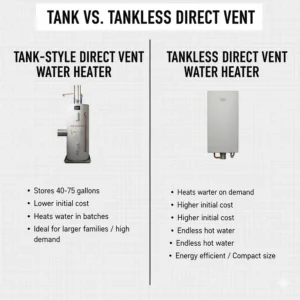
Switching gears to tankless options, the Rheem RTG-70DVLN-1 offers endless hot water in a compact, direct vent package. This 160,000 BTU unit handles multiple simultaneous demands without breaking a sweat.
Key Specifications:
- 0.82 UEF efficiency
- 3-inch/5-inch concentric venting
- EcoNet mobile app compatibility
- Hot Start Programming feature
What Customers Say: Large families love never running out of hot water. The unit’s ability to maintain consistent temperature during multiple showers earns consistent praise in customer reviews.
✅ Pros:
- Unlimited hot water supply
- Space-saving wall-mount design
- Low 0.26 GPM activation flow
❌ Cons:
- Higher initial investment than tank models
- Requires 120V power supply
Price Range: $1,600-$2,000
7. Rinnai RUCS75IN – Best Premium Tankless
For those seeking the ultimate in tankless performance, the Rinnai RUCS75IN delivers. This condensing unit achieves an impressive 0.91 UEF while providing 7.5 GPM at a 40-degree temperature rise—enough for large homes with high demand.
Key Specifications:
- Ultra-low NOx emissions
- Concentric vent compatibility
- Commercial-grade construction
- Individual factory testing
What Customers Say: Premium buyers appreciate Rinnai’s legendary reliability and whisper-quiet operation. Many report 10+ years of trouble-free service with proper maintenance.
✅ Pros:
- Industry-leading efficiency and performance
- Extremely quiet operation
- Proven longevity with proper care
❌ Cons:
- Premium pricing
- Professional installation strongly recommended
Price Range: $1,800-$2,200
✨ Don’t Miss These Exclusive Deals! 🛒
Ready to upgrade your home’s hot water system? Click on any highlighted product above to check current pricing and availability on Amazon. These carefully selected models represent the best direct vent water heater options for 2025, each backed by strong warranties and customer satisfaction. Don’t let another day go by with inadequate hot water—invest in comfort and efficiency today! 💧⚡
What Is a Direct Vent Water Heater?
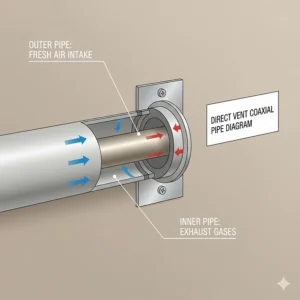
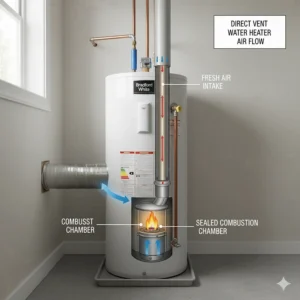
Let me break down the technology in simple terms. A direct vent water heater is a specialized heating appliance that uses a sealed combustion system to heat water efficiently and safely. The “direct vent” designation refers to its unique venting configuration that simultaneously draws fresh air from outside for combustion and exhausts waste gases back outdoors—all through a single, dual-chamber pipe assembly.
Think of it like this: traditional atmospheric vent heaters are like having a fireplace that pulls air from inside your home. In contrast, a direct vent water heater operates more like a hermetically sealed unit that’s completely independent of your indoor air supply. This closed-loop system prevents any combustion byproducts from entering your living space, making these units particularly safe for installation in tight spaces, closets, or manufactured homes.
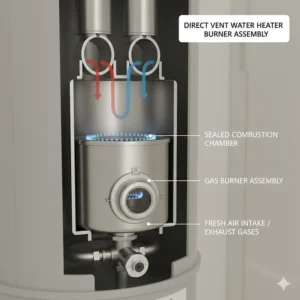
The technology relies on either natural convection or a powered blower (in power direct vent models) to manage airflow. A coaxial vent pipe—essentially one pipe nested inside another—handles both functions elegantly. The inner pipe exhausts combustion gases while the outer pipe simultaneously pulls in fresh air for the burner. This ingenious design minimizes wall penetrations and simplifies installation compared to separate intake and exhaust systems.
Direct vent water heaters represent a significant advancement over older atmospheric venting because they eliminate backdrafting concerns entirely. In modern, energy-efficient homes that are tightly sealed against air infiltration, atmospheric vents can struggle to find adequate combustion air. Direct vent technology sidesteps this issue completely by sourcing air independently from outdoors.
How Direct Vent Systems Work: The Science Made Simple
Understanding the mechanics helps you appreciate why these systems perform so well. When you turn on a hot water tap, here’s what happens inside your direct vent water heater:
Step 1: Air Intake
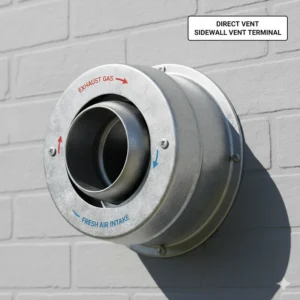
The outer chamber of the vent pipe draws fresh, oxygen-rich air from outside through a terminal mounted on your home’s exterior wall. This air travels through the annular space (the gap between inner and outer pipes) toward the water heater.
Step 2: Combustion Process
Fresh air enters the sealed combustion chamber where it mixes with natural gas or propane at precisely controlled ratios. The burner ignites this mixture using either a pilot light or electronic ignition system, creating intense heat that transfers to the water in the tank.
Step 3: Heat Transfer
Hot combustion gases rise through the flue tube at the tank’s center, transferring thermal energy to the surrounding water. High-efficiency models use enhanced heat exchangers or helical coils to extract maximum heat before exhausting gases.
Step 4: Exhaust Ventilation
Cooled exhaust gases containing carbon dioxide and water vapor travel back through the inner vent pipe to the exterior terminal, where they safely disperse into the atmosphere. The process creates a natural draft or uses a powered blower to maintain proper flow.
Step 5: Safety Systems
Modern direct vent water heaters incorporate multiple safety features. Flame arrestors prevent external ignition, oxygen depletion sensors shut down operation if intake is blocked, and thermal switches prevent overheating. These safeguards make direct vent systems among the safest water heating options available.
The beauty of this design lies in its self-contained operation. Your furnace, cooking appliances, and water heater don’t compete for combustion air, and there’s zero risk of carbon monoxide entering living spaces through backdrafting.
Direct Vent vs Traditional Water Heaters: Key Differences
| Feature | Direct Vent Water Heater | Atmospheric Vent | Power Vent |
|---|---|---|---|
| Air Source | Outside air only | Indoor air | Indoor air |
| Venting Method | Horizontal/vertical through wall | Vertical through roof | Horizontal/vertical |
| Installation Flexibility | High – can go anywhere | Low – needs chimney access | Medium – needs electrical |
| Indoor Air Quality | Excellent – sealed system | Good – draws indoor air | Good – draws indoor air |
| Backdrafting Risk | Zero | Moderate | Low |
| Energy Efficiency | 0.63-0.88 UEF typical | 0.58-0.64 UEF typical | 0.67-0.76 UEF typical |
| Ideal For | Tight homes, basements | Traditional homes with chimneys | Flexible installations |
The differences extend beyond specifications. In practical terms, a direct vent water heater offers installation options that simply aren’t possible with atmospheric venting. Got a basement mechanical room with no chimney access? No problem. Need to install a water heater in a manufactured home? Perfect application. Want to put your heater in a closet within living space? Direct vent makes it safe and feasible.
Traditional atmospheric vent systems, while proven and reliable, face increasing challenges in modern construction. Today’s homes feature advanced air sealing techniques that dramatically reduce air infiltration. This improved envelope performance—while excellent for energy efficiency—can starve atmospheric combustion appliances of adequate air. Direct vent technology elegantly solves this problem by going straight to the source.
Benefits of Direct Vent Water Heaters
Superior Indoor Air Quality 🌬️
One of the most compelling advantages I’ve noticed is the improvement in indoor air quality. Since the combustion process remains completely sealed from your living space, there’s no depletion of indoor oxygen levels and zero introduction of combustion byproducts. This matters tremendously if you have family members with respiratory sensitivities or allergies.
The sealed combustion chamber also means your home’s air isn’t being pulled up the flue. With atmospheric vents, heated indoor air continuously escapes through the chimney—air you’ve already paid to condition. Direct vent systems eliminate this parasitic loss entirely.
Installation Versatility and Flexibility 🔧
Here’s where direct vent technology really shines. I’ve helped friends install these units in locations that would be impossible with traditional venting:
✅ Basements without chimney access – Simply vent through the rim joist
✅ Interior closets and utility rooms – Safe because combustion is sealed
✅ Manufactured and modular homes – Specifically designed for these applications
✅ Tight spaces – Horizontal venting eliminates need for vertical clearance
✅ Multi-story buildings – No complex vertical venting required
The horizontal venting capability is particularly valuable. Most direct vent water heaters can exhaust through a sidewall up to 80 inches from the unit without requiring any electrical power. This dramatically reduces installation complexity and cost compared to running vent pipe through multiple floors to reach a roof termination.
Enhanced Safety Features 🛡️
Safety represents another area where direct vent systems excel. The closed combustion design inherently prevents several hazards associated with traditional heaters:
✅ Zero backdrafting risk – Combustion gases can’t spill into living spaces
✅ No oxygen depletion – Indoor air remains untouched by combustion process
✅ FVIR compliance – Flammable Vapor Ignition Resistant systems are standard
✅ Sealed operation – No exposure to combustion chamber or pilot light
Modern models incorporate advanced safety technologies like electronic gas controls with self-diagnostics, thermal switches that prevent overheating, and flame arrestors that prevent external ignition sources from causing problems.
Energy Efficiency and Cost Savings 💰
While initial costs run slightly higher than basic atmospheric models, direct vent water heaters typically offer better efficiency. The sealed combustion process combined with improved insulation results in higher Uniform Energy Factor (UEF) ratings.
Consider these potential savings:
- Reduced standby losses from better insulation and sealed operation
- Higher combustion efficiency through optimized air-fuel ratios
- No conditioned air loss up the chimney during operation
- Tax credits and rebates often available for high-efficiency models
Many homeowners report 15-25% reductions in water heating costs after upgrading from an old atmospheric unit to a modern direct vent model. Over a typical 10-12 year lifespan, these savings can offset the premium initial investment.
Choosing the Right Size: Capacity Matters
Getting the size right is crucial for satisfaction with your new direct vent water heater. Too small, and you’ll run out of hot water. Too large, and you’re wasting energy heating water you don’t use. Let me walk you through the sizing process I use when helping friends and family choose their units.
Understanding First Hour Rating (FHR) 📊
The First Hour Rating tells you how many gallons of hot water the heater can supply in a single hour when starting with a full tank. This metric matters more than tank capacity alone because it accounts for both stored water and recovery during use.
Here’s a practical approach to determining your household’s FHR requirements:
Morning Rush Hour Calculation:
- Shower (2.5 GPM × 10 min) = 25 gallons
- Second shower = 25 gallons
- Dishwasher cycle = 6 gallons
- Hand washing/shaving = 4 gallons
- Total needed: 60 gallons
For this scenario, you’d want a direct vent water heater with a FHR of at least 60-65 gallons to handle peak demand comfortably.
Tank Capacity Guidelines by Household Size 👨👩👧👦
While FHR provides better guidance, tank capacity still matters for establishing baseline supply. Here’s what I typically recommend:
- 1-2 people: 30-40 gallon capacity (50-60 FHR)
- 2-3 people: 40-50 gallon capacity (60-70 FHR)
- 3-4 people: 50 gallon capacity (70-80 FHR)
- 5+ people: 50-75 gallon capacity (80-100+ FHR) or consider tankless
Remember that usage patterns matter as much as household size. A family of four with teenagers who take long showers needs more capacity than a family of four with young children.
Recovery Rate Considerations ⚡
Recovery rate indicates how quickly your direct vent water heater can reheat a full tank after depletion. This specification, measured in gallons per hour at a 90-degree temperature rise, varies significantly based on BTU input:
- 30,000-40,000 BTU: 40-50 GPH recovery
- 45,000-50,000 BTU: 50-60 GPH recovery
- 60,000-75,000 BTU: 65-80 GPH recovery
- 80,000-100,000 BTU: 85-130 GPH recovery
Higher recovery rates provide more flexibility for back-to-back hot water demands. If your household tends to cluster activities—everyone showering in the morning, for example—prioritize models with higher recovery rates.
Installation Requirements: What You Need to Know
Installing a direct vent water heater involves specific requirements that differ from traditional models. While I always recommend professional installation, understanding these requirements helps you prepare properly and budget accurately.
Venting Components and Clearances 🔩
The venting system forms the heart of direct vent technology. You’ll need:
Core Components:
- Coaxial vent pipe (typically 3-inch inner, 5-inch outer diameter)
- Exterior wall terminal with rain cap and pest screen
- Vent restrictor (for installations under 30 inches)
- Support clamps and wall thimbles
- High-temperature sealant
Clearance Requirements:
- Minimum from ground: 12 inches for vent termination
- From windows/doors: 4 feet horizontal, 1 foot below
- From air intakes: 3-4 feet depending on local codes
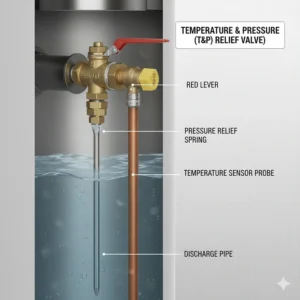
- Interior clearances: Varies by model (typically 6 inches sides, 2 inches back)
Most direct vent water heaters accommodate horizontal runs up to 80 inches without requiring additional power. For longer runs or vertical installations through multiple floors, consider power direct vent models with integral blowers.
Gas Line and Electrical Considerations ⚡
Your direct vent water heater needs proper gas and electrical service:
Gas Requirements:
- Natural gas or propane supply line (typically 1/2-inch)
- Properly sized for BTU input and pipe length
- Approved black iron pipe or CSST flexible gas line
- Manual shut-off valve within 6 feet of unit
- Sediment trap (drip leg) before inlet connection
Electrical Needs: Standard direct vent models require minimal electrical—just 120V for electronic ignition and controls. Power direct vent models need additional current for the blower motor. Requirements include:
- Dedicated 120V circuit
- Grounded outlet within 3-4 feet of unit
- GFCI protection recommended for wet locations
Condensate Drainage (High-Efficiency Models) 💧
Condensing direct vent water heaters like the A.O. Smith Vertex GDHE-50 produce condensate that must be properly drained. You’ll need:
- PVC drain line (3/4-inch minimum)
- Condensate neutralizer kit (some jurisdictions)
- Connection to floor drain or sump pump
- Proper slope (minimum 1/4-inch per foot)
This requirement adds complexity but shouldn’t deter you from considering high-efficiency models. The energy savings typically justify the extra installation steps.
Professional vs. DIY Installation 👷♂️
I strongly advocate for professional installation of direct vent water heaters. Here’s why:
✅ Code compliance – Plumbers understand local regulations
✅ Safety assurance – Proper gas connections and venting prevent hazards
✅ Warranty protection – Many manufacturers require professional installation
✅ Optimal performance – Correct setup ensures efficiency and longevity
✅ Permitting – Pros handle inspections and permit requirements
Typical professional installation costs range from $500-$1,200 depending on:
- Accessibility of installation location
- Need for gas line modifications
- Venting complexity
- Local labor rates
- Disposal of old unit
Maintenance Tips for Longevity
Proper maintenance extends the life of your direct vent water heater significantly. I’ve seen well-maintained units last 15+ years while neglected ones fail within 8-10 years. Here’s my maintenance schedule based on years of experience.
Annual Maintenance Tasks 🔧
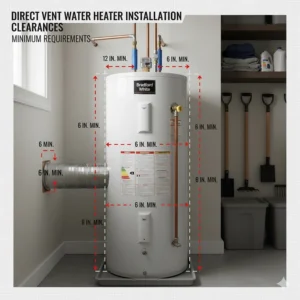
Temperature & Pressure Relief Valve Test
Once yearly, lift the T&P valve lever to ensure it operates freely and reseats properly. This critical safety device should discharge water when lifted and stop completely when released. If it continues dripping, replacement is necessary.
Sediment Flushing
Connect a garden hose to the drain valve and flush several gallons to remove accumulated sediment. For moderate to hard water areas, I recommend flushing 5-10 gallons every 6 months. This simple task dramatically improves efficiency and extends tank life.
Anode Rod Inspection
Check your sacrificial anode rod every 2-3 years. This component protects your tank from corrosion by attracting corrosive elements. When the rod is worn to less than 1/2-inch diameter or the core wire is exposed, replace it promptly.
Combustion Chamber Inspection
Visually inspect the burner area for debris, rust, or signs of improper combustion (soot buildup). Most direct vent water heaters feature sight windows for easy observation. Clean buildup with a soft brush and vacuum.
Monthly Quick Checks ✓
Temperature Setting Verification
Confirm your thermostat remains at 120°F—the ideal balance between safety and efficiency. Higher settings increase scalding risk and energy consumption. Lower settings may not adequately kill Legionella bacteria.
Vent Terminal Inspection
Check the exterior vent terminal for obstructions like bird nests, leaves, or insect activity. Ensure the rain cap moves freely and the pest screen remains intact.
Leak Detection
Look around the base of your unit for water accumulation indicating tank corrosion or connection leaks. Early detection prevents major damage.
Professional Service Schedule 🔧
Every 3-5 Years: Comprehensive Inspection
Hire a qualified plumber to perform thorough maintenance including:
- Complete combustion analysis
- Gas valve and burner cleaning
- Vent system inspection
- Electronic control testing
- Water quality assessment
- Anode rod replacement if needed
This professional service typically costs $150-$300 but can prevent expensive failures and extend unit lifespan by years.
Water Quality Considerations 💧
Hard water significantly impacts water heater longevity. If your water exceeds 7 grains per gallon hardness (120 ppm), consider:
- Installing a whole-house water softener
- More frequent sediment flushing (quarterly)
- Powered anode rods for enhanced protection
- Electronic descaling devices
I’ve seen dramatic lifespan differences between units in soft vs. hard water areas—sometimes 5+ years of additional service with proper water treatment.
Troubleshooting Common Issues
Even reliable direct vent water heaters occasionally experience problems. Here’s how to diagnose and address common issues before calling a professional.
No Hot Water 🚫
Possible Causes:
- Pilot light or ignition failure – Check if pilot is lit (units with pilot) or listen for ignition clicking (electronic ignition models)
- Gas supply interruption – Verify gas valve is fully open and other gas appliances work
- Tripped thermostat – Some models have resettable limit switches
- Electronic control failure – Check for error codes on LED display
DIY Fixes:
- Relight pilot following manufacturer’s instructions
- Press reset button on gas control if available
- Verify 120V power supply to unit
- Check circuit breaker hasn’t tripped
When to Call Pro: If relighting doesn’t work after 2-3 attempts, or if you smell gas, shut off supply and contact professional immediately.
Insufficient Hot Water ♨️
Possible Causes:
- Sediment buildup reducing capacity
- Defective thermostat not maintaining set temperature
- Undersized unit for household demand
- Dip tube failure allowing cold/hot water mixing
DIY Fixes:
- Flush tank to remove sediment
- Verify thermostat setting at 120°F
- Test T&P valve to ensure it’s seating properly
- Reduce simultaneous hot water usage
When to Call Pro: Persistent problems despite flushing or temperature adjustments require professional diagnosis, especially for thermostat or dip tube issues.
Strange Noises 🔊
Rumbling/Popping Sounds:
This classic “kettling” noise indicates sediment buildup heating and releasing steam bubbles. The fix is straightforward: flush the tank thoroughly until water runs clear.
Hissing/Sizzling:
Typically indicates water dripping onto hot surfaces. Check for:
- Leaking T&P valve
- Condensation on vent pipe dripping back
- Minor tank pinhole leaks
Banging/Hammering:
Water hammer in supply lines, not the heater itself. Install water hammer arrestors at the unit’s connections to solve this problem.
Discolored or Smelly Water 🚰
Rusty/Brown Water:
Usually indicates tank corrosion and imminent failure. Check if discoloration occurs only from hot water taps (tank issue) or all taps (supply line issue). If limited to hot water, begin shopping for replacement—the tank is corroding internally.
Rotten Egg Smell:
Sulfur bacteria reacting with anode rod produces this distinctive odor. Solutions include:
- Flushing and disinfecting tank with hydrogen peroxide solution
- Replacing standard anode with powered anode rod
- Installing water treatment system
This issue is more common in well water systems and doesn’t indicate equipment failure.
Energy Efficiency: Maximizing Your Investment
Getting the most efficiency from your direct vent water heater involves more than just buying a high-UEF model. I’ve identified several strategies that substantially reduce operating costs without sacrificing comfort.
Understanding UEF Ratings 📈
The Uniform Energy Factor replaced the old Energy Factor rating in 2017, providing more consistent comparison across models. UEF represents the ratio of useful energy output to total energy input, with higher numbers indicating better efficiency.
UEF Rating Tiers:
- 0.58-0.63: Standard efficiency atmospheric vents
- 0.63-0.70: Good efficiency direct vent models
- 0.70-0.85: High efficiency power vent/direct vent
- 0.85-0.95: Premium high-efficiency condensing models
- 0.95+: Ultra-high efficiency (typically tankless)
Each 0.05 increase in UEF translates to roughly 5% lower operating costs. Over a 10-year lifespan, upgrading from a 0.60 UEF to 0.70 UEF unit can save $200-400 in energy costs (depending on local gas prices and usage).
Insulation and Heat Loss Prevention 🔋
Even with good inherent efficiency, heat loss through pipes and tank surfaces wastes energy. Here’s how to minimize losses:
Tank Insulation:
Most modern direct vent water heaters feature adequate factory insulation (R-16 to R-24). However, if your model shows significant surface warmth, consider an insulation blanket—but check manufacturer guidelines first, as some models shouldn’t be wrapped.
Pipe Insulation:
This often-overlooked step offers immediate benefits. Insulate at least the first 6 feet of hot water pipes leaving your heater using:
- 3/4-inch foam pipe insulation for 3/4-inch pipes
- 1-inch foam for 1-inch pipes
- Self-sealing slit variety for easy installation
Properly insulated pipes reduce standby losses by 25-40% and deliver hot water to fixtures faster, reducing waste.
Heat Trap Nipples:
Most quality direct vent water heaters include factory-installed heat traps that prevent convective heat loss through pipes. These one-way valves maintain hot water in the tank rather than allowing it to migrate up supply lines.
Smart Usage Patterns 🧠
Behavioral changes cost nothing but deliver measurable savings:
Lower Temperature Settings:
Every 10-degree reduction below 140°F saves 3-5% on water heating costs. The sweet spot for most households is 120°F—safe from bacteria, comfortable for use, and efficient.
Strategic Timing:
If you have time-of-use electricity rates (affecting power direct vent models), schedule heavy usage during off-peak hours when possible.
Fixture Upgrades:
Low-flow showerheads (1.5-2.0 GPM) and aerators dramatically reduce hot water consumption without noticeable comfort loss. A family of four can save 5,000-8,000 gallons of hot water annually with these simple upgrades.
ENERGY STAR and Rebate Programs 💵
Qualifying direct vent water heaters often make you eligible for incentives:
Federal Tax Credits:
Under the Inflation Reduction Act, efficient water heaters may qualify for up to $2,000 in federal tax credits through 2032. Requirements typically include UEF ratings of 0.81+ for gas models.
State and Local Rebates:
Many utilities and states offer additional rebates ranging from $50-600 depending on efficiency level. Check DSIRE Database for programs in your area.
Manufacturer Promotions:
Major brands periodically offer cash-back programs, extended warranties, or promotional pricing on high-efficiency models.
Combined incentives can reduce net cost by $300-1,000, making premium efficient models much more accessible.
Comparing Brands: Who Makes the Best Models?
After years of research and real-world observation, I’ve developed strong opinions about which manufacturers consistently deliver quality direct vent water heaters. Let me share insights on the major players.
Rheem – Best for Value and Innovation 🥇
Rheem earns my respect for balancing affordability with solid performance. Their Performance line offers direct vent technology at accessible price points, while their Maximus series pushes efficiency boundaries.
Strengths:
- Wide product range covering all budgets
- Excellent warranty coverage (6-12 years typical)
- EcoNet smart home integration
- Made in America
Considerations:
- Some budget models use lighter-gauge materials
- Availability varies by region
Best Models: Performance XG50T06DV36U0 (budget), Maximus MXDV-50 (premium)
A.O. Smith – Best for Commercial-Grade Durability 🏆
A.O. Smith’s ProLine series brings commercial construction quality to residential applications. These units consistently outlast competitors in challenging water conditions.
Strengths:
- Superior tank protection (Blue Diamond glass lining)
- DynaClean sediment management
- Extensive product line with specialized models
- Strong professional contractor support
Considerations:
- Available only through wholesalers/contractors
- Slightly higher pricing than big-box brands
Best Models: ProLine GDVT-50 (standard efficiency), Vertex GDHE-50 (high efficiency)
Bradford White – Best Build Quality 🔨
Bradford White’s reputation for overbuilding equipment serves customers well. Their Defender FVIR system and ICON control represent thoughtful engineering.
Strengths:
- Exceptional tank construction and coating
- Innovative safety features
- Sold only through professionals (ensures proper installation)
- Made in USA
Considerations:
- Premium pricing
- Heavier units require more installation labor
Best Models: RG2DV50S6N (standard), RG2PDV50H6N (power direct vent)
Rinnai – Best Tankless Options 🚀
For direct vent tankless applications, Rinnai’s reputation is well-earned. Their condensing units achieve remarkable efficiency while delivering endless hot water.
Strengths:
- Industry-leading reliability
- Exceptional efficiency (up to 0.98 UEF)
- Comprehensive warranty coverage
- Smart home compatibility
Considerations:
- Premium pricing across the line
- Requires professional installation and maintenance
Best Models: SENSEI RX Series (ultra-high efficiency), RUCS75IN (high capacity)
Cost Analysis: Initial Investment vs. Long-Term Savings
Understanding the complete cost picture helps justify your direct vent water heater investment. Let me break down both immediate and ongoing expenses based on real-world data.
Initial Purchase and Installation 💰
Equipment Costs:
- Budget models: $900-$1,400 (standard direct vent, 40-50 gallons)
- Mid-range models: $1,400-$2,000 (enhanced features, better efficiency)
- Premium models: $2,000-$3,200 (high efficiency, advanced controls)
- Tankless models: $1,600-$2,500 (endless hot water, maximum efficiency)
Installation Costs:
- Standard installation: $500-$800 (straightforward replacement)
- Complex installation: $800-$1,500 (new vent penetration, gas line modification)
- Tankless installation: $1,000-$2,000 (requires substantial modifications)
Additional Expenses:
- Permit fees: $50-$200
- Old unit disposal: $25-$75
- Expansion tank: $75-$150 (if not included)
- Condensate pump: $150-$300 (for some high-efficiency models)
Total Initial Investment: $1,500-$4,000 for complete professional installation
Operating Costs and Savings 📊
Annual operating costs vary based on:
- Household size and usage patterns
- Local natural gas/propane prices
- Unit efficiency (UEF rating)
- Water temperature setting
Typical Annual Operating Costs (Family of 4, $1.50/therm gas):
- 0.60 UEF unit: $350-$425/year
- 0.70 UEF unit: $300-$360/year
- 0.80 UEF unit: $260-$315/year
- 0.90 UEF unit: $225-$275/year
Savings Calculation Example:
Upgrading from 0.60 UEF to 0.80 UEF saves roughly $90-$110 annually. Over 10 years, that’s $900-$1,100 in savings—potentially offsetting the higher initial cost of the efficient model.
Break-Even Analysis ⚖️
Let’s compare two scenarios:
Scenario A: Budget Model
- Purchase: $1,200
- Installation: $600
- Annual cost: $400
- 10-year total: $5,800
Scenario B: High-Efficiency Model
- Purchase: $2,400
- Installation: $700
- Annual cost: $275
- 10-year total: $5,850
While the 10-year costs are similar, the high-efficiency model offers:
- Better performance and features
- Likely longer lifespan (12-15 years vs. 10-12 years)
- Environmental benefits
- Eligibility for rebates ($300-600 typical)
With rebates, Scenario B total drops to $5,250-$5,550—clear winner!
Direct Vent Water Heater for Manufactured Homes
Manufactured and modular homes present unique challenges for water heating. Direct vent technology specifically addresses these issues, making it the ideal solution for factory-built housing.
Why Manufactured Homes Need Direct Vent 🏠
HUD regulations for manufactured homes mandate sealed combustion for gas appliances installed indoors. This requirement stems from the tight construction and limited air exchange typical of these structures. Direct vent water heaters meet this requirement perfectly through their sealed combustion chambers.
Traditional atmospheric vent models are often prohibited in manufactured homes because:
- Insufficient makeup air for safe combustion
- No existing chimney infrastructure
- Risk of carbon monoxide accumulation
- Code violations in most jurisdictions
Approved Models and Specifications 📋
Not all direct vent water heaters are approved for manufactured housing. Look for units specifically certified to HUD standards, typically indicated by:
- HUD approval sticker/certification
- Sealed combustion design
- Flexible vent kit compatibility
- Chassis mounting brackets
Recommended Models for Manufactured Homes:
- Rheem 21IR40DV – 40-gallon, specifically designed for manufactured housing
- A.O. Smith GDVT-40 – ProLine series with HUD certification
- Bradford White MI40T6FBN – Defender series manufactured home model
Installation Considerations 🔧
Manufactured home installations require special attention to:
Mounting:
Most units mount directly to the chassis using approved brackets to prevent movement during transport (if home will be relocated).
Venting:
Vent termination through belly board or sidewall requires weatherproof terminals designed for underfloor installation. Proper sealing prevents moisture intrusion.
Clearances:
Tight spaces in manufactured homes demand careful measurement. Verify clearance specifications before purchasing.
Water Connections:
PEX or CPVC supply lines are common in manufactured homes. Ensure compatibility with your new heater’s connection requirements.
Professional installation by contractors experienced with manufactured housing is essential. They understand the specific codes and best practices for these applications.
FAQs About Direct Vent Water Heaters
❓ How long does a direct vent water heater typically last?
❓ Can I install a direct vent water heater in a closet?
❓ What's the difference between direct vent and power direct vent?
❓ Do direct vent water heaters require electricity?
❓ How much does professional installation of a direct vent water heater cost in 2025?
Conclusion: Making Your Final Decision
Choosing the right direct vent water heater represents a significant investment in your home’s comfort and efficiency. Throughout this guide, we’ve explored the technology, compared top models, and analyzed the factors that matter most for your decision.
Here’s my final advice: prioritize reliability and efficiency over initial cost savings. A quality direct vent water heater from reputable manufacturers like A.O. Smith, Rheem, or Bradford White will serve you faithfully for 12-15 years with proper maintenance. The small premium you pay upfront translates to years of worry-free hot water and lower operating costs.
For most households, the A.O. Smith ProLine GDVT-50 hits the sweet spot of performance, durability, and value. Its commercial-grade construction, proven reliability, and excellent warranty coverage make it my top recommendation. However, if maximum efficiency is your priority, the A.O. Smith Vertex GDHE-50 delivers remarkable energy savings that quickly offset its higher price.
Don’t overlook the importance of professional installation. A properly installed direct vent water heater operates more efficiently, lasts longer, and provides safer operation than a DIY job. The $500-$800 installation cost is money well spent for peace of mind and optimal performance.
Finally, remember that local rebates and federal tax credits can substantially reduce your net investment. Before making your final purchase, check available incentives in your area—you might save hundreds of dollars while upgrading to a more efficient model.
✨ Ready to Upgrade Your Hot Water System? 🔥
Don’t let another cold shower ruin your morning! Click on any of the highlighted products above to check current Amazon pricing and customer reviews. These direct vent water heater models represent the best options available in 2025, each offering unique benefits for different household needs. Whether you’re prioritizing budget, efficiency, or premium performance, there’s a perfect match waiting for you. Make the smart investment in your home’s comfort today! 💧⚡
Recommended for You
- Propane Tankless Water Heater: 7 Game-Changing Picks 2025
- Electric Mini Water Heater: 7 Best Options That Save Money
- 30 Gallon Electric Water Heater: 7 Best Picks 2025
Disclaimer: This article contains affiliate links. If you purchase products through these links, we may earn a small commission at no additional cost to you.
✨ Found this helpful? Share it with your friends! 💬🤗
