
In This Article
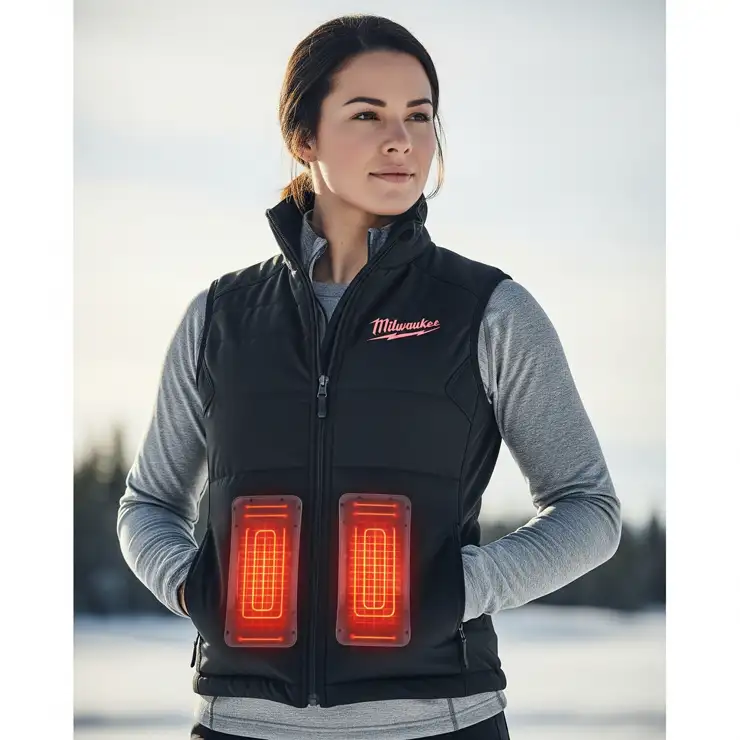
Cold doesn’t care about your schedule. It shows up at 6 a.m. on the loading dock, in the bleachers on a Friday night, and in the walk from the parking lot to an office set to “arctic.” For years, women who wanted real warmth without a puffy-jacket silhouette got a short, frustrating menu. Then Milwaukee, a brand built on jobsite tools, started cutting heated gear to women’s proportions. The women’s milwaukee heated vest has since become one of the more interesting cold-weather layers you can buy in 2026. ⚡
Here’s the pitch in plain terms. A women’s milwaukee heated vest warms your core, where warmth matters most, and it runs on the same M12 battery platform as the brand’s drills and flashlights. Your arms stay free. Your layers stay slim. And if you already own M12 batteries, the entry price can drop a lot.
Why the core? Federal workplace-safety researchers warn that cold stress can lead to hypothermia, frostbite, trench foot and chilblains. They also note that near-freezing temperatures count as a risk factor in regions unused to winter weather, per the CDC’s NIOSH cold stress overview. A heated vest is a comfort tool, not a medical device. Still, a warm torso is the foundation of any sensible cold-weather system.
This guide ranks seven real options: five from Milwaukee’s women’s heated line and two non-Milwaukee alternatives. It explains what each spec means in daily life, then closes with buying frameworks, safety notes and FAQs. Prices appear as ranges only, because they move constantly. 🔋
Women’s Milwaukee Heated Vest at a Glance: Quick Comparison
Short on time? Here’s the whole lineup side by side before we dig into each one.
| Product | Type | Heat Zones | Price Range | Best For |
|---|---|---|---|---|
| Milwaukee F300G-21 Hexon AXIS Vest Kit | Vest + battery + charger | Chest, back | Around $150-$180 | First-time buyers with no M12 gear |
| Milwaukee F300B-20 Hexon AXIS Vest (Bare Tool) | Vest only | Chest, back | Around $150-$170 | Anyone who already owns M12 batteries |
| Milwaukee 334B-21 AXIS Vest Kit | Vest + battery + charger | Chest, back | Roughly $130 and up (check current price) | Shoppers hunting a proven previous-generation design |
| Milwaukee F102B-21 AXIS Jacket | Jacket kit | Chest, back, shoulders | Check current price | Longest runtime, sleeves included |
| Milwaukee 336B-21 Heated Hoodie | Hoodie kit | Chest, back | Around $130-$170 | Casual three-season wear |
| ORORO Women’s Heated Vest | USB-C rechargeable vest | 4 zones (per listings) | Budget tier (check current price) | Light layering on a budget |
| Venustas Women’s Heated Vest | Battery-included quilted vest | Check listing | Budget-to-mid tier (check current price) | Wider heating coverage per dollar |
Looking at the table, the Milwaukee F300G-21 Hexon AXIS Vest Kit is the cleanest “buy it and wear it” option, while the Milwaukee F300B-20 Hexon AXIS Vest (Bare Tool) wins on value for anyone with batteries already sitting in a toolbox. The two non-Milwaukee picks trade tool-grade ecosystem for lower entry cost. Pricing varies by size, color and retailer, so always check current price before you commit.
💬 Just one click — help others make better buying decisions too!😊
What Is a Women’s Milwaukee Heated Vest?
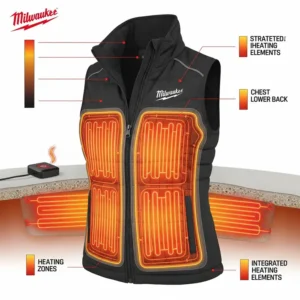
A women’s milwaukee heated vest is a sleeveless, battery-powered layer from Milwaukee Tool that warms the chest and back with embedded heating elements. Cut for women’s proportions, it runs on the 12-volt M12 battery platform, offers three heat settings, and works as either a mid-layer or a wind- and water-resistant outer shell.
The lineup has moved through three recognizable generations. The older 333 series is already listed as discontinued at one electrical distributor. The 334 series added Quick-Heat, which the manufacturer says heats up three times faster than earlier vests and competitors. That’s a brand claim, not an independent measurement. The current F300 series adds Hexon Heat Technology, built around staying warm longer and spreading heat across more of the garment.
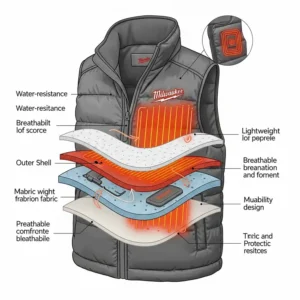
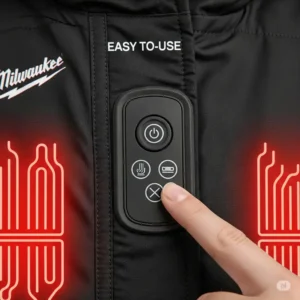
Every generation shares the same practical backbone. A one-touch controller sets the heat level, and a hidden pass-thru pocket lets you seat the battery in front or in back. The ripstop polyester shell is designed to stop small tears from spreading. Retailer listings show black, gray and green colorways across the current line, plus a matching jacket and hoodie.
Why does that matter to you? Because “milwaukee women’s heated vest” is really a family of products, not one model. Knowing which generation you’re looking at is the single biggest factor in what you’ll pay and what features you’ll get, and the next section sorts them out.
Top 7 Women’s Milwaukee Heated Vest Picks: Expert Analysis
Five Milwaukee options and two non-Milwaukee alternatives follow, each with the specs translated into everyday meaning. Review notes below are aggregated from real retailer pages and published roundups, and review pools for several models are still small.
1. Milwaukee F300G-21 Hexon AXIS Vest Kit — best all-in-one starter kit
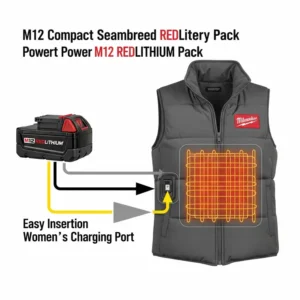
This is the box to buy if “M12 battery” means nothing to you yet. Retailer listings show it ships with the vest, an M12 REDLITHIUM 2.0 compact battery, a charger and a battery holder, so nothing needs hunting down before your first frosty morning.
The headline spec is Hexon heating across chest and back zones, plus a pass-thru pocket for front or rear battery placement. Rated runtime is 8 hours on low, 4 on medium and 2 on high. In practice, high is a short “thaw out” gear, while low is your all-shift setting. Desk-bound? Move the battery to the back pocket so it stops pressing on your stomach.
Based on the spec comparison, this is the lowest-friction entry into the line. Review volume on retailer pages is thin for this newest generation, so treat star counts cautiously. A trade-site review of the earlier AXIS vest called the cut slim and more flattering than many heated vests.
Pros:
- ✅ Everything you need ships in one box
- ✅ Hexon heat plus app-ready power source compatibility
- ✅ Machine-washable and slim enough to layer
Cons:
- ❌ Small review pool for the newest generation
- ❌ Costs more than many USB-rechargeable rivals
Expect to spend around $150-$180 depending on color and size, which is fair value when you need the battery and charger. Check current price.
2. Milwaukee F300B-20 Hexon AXIS Vest (Bare Tool) — smartest buy if you already own M12 batteries
Same vest, minus the battery and charger. That’s the whole trick, and it’s a good one. Listings show only the vest and a battery holder in the box, so every dollar goes into the garment itself.
Because it’s compatible with all M12 batteries, anything from a compact 2.0 pack to a larger one will power it. Pair it with the Milwaukee 48-11-2330 Heated Gear Power Source and you unlock app control, ten heat levels and, per the manufacturer, up to 12 hours on low. Hexon garments are the ones that work with that app. On paper, the bare-tool route is the best total-cost play for anyone who already owns the platform.
Reviewers weigh in unevenly here. One retailer listing for this vest shows a 3.9-out-of-5 customer rating, a modest score that likely reflects sizing and fit preferences rather than a defect pattern, though the listing doesn’t say. Check the sizing chart before ordering.
Pros:
- ✅ Lowest cost of entry for existing M12 owners
- ✅ Works with every M12 battery and the app power source
- ✅ Same Hexon heating as the full kit
Cons:
- ❌ Useless without a compatible battery and charger
- ❌ Mixed star rating on one major listing
Prices land around $150-$170 for the vest alone, so skip it unless you already own batteries. If you do, it’s the best value in the lineup.
3. Milwaukee 334B-21 AXIS Vest Kit — proven Quick-Heat design, one generation back
Think of this as the Hexon vest’s older sibling. It runs carbon-fiber heating elements with the Quick-Heat function, offers three settings per zone on a one-touch LED controller, and lists up to 8 hours on low with the included CP2.0 battery. The practical upgrades over earlier models are an adjustable waist and five exterior pockets, which genuinely matter when you want your phone, gloves and keys within reach.
Availability is the catch. Several retailers list the 334 vests as sold out, and some state that all sales are final. Also remember that the Hexon-only app won’t connect to this generation, though the newer power source will still run it.
A trade review by Tools in Action of the closely related AXIS vest said it heated quickly and evenly within minutes and is washable and water-resistant. The same review called it pricier than many other heated vests. Reviews for this exact model number couldn’t be verified.
Pros:
- ✅ Five exterior pockets for everyday carry
- ✅ Adjustable waist improves fit and heat retention
- ✅ Same M12 battery ecosystem
Cons:
- ❌ Frequently sold out at retailers
- ❌ No app control, older heating tech
Expect roughly $130 and up for the vest alone, with kits costing more. It’s worth it only at a discount; otherwise the Hexon kit gives you more for similar money.
4. Milwaukee F102B-21 AXIS Jacket — longest runtime and a bonus shoulder zone
Strictly speaking, this isn’t a vest, but it belongs in any honest conversation about the women’s milwaukee heated vest family. If your arms freeze before your core does, the jacket is the logical upgrade.
It adds a third heat zone across the shoulders, with zone control options for chest and back and/or shoulders. Rated runtime climbs to 12 hours on low, 6 on medium and 3 on high, thanks to the larger 3.0 battery in the kit. Pockets include two zippered hand pockets, an interior zip pocket and the zippered battery pass-thru, and an adjustable drawcord at the waist keeps warm air in. The manufacturer lists a one-year jacket warranty and a two-year battery warranty.
On the review front, retailer pages show only a handful of ratings, though the ones found were strong, including a 5-out-of-5 on one distributor page. That’s a tiny sample, so treat it as encouraging rather than conclusive.
Pros:
- ✅ Longest rated runtime of the Milwaukee options
- ✅ Shoulder zone warms the often-ignored upper back
- ✅ Zippered pockets keep small items secure
Cons:
- ❌ Sleeves reduce the free-arm advantage of a vest
- ❌ Pricing was inconsistent across retailers
Check current price. The jacket sits in the premium tier, and the extra runtime justifies it for full-shift outdoor work.
5. Milwaukee 336B-21 Heated Hoodie — casual three-season comfort
Not everyone wants ripstop and utility pockets. The hoodie swaps the technical shell for a cotton/polyester fleece with a jersey lining, which feels more like a favorite sweatshirt than a piece of equipment. Raglan sleeves are designed to move and layer, and four pockets include a device pocket on the right side.
Heating is the Quick-Heat generation, with chest and back zones, three settings and up to 8 hours on low with the CP2.0 battery. In plain terms, you get the same warmth technology as the 334 vest inside something you can wear to a coffee shop. One caution: retailer listings disagree on water resistance, so don’t assume rain protection and check the product page.
One retailer shows a 4.5-out-of-5 rating from just four reviews. That’s encouraging but statistically small. The hoodie is marketed as a three-season piece, which matches its fleece construction.
Pros:
- ✅ Looks like normal clothing, not gear
- ✅ Device pocket and raglan sleeves aid movement
- ✅ Chest and back zones with three settings
Cons:
- ❌ Water resistance claims conflict across listings
- ❌ Older Quick-Heat tech, no Hexon app support
Expect around $130-$170 depending on whether you buy the kit or the bare hoodie. It’s good value for casual wear, less so for rough jobsite use.
6. ORORO Women’s Heated Vest — best budget alternative with USB-C charging
Step outside the Milwaukee orbit and the picture changes. This vest charges over USB-C, so there’s no tool-battery ecosystem to buy into. Listings describe four heating zones, and roundups credit a women-specific cut with narrower shoulders, a shaped waist and chest panels placed where warmth is actually needed.
Where it wins is simplicity: grab it, charge it, wear it. Where it gives ground is flexibility, because you can’t swap in a drill battery for a second shift of heat. Runtime figures weren’t verifiable across listings, so check the specific model page before relying on any claim.
Reviewers like the fit. One roundup cites a 4.4-star average across more than 2,000 reviews for the related ORORO women’s heated fleece vest, and several roundups name the brand’s women’s vests as top picks. Those numbers belong to the related fleece model, not necessarily this exact vest.
Pros:
- ✅ Women-specific cut praised by roundup reviewers
- ✅ USB-C charging, no tool battery needed
- ✅ Positioned as the budget-friendly pick
Cons:
- ❌ No shared battery ecosystem with power tools
- ❌ Runtime figures vary by listing
Roundups position it in the budget tier, so check current price. For light layering, it’s the cheapest sensible way in.
7. Venustas Women’s Heated Vest — wider heating coverage for lighter budgets
Venustas rounds out the list as a second non-Milwaukee option. Listings describe a lightweight quilted vest with a battery included, and one roundup awards it “best heating coverage” and a value badge. That’s a useful signal, though no verified review counts turned up.
Because specifics vary by listing, here’s what to confirm before buying: the number of heating zones, the battery’s capacity, and whether a charger is included. A quilted shell also behaves differently from ripstop. It looks dressier and feels softer, but it resists weather less aggressively than the Milwaukee shells.
Treat this as a thoughtful alternative if you want broad coverage and a more everyday look. It isn’t built for the same abuse as the tool-brand vests, and its battery won’t power anything else in your garage.
Pros:
- ✅ Battery included with the vest
- ✅ Roundups credit wide heating coverage
- ✅ Quilted design reads as everyday wear
Cons:
- ❌ Few verified review counts
- ❌ Shell is less rugged than ripstop
Positioned in the budget-to-mid tier, so check current price. It’s a decent value pick if coverage matters more than durability.
Specs and Review Signals Compared
| Product | Low-Setting Runtime | Battery Platform | Price Range | Review Signal Found |
|---|---|---|---|---|
| Milwaukee F300G-21 Hexon AXIS Vest Kit | Up to 8 hrs | M12 (2.0 included) | Around $150-$180 | Thin pool; positive trade-site notes on earlier AXIS vest |
| Milwaukee F300B-20 Hexon AXIS Vest (Bare Tool) | Up to 8 hrs (with 2.0) | M12 (not included) | Around $150-$170 | 3.9/5 on one listing |
| Milwaukee 334B-21 AXIS Vest Kit | Up to 8 hrs | M12 (CP2.0 included) | Roughly $130 and up | Not verified; related vest reviewed positively |
| Milwaukee F102B-21 AXIS Jacket | Up to 12 hrs | M12 (3.0 included) | Check current price | 5/5 on one small listing |
| Milwaukee 336B-21 Heated Hoodie | Up to 8 hrs | M12 (CP2.0 included) | Around $130-$170 | 4.5/5 from 4 reviews |
| ORORO Women’s Heated Vest | Check listing | USB-C rechargeable | Budget tier | Related fleece model 4.4/5 across 2,000+ reviews (one roundup) |
| Venustas Women’s Heated Vest | Check listing | Battery included | Budget-to-mid tier | Roundup “best coverage” label; no verified counts |
Reading across, the Milwaukee F102B-21 AXIS Jacket leads on runtime, but the Milwaukee F300G-21 Hexon AXIS Vest Kit is the most balanced vest. The ORORO Women’s Heated Vest has the strongest crowd-sourced signal, though it applies to a related model. Review pools for Milwaukee’s women’s line are small, which is why spec-level reasoning matters more than star ratings here.
How to Choose a Women’s Milwaukee Heated Vest: 7 Steps
Pick the generation first (Hexon for new, 334 for bargain hunting), then match battery needs to your workday and confirm sizing and return terms. Here’s the full sequence:
- Count your M12 batteries. If you own any, the bare-tool route saves real money. If not, buy a kit.
- Choose a generation. Hexon adds app compatibility and longer-warmth tuning; the 334 series is older and often sold out.
- Decide the format. A vest keeps arms free, a jacket adds sleeves and shoulder heat, and a hoodie suits casual wear.
- Match runtime to your day. Low is the all-shift setting, and high drains the battery in roughly two hours on the vests.
- Size for layering. Listings span small through 2X, so check the sizing chart against the layers you’ll actually wear underneath.
- Decide whether you want the app. It requires the power source and a Hexon garment.
- Read the return policy. Some retailers mark heated apparel as all sales final.
Hexon vs AXIS: Features That Actually Matter (And Those That Don’t)
Let’s separate signal from marketing noise. 🔍
What matters: runtime math, pass-thru battery placement, heat zones and washability. The 8/4/2-hour runtime ladder tells you how to live with the vest, because low carries a full shift and high is an emergency lever. The pass-thru pocket matters more than it sounds, since a battery pressed against your ribs in a car seat is miserable. Heating zones matter less by count than by placement: chest and back cover the core, and the jacket’s shoulder zone is a genuine extra.
What doesn’t: the “3X faster heat-up” line, which compares against unnamed competitors and hasn’t been independently verified. Also skip the jobsite-feedback copy, which is marketing rather than a measurable feature. On paper, the 334 vest’s low-setting runtime matches the Hexon vest, so Hexon’s pitch is warmth retention and app control rather than extra hours.
The biggest practical divider is the Milwaukee 48-11-2330 Heated Gear Power Source. This 36W flat pack recharges itself in about 70 minutes over USB-C, can charge a phone at 15W, and offers Bluetooth control with ten heat levels. It runs older M12 heated gear too, but the app only works with Hexon garments. Pricing for it ranges around $100-$165, so factor that into your total.
Women’s Milwaukee Heated Vest vs Other Heated and Non-Heated Options
Is a tool-brand vest really better than a cheap USB model, or than a good down vest? It depends on what you value.
| Option | Warmth Control | Bulk | Power Ecosystem | Best For |
|---|---|---|---|---|
| Milwaukee F300G-21 Hexon AXIS Vest Kit | Three levels, plus app via power source | Slim, ripstop shell | M12 tool batteries | Workers and anyone already on M12 |
| ORORO Women’s Heated Vest | Heat levels on a rechargeable pack | Slim, women-specific cut | USB-C | Everyday commuters on a budget |
| Venustas Women’s Heated Vest | Heat control per listing | Lightweight quilted | Included battery | Style-conscious wearers |
| Traditional insulated vest | None; passive insulation | Varies by fill | None | Mild cold, no charging |
The tool-brand vest wins on ecosystem and durability, while the USB models win on price and simplicity. A traditional vest never runs out of battery, but it also can’t turn up the heat when the wind shifts. Notice that the Milwaukee F300G-21 Hexon AXIS Vest Kit is the only option here with a workday-rated runtime ladder and a path to app control. If your cold exposure is short and casual, the ORORO Women’s Heated Vest or the Venustas Women’s Heated Vest may be all you need.
What to Expect: Real-World Performance
Specs are promises; here’s how they translate into a day of wear.
Expect the vest to warm noticeably within minutes, based on the trade review of the earlier AXIS vest and the manufacturer’s heat-up claims. Starting on high for a short burst and dropping to low is a common routine, and it conserves battery. Rated runtimes are manufacturer figures, so real-world hours will shift with ambient temperature, heat setting and battery age.
Cold also affects batteries. Lithium-ion packs generally deliver less in freezing conditions, which is one reason a spare matters on long outdoor days. Safety guidance from the Washington State Patrol, relaying CPSC data, advises against charging batteries below 32°F or above 105°F, so bring packs inside to charge.
Weather resistance is real but limited. The AXIS ripstop shell is described as wind- and water-resistant, which handles drizzle and gusts, not a downpour. Layer a proper rain shell on top for heavy wet weather, and remember that the vests are designed as either a mid-layer or an outer layer.
Practical Usage Guide: Setup, Battery Care and First-30-Day Tips
A few habits will keep your vest running well for seasons. 🔋
Setup in five minutes:
- Fully charge the battery using the matching M12 charger before the first wear.
- Try the vest over a base layer and under your coat to confirm fit.
- Seat the battery in the pass-thru pocket, front or back, and press the controller to cycle settings.
- Start on high for a few minutes, then drop to low.
- Move the battery to the back pocket when you’re sitting.
Battery care: Use only the manufacturer’s charger, and don’t leave packs charging unattended. Charge on a hard, flat surface away from anything flammable, and unplug once the battery is full. This follows the Washington State Patrol’s lithium-ion safety guidance, which also recommends storing batteries somewhere cool and dry and reports more than 25,000 CPSC-tracked fire or overheating incidents involving lithium-ion batteries between 2017 and 2022.
Washing: Listings call the vests washer and dryer safe. Remove the battery, zip everything shut, and follow the care tag.
Common first-month mistakes: running high all day, tucking the controller under bulky layers where you can’t reach it, and forgetting a spare battery on long shifts.
Real-World Scenarios: Which Vest Fits Which Life
Three profiles show how the picks play out in practice.
The warehouse associate. Eight-hour shifts on a cold dock, no tool batteries at home, and a budget that tops out at a couple hundred dollars. Based on the spec comparison, the Milwaukee F300G-21 Hexon AXIS Vest Kit fits: the 8-hour low rating covers a shift, and the kit includes the battery. A spare pack for double shifts would be wise.
The electrician who already owns M12 gear. Cold attics, unheated panels and a shelf full of batteries. The Milwaukee F300B-20 Hexon AXIS Vest (Bare Tool) is the efficient buy, and the Milwaukee F102B-21 AXIS Jacket is the upgrade if her arms are the problem. Adding the Milwaukee 48-11-2330 Heated Gear Power Source gives her app control.
The commuting parent. Short outdoor stretches at pickup lines and weekend games, with no need for jobsite durability. The ORORO Women’s Heated Vest keeps costs down and charges over USB-C, while the Venustas Women’s Heated Vest suits someone who wants a quilted, everyday look.
✨ Don’t Miss These Exclusive Deals!
🔍 Take your winter wardrobe to the next level with these carefully selected products. Click on any highlighted item to check current pricing and availability. These layers will help you stay warm and comfortable all season long!
Problem → Solution Guide: Fixing Common Heated Vest Frustrations
“It isn’t warm enough.” Confirm the battery is fully seated and the zones are active, then step up from low to medium. Add a wind-blocking layer over the vest. If the problem persists on a Milwaukee 334B-21 AXIS Vest Kit, consider that it’s an older design than the Hexon generation.
“The battery dies early.” High burns through power in roughly two hours on the vests, so keep it for short bursts. Carry a spare, or add the Milwaukee 48-11-2330 Heated Gear Power Source, rated up to 12 hours on low.
“The battery pocket digs into me.” Use the pass-thru and move it to the back pocket, especially when seated in a car or at a desk.
“My hands and feet are still cold.” A vest warms the core and nothing else. Add insulated gloves and warm socks, and consider other heated M12 gear if cold extremities are your main complaint.
“It’s too bulky under my coat.” Size down a layer or choose a slim vest such as the Milwaukee F300G-21 Hexon AXIS Vest Kit rather than the Milwaukee 336B-21 Heated Hoodie, which adds fleece volume.
Long-Term Cost and Maintenance: What You’ll Really Spend
Sticker price is only half the story. The other half is batteries, chargers and how many winters you’ll wear the thing.
| Option | Upfront Cost | Battery Situation | Ongoing Value | Best For |
|---|---|---|---|---|
| Milwaukee F300G-21 Hexon AXIS Vest Kit | Around $150-$180 | Included and reusable across M12 tools | Battery also powers other M12 gear | New M12 buyers |
| Milwaukee F300B-20 Hexon AXIS Vest (Bare Tool) | Around $150-$170 | You supply it | Lowest total cost if you own batteries | Existing M12 owners |
| ORORO Women’s Heated Vest | Budget tier | Included, USB-C | Battery powers only the vest | Casual use |
| Milwaukee 48-11-2330 Heated Gear Power Source | Around $100-$165 | Standalone flat pack | Adds app control, 12-hour low runtime | Heavy users |
Looking at the numbers, a vest in the $150-$180 range worn about 100 days a season works out to roughly $1.50-$1.80 per wear in year one, and the figure shrinks every winter. The Milwaukee F300B-20 Hexon AXIS Vest (Bare Tool) has the best long-term economics for anyone who owns batteries, because the pack also runs your tools. For a non-tool household, the ORORO Women’s Heated Vest keeps upfront spending lowest, but its battery won’t serve any other purpose. Warranty coverage is worth noting: the jacket lists one year on the garment and two on the battery.
Safety, Battery and Cold-Stress Guide
Heated clothing is comfortable, but comfort isn’t the same as protection. 🛡️
Cold-stress basics. NIOSH recommends that employers who send people into the cold build prevention programs that include proper cold-weather gear, work/rest schedules and worker training, according to its 2019 publication on preventing cold-related illness. A heated vest supports that approach but doesn’t replace it. Wet clothing, wind and exhaustion still matter.
Skin sensitivity. If you have reduced sensation from a medical condition, talk to your doctor before using any heated garment, since you may not notice when heat becomes too much.
Battery safety. Stop using a battery that swells, smells odd, leaks or runs unusually hot. Never charge a damaged pack. Check the CPSC’s recall list before buying older or secondhand gear, and never mix chargers across brands.
Labels and certification. Stick with known brands and the manufacturer’s charger, particularly for the lesser-known USB models. If a listing’s safety claims feel vague, treat that as a reason to look elsewhere.
Common Mistakes When Buying a Women’s Milwaukee Heated Vest
A few missteps come up again and again, and each is easy to avoid.
First, buying a kit when you already own batteries. The Milwaukee F300B-20 Hexon AXIS Vest (Bare Tool) would have saved you money. Second, assuming the app works everywhere. It requires a Hexon garment and the Milwaukee 48-11-2330 Heated Gear Power Source, so the Milwaukee 334B-21 AXIS Vest Kit and the Milwaukee 336B-21 Heated Hoodie can’t use it.
Third, ignoring return policies. Some retailers mark heated apparel as final sale, which turns a sizing mistake into a real cost. Fourth, sizing for the shirt you’re wearing in the store instead of the layers you’ll wear in January.
Fifth, believing speed claims like “3X faster heat-up” without context. The comparison is against unnamed competitors, so weigh it lightly. And finally, forgetting the basics of care: pull the battery before washing, and don’t wait until the first freeze to test your gear.
FAQ
❓ Does a women's milwaukee heated vest come with a battery and charger?
❓ Can I use my existing M12 batteries with a women's milwaukee heated vest?
❓ Is the Hexon vest worth more than the older 334 model?
❓ Can I wear a women's milwaukee heated vest under a coat?
❓ How long will a women's milwaukee heated vest run on one battery?
Conclusion
So, which women’s milwaukee heated vest should you buy? If you’re new to the platform, the Milwaukee F300G-21 Hexon AXIS Vest Kit is the easiest, most complete choice. If you already own M12 batteries, the Milwaukee F300B-20 Hexon AXIS Vest (Bare Tool) is the value play, and the Milwaukee 48-11-2330 Heated Gear Power Source is a smart add-on if you want app control and long low-setting runtime. Need sleeves and shoulder heat? The Milwaukee F102B-21 AXIS Jacket earns its premium. Prefer a casual look? The Milwaukee 336B-21 Heated Hoodie fits. On a tighter budget, the ORORO Women’s Heated Vest and the Venustas Women’s Heated Vest deliver warmth without tool-brand costs, with the trade-offs noted above.
A few honest caveats. Review pools for several Milwaukee women’s models are small, and runtimes are manufacturer ratings rather than independent measurements. Prices shift constantly, so always check current price before you decide. Still, based on the spec comparison, the women’s milwaukee heated vest family offers a rare mix: slim cuts, a durable shell, and a battery system you may already own. Choose the format that matches your day, charge it properly, and let the cold come. ❄️
✨ Ready to stay warm all winter?
🔍 Click on any highlighted product above to check current pricing and availability, then pick the layer that fits your day. A warm core makes every cold morning easier!
Recommended for You
- 7 Best Heated Hunting Vest Options That Actually Work in 2025
- 7 Best Ororo Heated Vest Review Models That Will Transform Your Winter in 2025
- 10 Best Heated Golf Vest Options For Ultimate Warmth on Course in 2025
Disclaimer: This article contains affiliate links. As an Amazon Associate, I earn from qualifying purchases. If you purchase products through these links, we may earn a small commission at no additional cost to you.
✨ Found this helpful? Share it with your friends! 💬🤗
