
In This Article
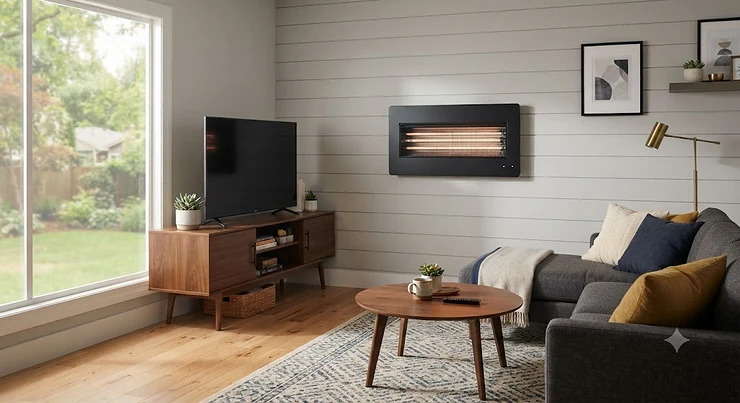
Picture this: it’s February, your furnace is working overtime, and there’s still that one room in the house — the sunroom, the finished basement, the drafty home office — that never quite gets warm. That’s the exact gap a wall mount infrared heater is built to fill. In plain terms, a wall mount infrared heater is a fixed, space-saving electric unit that radiates heat directly toward people and objects rather than warming the air around them, so you feel warmth almost instantly instead of waiting for a room to slowly catch up.

Unlike a portable box fan-heater rattling around on your floor, these units bolt to the wall and stay there, out of the way of pets, kids, and vacuum cords. And the category has genuinely gotten smarter this year — WiFi control, app scheduling, and dual-mode heating are now common even on mid-range models, not just the premium stuff. According to the <a>U.S. Department of Energy</a>, electric resistance heating converts essentially 100% of the electricity it draws into usable heat, and infrared panels push that efficiency further by skipping the “heat the whole room first” step entirely.
This guide breaks down seven real, currently available models spanning budget, mid-range, and premium tiers, with honest analysis of who each one actually fits — not just a spec dump. We’ll also dig into low-profile designs, permanent installation questions, and where these heaters beat (and lose to) the alternatives. Affiliate disclosure: this article contains Amazon affiliate links, and we may earn a small commission on qualifying purchases at no extra cost to you.
Quick Comparison Table
Before you scroll through seven full write-ups, here’s the 30-second version. Wattage tells you rough coverage, and “Best For” tells you the situation each unit was actually designed to solve.
| Heater | Wattage | Mount Style | Best For |
|---|---|---|---|
| Heat Storm HS-1500-PHX-WIFI | 750W/1,500W dual | Wall-only | Best overall smart pick |
| Könighaus 600W Smart Dual Infrared Heater | 600W | Wall or freestanding | Bathrooms & multi-room flexibility |
| WarmlyYours Ember Mirror Infrared Panel | 600W | Wall (vertical/horizontal) | Premium bathroom install |
| Dr. Infrared Heater DR-238 | 1,500W | Wall or ceiling | Garages, patios, permanent installs |
| Ballu Mica Infrared Panel Heater | Panel-rated | Wall or portable stand | Larger living spaces |
| FrauSonne 350W Infrared Space Heater | 350W | Wall-only | Budget, low-profile small rooms |
| Heat Storm HS-1000-WA (Wave) | 1,000W | Wall-only | Space-saving budget bedrooms/offices |
Look at that spread and a pattern jumps out fast: wattage doesn’t track neatly with price, and it definitely doesn’t track with “better.” The FrauSonne 350W Infrared Space Heater costs the least here and is genuinely the right call for a small home office, while the Dr. Infrared Heater DR-238 carries a higher price tag specifically because it’s built to survive outdoor mounting brackets and temperature swings the others were never designed for. If your room is under 150 square feet, more watts just means a bigger electric bill for heat you don’t need.
💬 Found the right size range already? Compare current prices on these picks before they shift.
Top 7 Wall Mount Infrared Heaters: Expert Analysis
We picked these seven specifically to cover the situations real buyers actually face — tight apartments, steamy bathrooms, drafty garages, and everything between. Every entry below reflects real published specs and aggregated review sentiment, clearly labeled as such.
1. Heat Storm HS-1500-PHX-WIFI — best all-around smart wall heater
The Phoenix earns its “best overall” tag by nailing the basics rather than chasing gimmicks. It runs at two output levels — 750 watts for gentle maintenance heat and 1,500 watts when you actually need to chase a chill out of the room — and both settings run through the same touchscreen thermostat display.
At 1,500 watts and roughly 5,200 BTU, this unit is rated for up to 150 square feet as a primary heat source, or up to 750 square feet when it’s just supplementing your main furnace. That distinction matters: buyers who expect it to fully replace central heat in a large open-plan room will be disappointed, but as a zone heater for the room you’re actually sitting in, the math works out fine. Based on the spec comparison, this is one of the few models in this price bracket offering true WiFi app control alongside Alexa and Google Assistant compatibility, which is a genuine step up from the simple remote-only competition.
Reviewers consistently report that the unit runs quiet enough for a home office, and one particularly detailed HuffPost writeup found a household running three units cut its monthly heating cost from roughly $500 to around $250 during a cold January, with daily energy use maxing out near 14.5 kWh. That’s a real, sourced data point rather than a marketing claim, and it lines up with what a well-controlled infrared zone heater should do for supplemental heating.
Pros:
- ✅ Dual 750W/1,500W settings suit small and larger rooms
- ✅ WiFi, Alexa, and Google Assistant control built in
- ✅ Cool-to-touch grill and tip-over shutoff for family homes
Cons:
- ❌ Not rated as a sole heat source for large rooms
- ❌ WiFi setup can be fiddly on older router firmware
Expect this one to sit in the mid-$100s range, and given the smart features layered on top, it’s a strong value pick — check current price before buying since availability shifts.
2. Könighaus 600W Smart Dual Infrared Heater — best for bathroom versatility
What most buyers overlook about the Könighaus 600W Smart Dual Infrared Heater is that it’s designed to double as furniture, not just an appliance. It ships with a built-in towel rack, stand feet for freestanding use, and a full wall-mounting kit, so the same unit can live in a bathroom as a towel warmer/heater combo or move to a bedroom as a standalone floor heater.
The 600 watts here is intentionally modest — this is a supplemental comfort heater for a bathroom or small bedroom, not a whole-room primary source, and Könighaus is upfront in its own documentation that the panel is meant for well-insulated spaces or occasional use. On paper this means you shouldn’t expect it to fight a drafty attic room to a standstill, but for taking the chill off tile floors during a morning routine, it’s well matched to the job. TUV SUD certification on the broader Könighaus lineup adds a layer of third-party safety verification that budget no-name panels often skip entirely.
Aggregated buyer feedback on the smart/app-controlled Könighaus line points to the WiFi/Tuya app setup being genuinely simple, and the dual-use design (wall or floor) as the most-praised feature — flexibility that a pure wall-only unit can’t offer.
Pros:
- ✅ Converts between wall-mounted and freestanding use
- ✅ Built-in towel rack doubles as a bathroom accessory
- ✅ WiFi app and remote control included
Cons:
- ❌ 600W output limits it to small or supplemental use
- ❌ Best suited to well-insulated rooms only
Pricing typically lands in the low-to-mid hundreds; check the current listing for the exact wattage variant, since Könighaus sells 450W, 600W, and 800W versions of essentially the same design.
3. WarmlyYours Ember Mirror Infrared Panel — best premium bathroom install
If you want a heater that doesn’t look like a heater, the WarmlyYours Ember Mirror Infrared Panel is the standout. It’s a genuine bathroom mirror with a 600-watt infrared heating element built directly behind the glass, delivering 2,047 BTUs per hour while doubling as a fog-free mirror and, with the optional bar attachment, a towel warmer.
Here’s what the spec sheet won’t tell you outright: because it’s cTUVus certified with a documented average surface temperature of 194°F and a hard safety limit at 248°F, this is one of the more rigorously safety-tested panels in the wall-mount infrared category, which matters a lot given it’s designed specifically for damp bathroom environments. Coverage is rated for spaces up to 86 square feet, which fits the vast majority of residential bathrooms without over-provisioning. The company backs it with a 5-year warranty, a longer commitment than most budget competitors offer.
Reviewers and the manufacturer both emphasize the fanless, allergy-friendly operation — no moving parts means no circulating dust, which is a real advantage for anyone sharing a small bathroom with allergy or asthma concerns.
Pros:
- ✅ Functions as mirror, heater, and optional towel warmer
- ✅ cTUVus certified with documented safety limits
- ✅ Silent, fanless operation with no circulating dust
Cons:
- ❌ Premium price relative to standard panel heaters
- ❌ 600W ceiling means it won’t heat larger rooms alone
This sits in the premium tier, generally in the mid-$300s to $400s range depending on size and finish — a legitimate splurge if bathroom aesthetics matter as much as warmth to you.
4. Dr. Infrared Heater DR-238 — best for permanent garage or patio installation
The Dr. Infrared Heater DR-238 is the pick when “wall mount” needs to mean genuinely rugged, not just “has a bracket.” Its housing is weatherproof anodized aluminum, and it ships with adjustable mounting brackets built for either wall or ceiling installation — a detail that matters enormously if you’re heating a garage bay, covered patio, or workshop rather than a climate-controlled bedroom.
At 1,500 watts with a carbon heating element and three selectable heat settings, this unit is engineered for spaces that see temperature swings a typical indoor panel never has to survive. Independent hands-on testing found the bracket system made wall or ceiling installation notably easy, and testers specifically praised how much heat it threw without any audible hum — a meaningful upgrade over the fan-driven heaters that dominate the budget end of this category. The main practical complaint from that same testing was a 6-foot cord that feels short for a ceiling-mounted setup, so budget for an extension if you’re going overhead rather than on a side wall.
Aggregated reviewer sentiment frames this as one of the more dependable “permanent installation” heaters in its price class, particularly for covered outdoor spaces where a plug-in freestanding unit simply isn’t a safe option.
Pros:
- ✅ Weatherproof housing rated for garages and patios
- ✅ Wall or ceiling mounting brackets included
- ✅ Carbon element runs with virtually no audible hum
Cons:
- ❌ Included cord is short for ceiling installs
- ❌ Not designed as a bathroom or bedroom aesthetic piece
Expect a price in the $150-$200 range, which is reasonable given the outdoor-rated housing most indoor-only competitors lack entirely.
5. Ballu Mica Infrared Panel Heater — best for larger living rooms
The Ballu Mica Infrared Panel Heater takes a different engineering approach than the rest of this list: instead of a single flat emitting surface, it uses mica panel technology to throw heat across a 180-degree arc, which in practice means it covers more of a room instead of just the wall directly in front of it.
Reaching operating temperature in about 10 seconds is a genuinely useful spec here, not just a marketing number — it means you’re not standing in a cold room for five minutes waiting for the unit to catch up, which is a common complaint about older ceramic and quartz designs. The all-aluminum heating element is paired with WiFi app control, Alexa compatibility, and a programmable thermostat that includes an exposed temperature sensor for more accurate room readings than the internally-shielded sensors on cheaper units. The manufacturer’s own testing claims up to 37% energy cost savings versus less efficient heating methods, a figure worth treating as a ceiling rather than a guarantee, but directionally consistent with how far-infrared panels typically perform against basic resistance coils.
Because it can roll on casters or mount flush to the wall, this is a strong fit for anyone who isn’t 100% sure yet whether they want a permanent installation — you can live with it as a portable unit for a season before committing to drilling holes.
Pros:
- ✅ 180-degree panoramic heat coverage for larger rooms
- ✅ 10-second heat-up time versus slower ceramic designs
- ✅ Switches between wall-mount and rolling portable use
Cons:
- ❌ Larger footprint than slim panel-only competitors
- ❌ Casters and stand add setup steps if wall-mounting later
Mid-range pricing, generally in the low-to-mid $200s range — a reasonable middle ground between the budget panels and the premium mirror-style units on this list.

6. FrauSonne 350W Infrared Space Heater — best low profile wall mount infrared heater on a budget
If your only need is taking the edge off a small home office or a nursery, the FrauSonne 350W Infrared Space Heater is the leanest option here in every sense — lowest wattage, smallest footprint, and smallest price tag.
At 350 watts, this unit is intentionally scaled for small rooms, generally in the sub-120-square-foot range, and it includes a built-in thermostat plus both remote and app control despite its entry-level price point. What most buyers overlook about ultra-low-wattage panels like this one is that “less powerful” isn’t automatically “worse” — for a room this size, a bigger unit just cycles on and off more, wasting energy overshooting the target temperature, while a properly-sized 350W panel runs closer to continuously at a lower, steadier draw. That’s a legitimately more efficient way to heat a small, well-insulated space.
Because there’s no fan and a slim panel profile, it mounts nearly flush to the wall, which is exactly what shoppers searching for a low profile wall mount infrared heater are usually picturing — something that disappears into the room rather than jutting out like a radiator.
Pros:
- ✅ Slim panel profile sits nearly flush against the wall
- ✅ App and remote control at an entry-level price
- ✅ Right-sized wattage avoids overheating small rooms
Cons:
- ❌ Too low-output for anything beyond a small room
- ❌ Limited to supplemental rather than primary heating
This is the most affordable model on the list, typically landing under $100 — a sensible starter pick if you’re testing whether infrared heating suits your routine before investing in a pricier unit.
7. Heat Storm HS-1000-WA (Wave) — most space-saving wall heater for bedrooms and offices
Rounding out the list is the Heat Storm HS-1000-WA, marketed under the “Wave” name specifically for its slim, minimal-footprint design — Heat Storm’s own listing puts it at under 2 square feet of wall space, which is a genuinely tiny installation footprint for a 1,000-watt heater.
Key specs here translate directly into everyday convenience: a digital touchscreen thermostat with LED display means precise temperature control instead of guessing between “low” and “high,” and the design allows the cord to be concealed behind the unit when mounted directly over an outlet, which keeps the install looking clean rather than trailing a visible cable down the wall. Child lock and tip-over shutoff round out the safety features, both genuinely useful in a shared bedroom or kids’ playroom.
Aggregated Amazon review data on this Heat Storm lineup shows strong satisfaction around ease of installation and the peace of mind that comes from a wall-secured unit — several reviewers specifically flagged that eliminating tip-over risk was their main reason for choosing a wall model over a freestanding space heater in the first place.
Pros:
- ✅ Under 2 sq ft footprint — genuinely space-saving install
- ✅ Digital touchscreen thermostat with LED readout
- ✅ Cord concealment when mounted over an outlet
Cons:
- ❌ 1,000W ceiling limits it to small-to-medium rooms
- ❌ Feet for floor use sold separately, not included
Budget-friendly pricing, generally under $100 depending on sales — one of the better value plays here if wall space and floor safety are your top priorities.
How to Install and Set Up Your Wall Mount Infrared Heater
Getting a wall mount infrared heater working properly is less about the heater itself and more about where you put it. Start by picking a wall with a nearby dedicated outlet — most plug-in units, including everything on this list, are designed to hang directly over or beside an existing receptacle so the cord tucks away cleanly instead of running across the floor as a trip hazard.
Clearance matters more than people expect. Manufacturer manuals for panel-style units typically call for roughly 20 inches of clearance from the front of the unit and several inches to the sides and above, since these heaters emit radiant energy in a fairly direct line rather than in every direction. Mount too close to furniture, curtains, or bedding and you’re not just risking a fire hazard — you’re also blocking the very heat the unit exists to deliver.
For the studs-and-bracket install itself: locate wall studs with a stud finder rather than relying on drywall anchors alone for anything over about 800 watts, level the included bracket carefully (a few degrees off is obvious once the unit is hanging), and secure using the manufacturer’s hardware rather than substitute screws, which can affect the safety rating. Once mounted, most units need a short “burn-in” period on their first run — a faint smell from the heating element’s protective coating is normal for the first 10-15 minutes and should fade completely.
The most common first-30-days mistake isn’t installation — it’s sizing. Buyers frequently mount a 350-600W panel expecting whole-room performance it was never built to deliver, then assume the product is defective. Match wattage to square footage using the manufacturer’s coverage chart before you drill a single hole.
Real-World Scenarios: Matching the Right Heater to Your Space
Specs only mean so much until you map them onto an actual living situation. Here are three profiles that cover most of the buyers searching for this category.
If you’re a renter in a 400-square-foot studio apartment with a landlord who won’t approve central heating upgrades, a low-wattage, low-profile option like the FrauSonne 350W Infrared Space Heater or the Heat Storm HS-1000-WA makes the most sense — both mount with minimal wall impact, and neither draws enough power to trip an older apartment’s circuit when paired with other appliances.
If you’re renovating a bathroom and want something that earns its wall space by doing double duty, the Könighaus 600W Smart Dual Infrared Heater or the WarmlyYours Ember Mirror Infrared Panel solve two problems at once — heat and a functional mirror or towel warmer — which is a genuinely different value proposition than a plain heating panel bolted next to your vanity.
If you’re finishing a garage into a workshop or want reliable heat on a covered patio through a whole New England winter, the Dr. Infrared Heater DR-238 is built for exactly that brief, with weatherproofing the indoor-only models simply don’t have. And if it’s a larger converted basement or open-plan living room you’re heating, the Ballu Mica Infrared Panel Heater‘s wider coverage arc will do noticeably more work than a narrow single-panel unit trying to cover the same square footage.
How to Choose the Best Wall Mount Infrared Heater
Cutting through marketing language, here’s the actual decision process worth following, in order:
- Measure your room first. Match square footage to the manufacturer’s rated coverage — oversizing wastes electricity, undersizing leaves you cold and annoyed.
- Decide primary vs. supplemental heat. A unit rated for “150 sq ft primary” is usually rated for triple that as supplemental heat alongside your existing furnace — know which job you’re asking it to do.
- Check the mounting environment. Bathrooms and outdoor/garage spaces need IP-rated or weatherproof housing; a standard indoor panel is not safe in those conditions.
- Confirm smart features you’ll actually use. WiFi scheduling is genuinely useful if you want the room warm before you walk in — skip it if you’ll just flip a switch anyway and save some cost.
- Look for real safety certifications. UL, cTUVus, or TUV SUD marks indicate independent third-party testing, not just a manufacturer’s own claim.
- Factor in aesthetics if the wall is visible. A mirror-style or slim panel unit blends into a finished room; a bulkier bracket-mounted unit is better hidden in a garage or utility space.
- Compare warranty length. A 5-year warranty versus a 1-year warranty tells you a lot about how confident the manufacturer is in its own hardware.

Wall Mounted Infrared Heater vs Traditional Space Heaters
The core difference between an infrared heater wall mounted permanently and a traditional convection or forced-air space heater comes down to how the heat is delivered, not just how much. Convection heaters warm the air, which then has to circulate around the room before you feel it — open a door and that warm air pocket disappears fast. Infrared heat instead warms your skin, clothing, and nearby surfaces directly, the same way sunlight feels warm on a cold day even when the surrounding air is chilly.
That difference shows up practically in a few ways. Infrared units generally feel warmer faster on first turn-on, since there’s no “warm the room” lag. They’re also typically safer around curious kids and pets when the model has a cool-to-touch grill, since the heating element itself isn’t the exposed hot surface a coil-style convection heater often is. On the other hand, convection and forced-air heaters tend to warm an entire room more evenly over time, which matters more in a large, open space than a small zone you’re actively sitting in.
| Factor | Wall Mount Infrared | Traditional Convection/Forced-Air |
|---|---|---|
| Warm-up feel | Near-instant on skin | Gradual, whole-room lag |
| Best room size | Small to medium zones | Larger open rooms |
| Floor space used | None (wall-mounted) | Often none to some |
| Typical noise | Silent to near-silent | Fan hum on forced-air models |
Reading this table, the honest takeaway is that infrared wins decisively for targeted comfort in a room you’re actually occupying, while traditional convection heaters still have an edge for evenly warming a large, draft-heavy space where you want ambient background heat rather than direct warmth on your body.
Low Profile Wall Mount Infrared Heater: Why Slim Design Matters
A low profile wall mount infrared heater isn’t just a style preference — it changes how usable the room stays. A slim panel like the FrauSonne 350W Infrared Space Heater, sitting nearly flush against the wall, doesn’t eat into walkway space the way a bulkier bracket-mounted unit like the Dr. Infrared Heater DR-238 does, which projects further off the wall to accommodate its heavier internal components.
This matters most in genuinely tight spaces — a studio apartment hallway, a narrow home office, a small nursery where every inch counts. What most buyers overlook here is that low-profile design often correlates with lower wattage, since a slimmer housing has less room for the internal heating element and heat sink. That’s a fair trade in a small room but a real limitation in anything larger, so don’t chase “low profile” into a room it was never sized for.
Bathroom Wall Heater Alternative: Infrared Panels for Wet Rooms
Traditional bathroom heat lamps and baseboard convection heaters have real limitations in a damp environment — exposed coils and humidity are a bad combination, and most standard indoor heaters explicitly warn against bathroom installation entirely. That’s exactly the gap a properly-rated bathroom wall heater alternative like the WarmlyYours Ember Mirror Infrared Panel or Könighaus 600W Smart Dual Infrared Heater fills, since both are documented with splash-resistant or IP-rated housing suited to occasional moisture exposure.
The mirror-format option specifically solves a second bathroom problem most heaters ignore entirely — fogging. Since the panel runs warm continuously while active, it keeps the glass surface above the room’s dew point, meaning no more wiping condensation off with a towel before you can see your reflection. That’s a small but genuinely useful piece of transformation value a standard heat lamp simply can’t offer.
Permanent Heater Installation: Hardwired vs Plug-In
Every model on this list ships as a standard plug-in unit, but “wall mount” and “permanent heater installation” aren’t automatically the same thing, and it’s worth understanding the difference before you commit. A plug-in wall-mounted heater is bracket-secured to the wall but still draws power from a standard outlet, meaning it can be unplugged, moved, or replaced without an electrician. A true hardwired installation, by contrast, ties the unit directly into your home’s electrical circuit — more permanent, generally safer for higher-wattage units, but it does require a licensed electrician and typically a dedicated circuit breaker.
For most residential buyers browsing this category, plug-in wall mounting hits the right balance: it’s genuinely permanent in the sense that the unit stays bolted to the wall day to day, without the cost and commitment of running new wiring. Reserve hardwired installation for higher-wattage garage or workshop setups, like a scenario where the Dr. Infrared Heater DR-238 is running for hours daily in a detached structure and you want it fully integrated into a dedicated circuit rather than sharing a household outlet.
Common Mistakes When Buying an Infrared Wall Panel Heater
Even smart shoppers trip over the same handful of issues with an infrared wall panel heater, and most of them are avoidable with five minutes of research before checkout.
Buying based on wattage alone, ignoring square footage, is the single most common error — a 1,500W unit in a 100-square-foot bathroom is both overkill and a wasted purchase. Skipping the IP rating check for bathroom or outdoor installs is a close second; a heater rated for dry indoor use only is a genuine safety hazard in a damp bathroom, regardless of how good the reviews look. Assuming “smart features” always mean better value is another trap — WiFi control is worth paying extra for only if you’ll actually use scheduling and remote access, not just as a checkbox on a spec sheet.
Underestimating clearance requirements causes real problems too; mounting a unit 6 inches from curtains because that’s where the outlet happens to be is asking for a preventable incident. And finally, ignoring warranty length as a signal of build quality means missing one of the more honest indicators available — a manufacturer offering just 90 days is telling you something about how long they expect the unit to last.

Frequently Asked Questions
❓ What is the best wall mount infrared heater for a bathroom?
❓ How many square feet will a wall mount infrared heater warm?
❓ Is a low profile wall mount infrared heater less powerful?
❓ Can a wall mounted infrared heater run all day safely?
❓ Do I need an electrician for permanent heater installation?
Conclusion
If there’s one takeaway from all seven of these picks, it’s that “best” depends entirely on the room, not just the heater. The Heat Storm HS-1500-PHX-WIFI earns its spot as the best all-around choice because it balances smart features with genuinely useful dual-wattage flexibility, but a steamy bathroom calls for the WarmlyYours Ember Mirror Infrared Panel, and a drafty garage calls for the weatherproofed Dr. Infrared Heater DR-238 instead.
What ties every honest recommendation here together is matching wattage and housing rating to the actual room you’re heating — not chasing the biggest number on the spec sheet or the flashiest app. Do that, mount it correctly with proper clearance, and a wall mount infrared heater will quietly outperform a bulky, floor-hogging space heater for years with none of the tip-over anxiety.
Recommended for You
- Best Portable Infrared Heater 2026: 7 Top Picks Reviewed
- Best Infrared Heater 2026: 7 Top Picks That Actually Deliver Warmth
- Heated Body Suit for Polar Camping: 7 Proven Picks (2026)
Disclaimer: This article contains affiliate links. As an Amazon Associate, I earn from qualifying purchases. If you purchase products through these links, we may earn a small commission at no additional cost to you.
✨ Found this helpful? Share it with your friends! 💬🤗
