
In This Article
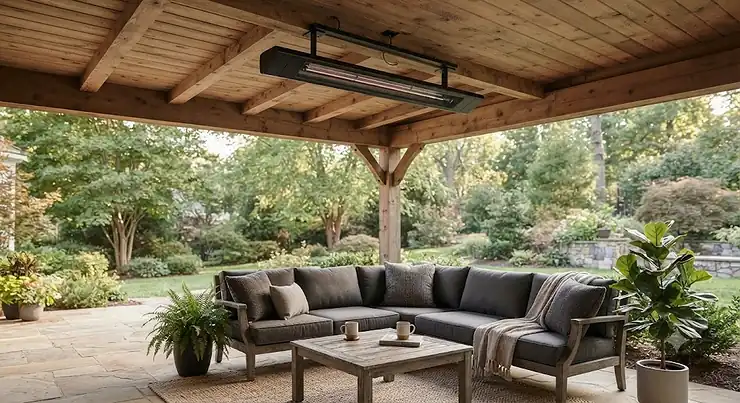
Nobody plans to abandon their patio in October. It just happens — one chilly evening turns into a season of drawn curtains and a grill collecting dust under a tarp. The fix isn’t complicated, but it is specific: an infrared heater for covered patio spaces behaves differently than one bolted to an exposed deck, and buying the wrong type is how people end up with a $150 heater warming the underside of their roof instead of their feet.
Here’s the short version. An infrared heater for covered patio use is an electric fixture that emits radiant energy — the same physics that lets you feel the sun on your skin on a cold day — to warm people and surfaces directly instead of heating the air around them. Because a roof or awning already blocks wind and rain, a covered patio is actually the easiest environment for these heaters to succeed in; you’re not fighting a breeze that scatters warmth before it reaches anyone.
That said, “easiest” doesn’t mean “one-size-fits-all.” A pergola with open slats sheds heat differently than a fully enclosed gazebo. A tabletop unit makes sense for a two-top on a condo balcony and looks almost comical bolted next to a ten-person sectional. This guide walks through seven real, currently available models — from a budget wall-mount to a permanently installed premium fixture — plus the buying logic, safety rules, and regional realities that decide whether your patio actually gets used in January or just looks nice in July. We researched aggregate customer sentiment, cross-checked specs against manufacturer documentation, and skipped anything that reads like a rebranded space heater with a weatherproof sticker slapped on top.
Quick Comparison Table
| Category Winner | Product | Power | Weatherproof Rating | Price Range |
|---|---|---|---|---|
| Best Overall Value | Dr. Infrared Heater DR-238 | 900/1,200/1,500W | Splash-resistant, covered-use rated | $130–$160 |
| Best Freestanding | Briza BA-CIH-S | 900/1,200/1,500W | IP55 | $130–$160 |
| Best for Entertaining Groups | AEROZY Oscillating Tower Heater | 1,500W, 9 levels | Covered-outdoor rated | $110–$160 |
| Toughest Weatherproofing | Paraheeter Outdoor Electric Infrared Patio Heater | 1,500W | IP65 | $140–$180 |
| Best for Pergolas (Permanent) | Infratech WD-Series | Up to 3,000W (dual element) | Rated for full outdoor exposure | $700–$1,000+ |
| Best for Gazebos (Compact Standing) | SereneLife Outdoor Electric Patio Heater | 1,500W | IP65 | $100–$140 |
| Best Tabletop | Star Patio Electric Tabletop Heater STP1566-BT | 1,500W | IP44 | $70–$100 |
Looking at the spread above, the split isn’t really budget-versus-premium — it’s mounting style versus space. A covered patio with an open pergola frame wants something like the Infratech WD-Series that can be hardwired well above head height, while a covered concrete patio with a solid roof is exactly where the Dr. Infrared Heater DR-238 or Briza BA-CIH-S earns its keep. Notice that weatherproof ratings climb as you move toward products meant for partially open structures — that’s not a coincidence, and we’ll unpack why in the ratings section below.
💬 Found a product here that fits your space? Tap through to check today’s availability before you commit to a spot on the wall.
Top 7 Infrared Heater for Covered Patio Picks: Expert Analysis
1. Dr. Infrared Heater DR-238 — budget hero for covered patio ceilings
The Dr. Infrared Heater DR-238 has been a fixture (literally) on covered porches for years, and the reason is simple math: three heat settings on one wall-mounted unit. The 900W, 1,200W, and 1,500W steps mean you’re not stuck blasting full power on a mild 55-degree evening just because that’s the only setting available — you dial down and the electric bill follows.
Mounted at the recommended 7-to-9-foot ceiling height, the carbon infrared element throws usable warmth in a fairly wide cone, which matters more on a covered patio than the manufacturer’s headline square-footage claim suggests; that number assumes ideal conditions rarely present outdoors, so treat it as a ceiling, not a guarantee. Based on the spec comparison with pricier wall-mounts on this list, the DR-238’s main trade-off is styling — it reads as “garage heater” more than “patio decor,” which is exactly why it dominates the value tier rather than the premium one.
Reviewers consistently report that the remote control is genuinely used daily rather than lost in a drawer, and a recurring theme in aggregated feedback is that assembly and mounting are straightforward for a two-person job. A less flattering pattern shows up too: a subset of buyers note the unit runs warm to the touch on its housing, reinforcing that clearance rules aren’t optional here.
Pros:
- ✅ Three heat settings cut energy waste on mild nights
- ✅ Straightforward wall or ceiling mounting hardware included
- ✅ Wide, usable heat cone for the price tier
Cons:
- ❌ Utilitarian look won’t match upscale patio decor
- ❌ Coverage claims run optimistic versus real outdoor conditions
At around $130–$160, the Dr. Infrared Heater DR-238 is the “just get warmth working” pick — hard to argue with the value if aesthetics aren’t the priority.

2. Briza BA-CIH-S — tripod-to-wall flexibility champion
Most heaters force a choice at checkout: wall-mounted or freestanding. The Briza BA-CIH-S dodges that entirely by shipping with both an included tripod stand (extending to 7 feet) and full mounting hardware, which is exactly why it earns the freestanding infrared outdoor heater slot on this list even though it moonlights as a wall fixture.
The IP55 rating puts it a notch above basic splash-resistant units — it’s built to handle wind-driven rain and dust without the internals taking damage, which matters if your covered patio still catches blowing rain along one edge. Here’s what the spec sheet won’t spell out: that same 900/1,200/1,500W range shared with the DR-238 means performance is nearly identical between the two, so the real decision driver is flexibility, not raw heat. If you might rearrange furniture next summer or aren’t ready to commit to a permanent wall spot, the tripod option buys you room to change your mind.
Aggregated review sentiment repeatedly praises the tip-over safety sensor as a genuine peace-of-mind feature for households with kids or pets underfoot, and the swap between tripod and wall mount is described as easier than expected for a first-timer. On the downside, some buyers report the tripod’s telescoping legs feel less sturdy at full extension in gusty conditions — a fair trade for the flexibility, but worth bracing against a wall or railing if wind is a factor.
Pros:
- ✅ True dual-use — tripod stand or permanent wall/ceiling mount
- ✅ IP55 rating handles wind-driven rain and dust
- ✅ Tip-over auto shutoff adds real safety margin
Cons:
- ❌ Tripod legs feel less stable at full 7-foot extension
- ❌ Heat output ties with cheaper fixed-mount competitors
Priced in the $130–$160 range, the Briza BA-CIH-S is the pick when “I’m not 100% sure where this is going yet” is part of your buying decision.
3. AEROZY Oscillating Tower Heater — best oscillating spread for groups
Every other heater on this list throws heat in a fixed direction. The AEROZY Oscillating Tower Heater doesn’t — its 60-degree oscillation sweeps warmth across a wider arc, which is the single biggest reason it belongs in the outdoor entertaining heat source conversation. A stationary heater warms whoever sits directly in its path and leaves the rest of the table complaining; a sweeping one distributes discomfort more evenly across six chairs instead of concentrating comfort on two.
Nine heat levels is a genuinely useful spec here, not marketing filler — it lets you match output to a group of two on a quiet Tuesday or a full dinner party on Saturday without buying two different heaters. Based on the spec comparison against the wall-mounted units above, the trade-off is floor space: at 32.2 inches tall, the tower needs its own footprint near the seating area rather than disappearing overhead.
Reviewer sentiment aggregated across major retail listings consistently calls out the 9-hour timer as convenient for unattended overnight safety, and the remote’s range is frequently described as sufficient for a full patio. A recurring complaint centers on the oscillation motor being audible in an otherwise quiet setting — a minor issue for a lively dinner party, more noticeable for a solo reading session.
Pros:
- ✅ 60-degree oscillation spreads warmth across more seats
- ✅ Nine heat levels match output to group size
- ✅ 9-hour timer supports safe unattended overnight use
Cons:
- ❌ Takes up floor space rather than mounting overhead
- ❌ Oscillation motor produces audible hum in quiet settings
Expect to pay in the $110–$160 range — a fair ask for the only heater here actually designed around how groups sit and move.
4. Paraheeter Outdoor Electric Infrared Patio Heater — IP65 toughest weather seal
If your covered patio doubles as the walkway to an outdoor kitchen — the kind of space that catches grease splatter, hose spray during cleanup, and the occasional open-air rain gust along an exposed edge — the Paraheeter Outdoor Electric Infrared Patio Heater‘s IP65 rating is the reason to pick it over the IP55 options above. That jump matters more than the single digit suggests: IP65 means fully dust-tight construction plus resistance to low-pressure water jets from any direction, not just occasional splashing.
CSA certification is worth flagging on its own, since it signals third-party safety testing beyond the manufacturer’s own claims — a detail Amazon listings for lesser brands often gloss over entirely. Wall or portable tripod mounting keeps it flexible for placement near a grill station or prep counter, and the remote lets you kill power from across the kitchen without walking over with wet hands. What most buyers overlook about this model is that the same 1,500W ceiling as its competitors means you’re not paying extra for more heat — you’re paying extra for a housing built to survive a harsher microclimate.
Reviewers frequently mention confidence using it near cooking areas specifically because of the CSA mark, and the remote’s heat-level memory (retaining your last setting) draws repeat praise. A less common but recurring gripe involves the mounting bracket hardware feeling thin relative to the unit’s weight, so a stud finder and proper anchors are worth the extra ten minutes.
Pros:
- ✅ IP65 rating handles jets, not just splashes
- ✅ CSA certification adds third-party safety verification
- ✅ Flexible wall or tripod placement near cooking zones
Cons:
- ❌ Included mounting hardware feels light-duty for the weight
- ❌ Heat output matches cheaper models despite the premium seal
In the $140–$180 range, the Paraheeter Outdoor Electric Infrared Patio Heater is the sensible upgrade when your patio sees more moisture exposure than a fully enclosed structure would.
5. Infratech WD-Series — permanent pergola-grade power
Everything above this point is a plug-in appliance. The Infratech WD-Series is closer to a fixture — hardwired, dual-element, and built to be mounted once and left there for years, which is precisely why it’s the answer to infrared heater for pergola searches rather than the tripod units further up this list. An open-slat pergola loses heat upward and sideways in a way a solid patio roof doesn’t, so the WD-Series compensates with dual quartz elements capable of scaling up to 3,000 watts per fixture, covering roughly a 7-by-7-foot zone when mounted 7 to 8 feet overhead.
Manufacturer documentation cites roughly 90% energy efficiency against gas alternatives sitting closer to 50%, and while that comparison flatters the electric side (gas heaters lose more energy to open-air convection by design), the underlying point holds: quartz infrared elements waste very little output warming air nobody’s standing in. Based on the spec comparison with the plug-in units, the honest trade-off is installation complexity and upfront cost — this is a licensed-electrician job in most municipalities, not a weekend DIY mount.
Aggregate sentiment from patio-heater buying guides and retailer reviews consistently flags the “barely visible glow” as a deliberate design choice buyers appreciate for ambiance, alongside praise for the made-in-USA build quality and multi-year warranty coverage. The recurring drawback, unsurprisingly, is price shock relative to the rest of this list — this isn’t a heater you buy on impulse.
Pros:
- ✅ Dual-element design suited to open pergola structures
- ✅ Roughly 90% quoted efficiency versus gas alternatives
- ✅ Permanent installation with multi-year warranty backing
Cons:
- ❌ Requires professional electrical installation in most cases
- ❌ Price sits far above every plug-in model on this list
Budget $700–$1,000+ depending on wattage and voltage configuration — steep, but it’s the only entry here actually engineered for a permanently open-air structure.

6. SereneLife Outdoor Electric Patio Heater — quietest compact standing option
Gazebos occupy an odd middle ground: more enclosed than a pergola, less sealed than a covered concrete patio, and often smaller in floor area than either. The SereneLife Outdoor Electric Patio Heater fits that middle ground well as a standing unit that doesn’t demand the tower footprint of the AEROZY or the wall real estate of the mounted options. Its aluminum reflector concentrates the 1,500W output rather than scattering it, which compensates somewhat for the reduced overhead clearance typical inside a gazebo’s beam structure.
IP65 waterproofing matches the Paraheeter above, which is a meaningfully higher bar than most standing heaters in this price bracket bother to clear. Reviewers consistently describe the operation as notably quiet compared to oscillating tower units — a fair trade-off given gazebos tend to be smaller, more intimate spaces where a humming motor is more noticeable than it would be across an open patio. Based on the spec comparison, what most buyers overlook is that the aluminum reflector design means positioning matters more than with diffuse-emission heaters; angle it correctly toward seating and it outperforms its wattage, angle it wrong and heat escapes past the group entirely.
A recurring theme in aggregated feedback is appreciation for the smaller footprint fitting into tight gazebo corners without blocking foot traffic. The consistent complaint involves the remote’s button layout being described as fiddly in low light — a minor annoyance, but worth knowing before an evening event.
Pros:
- ✅ Compact standing footprint suited to gazebo interiors
- ✅ IP65 waterproofing exceeds most standing-heater competitors
- ✅ Quieter operation than oscillating alternatives
Cons:
- ❌ Reflector design makes positioning more important than average
- ❌ Remote button layout is hard to read in low light
Priced around $100–$140, the SereneLife Outdoor Electric Patio Heater is the practical choice for a gazebo that needs real weatherproofing without a wall-mount commitment.
7. Star Patio Electric Tabletop Heater STP1566-BT — smallest footprint for tight tables
Sometimes the honest answer to “what heater do I need” is “the smallest one that works,” and the Star Patio Electric Tabletop Heater STP1566-BT is built for exactly that scenario. As a tabletop infrared outdoor heater, its dome-shaped 1,500W design is meant to sit directly on a table or side surface, warming a tight cluster of two to four people rather than an entire patio — which is precisely the job on a condo balcony or a small bistro-table setup where a wall mount or floor tower simply won’t fit.
Its IP44 rating is the lowest weatherproof number on this list, and that’s worth being direct about rather than glossing over: IP44 protects against splashing water from any direction, not wind-driven rain or hose-level jets. That’s a reasonable trade under a solidly covered patio roof, but it’s not the spec to lean on if your “covered” space still lets weather blow in sideways. A simple pull-string switch keeps operation dead simple — no remote to misplace, no app to configure, just heat on demand for a spontaneous evening coffee outside.
Reviewers frequently mention the hammered bronze finish looking more decorative than the purely functional wall-mounts above, doubling as a centerpiece rather than an obviously utilitarian appliance. A consistent critique is that the stated 110-square-foot coverage feels generous — expect strong warmth in the immediate 3-to-4-foot radius and a rapid drop-off beyond it.
Pros:
- ✅ Genuinely compact — fits any small patio or balcony table
- ✅ Decorative hammered-bronze finish doubles as ambiance
- ✅ Simple pull-string operation with no remote to lose
Cons:
- ❌ IP44 rating is the weakest weatherproofing on this list
- ❌ Real-world coverage radius is smaller than advertised
At roughly $70–$100, the Star Patio Electric Tabletop Heater STP1566-BT is the no-fuss answer for small covered spaces that don’t need — or have room for — anything bigger.
Full Specs Comparison: All 7 Models Side by Side
| Product | Power | Mount Style | Weatherproof Rating | Best For |
|---|---|---|---|---|
| Dr. Infrared Heater DR-238 | 900/1,200/1,500W | Wall/ceiling | Covered-use rated | Budget covered patio |
| Briza BA-CIH-S | 900/1,200/1,500W | Tripod or wall/ceiling | IP55 | Freestanding infrared outdoor heater |
| AEROZY Oscillating Tower Heater | 1,500W, 9 levels | Freestanding tower | Covered-outdoor rated | Group entertaining |
| Paraheeter Outdoor Electric Infrared Patio Heater | 1,500W | Wall or tripod | IP65 | Outdoor kitchen zones |
| Infratech WD-Series | Up to 3,000W | Hardwired wall/ceiling | Full outdoor exposure | Pergola, permanent install |
| SereneLife Outdoor Electric Patio Heater | 1,500W | Freestanding | IP65 | Gazebo interiors |
| Star Patio Electric Tabletop Heater STP1566-BT | 1,500W | Tabletop | IP44 | Small tables, balconies |
A pattern worth calling out: five of these seven top out at 1,500W, which is the practical ceiling for a standard 120V household circuit without dedicated wiring. The two outliers — the Infratech WD-Series at up to 3,000W per fixture — require either 240V service or professional installation, so the real fork in this table isn’t wattage at all, it’s whether you’re willing to hardwire a fixture or want something you can unplug and move next season.
Infrared Heater for Covered Patio: Practical Usage Guide
Getting a new heater out of the box is the easy 10%. The other 90% is setup decisions that determine whether it actually performs — and this is where a freestanding infrared outdoor heater and a hardwired one part ways.
For freestanding and tabletop units like the Star Patio Electric Tabletop Heater STP1566-BT or the tripod-mounted Briza BA-CIH-S, stability is the first-30-days mistake to avoid. Wind gusting under a covered patio roof can still catch a top-heavy tower on an unlevel surface, so check that any deck boards or pavers underneath sit flat before your first use, not after a tip-over sensor trips mid-dinner. For wall-mounted units like the Dr. Infrared Heater DR-238 or Paraheeter Outdoor Electric Infrared Patio Heater, the common mistake is under-measuring clearance — most manufacturers specify a minimum 24-to-36-inch buffer from combustible materials like wood beams or fabric awnings, and eyeballing that distance instead of measuring it is how warranty claims get denied.
Maintenance is lighter than people expect but not zero. Wipe the reflector or heating element housing every few weeks during heavy-use months — dust and pollen buildup on the reflective surface measurably reduces radiant output over a season, the same way a dirty flashlight lens dims your light without the bulb itself failing. Check mounting hardware for looseness twice a season, since temperature swings expand and contract screws in wall anchors. If you’re running a unit like the Infratech WD-Series on a smart plug or timer schedule, verify the schedule after every daylight-saving time change — an oddly common source of “why didn’t my heater turn on” complaints in aggregated reviews.
One optimization trick worth adopting: pair any of these heaters with reflective or dark-colored seating fabric nearby. Since infrared energy warms surfaces rather than air, darker materials absorb and re-radiate that warmth back toward you, effectively stretching your wattage further than a lighter-colored cushion would.
Real-World Scenarios: Matching the Right Heater to Your Setup
Specs only mean something once you map them to an actual space. Here are four situations pulled from how these seven products get used in practice.
The outdoor kitchen host. If you’re running a grill station and prep counter under a partial roof, moisture and grease are constant background risks. The Paraheeter Outdoor Electric Infrared Patio Heater‘s IP65 rating and CSA certification make it the sensible fit here — mounted where it won’t catch direct splatter but still throws heat across the cooking and serving zone. Budget-wise, this crowd tends to already be spending on grills and countertops, so the $140–$180 range isn’t a stretch.
The pergola owner planning ahead. An open-beam pergola with no solid roof needs more raw output per fixture than a fully covered patio, and that’s exactly the gap the Infratech WD-Series is built to close. This scenario usually involves a homeowner already budgeting for a broader outdoor renovation — the heater installation gets bundled with an electrician who’s already running wiring for string lights or a ceiling fan, which softens the higher cost.
The gazebo dinner-party regular. Someone hosting six-to-eight guests inside a semi-enclosed gazebo a few times a month wants even, quiet warmth without a heater dominating the small footprint. The SereneLife Outdoor Electric Patio Heater‘s compact standing design and IP65 rating fit that frequency and environment well, while the AEROZY Oscillating Tower Heater is the better call if that same gazebo seats people in a wider semicircle rather than a tight cluster.
The small-balcony minimalist. A renter or condo owner with a two-chair balcony setup and no interest in mounting anything permanently is squarely in Star Patio Electric Tabletop Heater STP1566-BT territory — under $100, no installation, and genuinely proportioned to the space rather than overkill.
✨ Not sure which scenario matches yours? Compare specs side by side before you buy — check current availability on the models above.
How to Choose an Infrared Heater for Covered Patio Use
Picking between seven legitimate options gets easier with a short checklist run in order:
- Measure your actual roof or overhang coverage first. A fully solid roof tolerates a lower weatherproof rating; an open-slat structure or partial overhang pushes you toward IP65-rated units regardless of budget.
- Count realistic seating capacity, not aspirational capacity. A two-chair balcony doesn’t need 1,500W of oscillating coverage — it needs a tabletop unit and a smaller electric bill.
- Check your available circuit before falling for a 3,000W spec sheet. Standard 120V outlets top out around 1,500W safely; anything above that typically means 240V service and professional installation, as with the Infratech WD-Series.
- Decide between permanent and portable before you shop, not after. Wanting flexibility later means starting with a freestanding infrared outdoor heater like the Briza BA-CIH-S, not fighting to return a hardwired fixture.
- Match mounting height to your actual ceiling or beam clearance. Most wall-mounted infrared heaters perform best 7-to-9 feet overhead — a lower covered patio ceiling may call for a standing or tabletop model instead.
- Weigh CSA or UL certification alongside the price tag. A cheaper uncertified unit and a certified one at a similar wattage aren’t actually equivalent purchases once you factor in insurance and safety liability.
- Budget for the accessories you’ll actually need — mounting brackets, a weatherproof cover for the off-season, and potentially an electrician’s time — rather than comparing sticker prices in isolation.

Weatherproof Heater Rating: What IP Codes Actually Mean
“Weatherproof” on a product listing is a marketing word with no legal teeth behind it. The number that actually matters is the IP (Ingress Protection) rating, a two-digit code defined by international standard IEC 60529 that grades resistance to solid particles (first digit) and liquid intrusion (second digit) rather than relying on vague adjectives.
Here’s the practical translation for the products on this list: IP44, found on the Star Patio Electric Tabletop Heater STP1566-BT, protects against splashing water from any direction — fine under a genuinely solid roof, insufficient if wind regularly drives rain sideways onto your patio. IP55, on the Dr. Infrared Heater DR-238 and Briza BA-CIH-S, steps up to protection against low-pressure water jets, a meaningful jump for partially exposed edges. IP65, shared by the Paraheeter Outdoor Electric Infrared Patio Heater and SereneLife Outdoor Electric Patio Heater, adds full dust-tight construction on top of that same jet resistance — the number to look for if your covered patio has any open sides at all.
What most buyers overlook is that a higher IP rating doesn’t automatically mean “better heater” in terms of heat output — the Paraheeter and Dr. Infrared Heater DR-238 put out nearly identical wattage despite the rating gap. You’re paying the premium for housing durability, not warmth. Treat the IP number as a match to your specific structure, not a general quality score to maximize regardless of need.
Infrared Heater vs Traditional Gas Patio Heater
The other major outdoor heating category is propane or natural gas — the tall mushroom-cap towers seen at restaurant patios for two decades. The comparison matters because plenty of shoppers land on “infrared heater for covered patio” searches after a gas heater disappointed them.
| Factor | Infrared Electric Heaters | Traditional Gas Heaters |
|---|---|---|
| Heat delivery | Warms people/objects directly, wind-resistant | Warms air, easily disrupted by breeze |
| Covered-space safety | No combustion, no ventilation required | Combustion byproducts need airflow — riskier under low roofs |
| Running cost | Lower per hour on electricity in most U.S. markets | Propane refills add recurring cost and hassle |
| Setup | Plug-in or simple hardwire | Requires tank storage and periodic refilling |
| Best For | Covered patios, pergolas, gazebos | Fully open, uncovered spaces with ventilation |
The clearest takeaway from the table: gas heaters generate real ventilation concerns in genuinely covered spaces, since combustion byproducts need somewhere to escape that a solid roof doesn’t easily provide — which is precisely why every product on this list is electric rather than propane. On uncovered patios where wind is the primary enemy, gas heaters’ taller mushroom-style heat plumes can still make sense, but under any kind of roof, an infrared electric unit like the Dr. Infrared Heater DR-238 avoids the combustion question entirely while matching or beating gas on running cost in most U.S. electricity markets.
Outdoor Entertaining Heat Source: Matching Output to Your Guest List
Choosing an outdoor entertaining heat source is really a math problem disguised as a shopping decision: heat output per square foot, divided by however many people are actually sitting in that footprint. A single 1,500W unit comfortably serves two-to-four people clustered close together — which is exactly the Star Patio Electric Tabletop Heater STP1566-BT‘s sweet spot — but that same wattage spread across an eight-person dinner table leaves the far end noticeably colder.
This is where the AEROZY Oscillating Tower Heater‘s 60-degree sweep earns its keep for larger groups: rather than adding a second full heater, the oscillation effectively time-shares one unit’s output across a wider arc of seating. For a mixed group where people are standing, moving, and refilling drinks rather than seated in fixed spots — a proper backyard party rather than a dinner table — a single stationary heater creates obvious hot and cold zones that a moving one smooths out considerably.
The honest advice most product listings won’t give you: if your regular gathering exceeds eight people spread across more than 200 square feet of covered space, one heater of any kind on this list is probably not enough, and you’re better served pairing two mid-tier units (say, two Briza BA-CIH-S heaters at opposite ends) than buying one oversized fixture and hoping it reaches everyone.
Common Mistakes When Buying an Infrared Heater for Covered Patio
A few buying patterns show up repeatedly in aggregated reviews and buying-guide feedback, and most are avoidable with five extra minutes of measuring before checkout.
Ignoring actual ceiling height. Wall-mounted units like the Dr. Infrared Heater DR-238 are engineered around a 7-to-9-foot mounting range; mount one at 5 feet and you’ll either feel uncomfortably direct heat or violate the manufacturer’s clearance minimum, sometimes both.
Buying on wattage alone. Two heaters at identical 1,500W ratings can perform noticeably differently based on reflector design and emission angle — the SereneLife Outdoor Electric Patio Heater‘s aluminum reflector concentrates heat differently than the AEROZY Oscillating Tower Heater‘s wider sweep, despite matching wattage on paper.
Underestimating weatherproofing needs for a “covered” space. Plenty of covered patios have at least one open side that catches wind-driven rain, and an IP44 unit in that spot is a warranty claim waiting to happen.
Skipping the circuit check. Assuming a standard household outlet handles anything you buy is how people end up disappointed by the Infratech WD-Series‘s 240V requirements after the fact rather than before ordering.
Treating certification as optional. CSA or UL certification, present on the Paraheeter Outdoor Electric Infrared Patio Heater among others, isn’t a marketing badge — it’s independent verification the unit met safety testing standards, which matters for both safety and, in some cases, homeowner’s insurance compliance.
Long-Term Cost & Maintenance
The sticker price is a fraction of the real cost conversation. Running a 1,500W heater for roughly three hours a night, several nights a week through a shoulder season, adds up in electricity — the exact number depends heavily on local utility rates, but it’s worth calculating against your own bill rather than assuming a flat number, since rates vary by region and by time-of-use pricing plans.
Where the math shifts meaningfully is multi-setting units. The Dr. Infrared Heater DR-238 and Briza BA-CIH-S both offer 900W, 1,200W, and 1,500W steps — running at the lowest setting on a mild 60-degree night rather than defaulting to full power is a real, compounding savings over a season, not a marketing footnote. The AEROZY Oscillating Tower Heater‘s nine levels extend that same logic further, letting output track outdoor temperature more precisely across a whole autumn.
On the maintenance side, expect essentially zero moving-part wear for wall-mounted fixed units — the main task is periodic cleaning and mounting-hardware checks discussed earlier. Freestanding and tower units add one more consideration: the tripod legs and oscillation motor on units like the Briza BA-CIH-S or AEROZY Oscillating Tower Heater are the parts most likely to need attention over a multi-year lifespan, so factor in that a fixed wall mount likely outlasts a mechanically moving one, all else equal. The Infratech WD-Series, backed by a multi-year manufacturer warranty and largely static components, sits at the other extreme — higher upfront cost, but a genuinely long service life with minimal ongoing fuss.
Extend Patio Season: What to Realistically Expect by Region
“Extend patio season” gets thrown around as if any infrared heater turns a covered patio into a year-round room regardless of climate, and that’s an overpromise worth correcting honestly. In milder U.S. regions — much of the Southeast, coastal California, the Pacific Northwest outside winter storms — a 1,500W heater like the Star Patio Electric Tabletop Heater STP1566-BT or Dr. Infrared Heater DR-238 genuinely can stretch comfortable outdoor use two to three extra months on either side of summer, since ambient temperatures rarely drop far below the 40s.
In colder northern climates, the honest expectation shifts. A single mid-tier heater keeps a covered patio usable into the 30s-and-40s range on calm nights, but once temperatures drop into the 20s or wind becomes a factor even under cover, one plug-in unit isn’t going to carry the space alone — this is where the higher-output Infratech WD-Series, potentially paired with a second fixture, becomes the realistic option rather than a luxury upgrade. The physics behind radiant heating explains why: infrared warms what it directly strikes, and as ambient air temperature drops, more of that radiant energy gets lost to conduction into cold surrounding surfaces before it reaches you, meaning colder baseline climates need proportionally more wattage to achieve the same comfort, not just “any heater.”
The realistic framework: match wattage and quantity to your coldest regularly-used month, not your average one, and budget one properly-sized heater per roughly 100-to-150 square feet of seating area in genuinely cold climates rather than per patio.
Safety, Clearance & Regulations for Covered Patio Heaters
Every product on this list includes tip-over protection and overheat shutoff as standard safety features, and for good reason — the U.S. Consumer Product Safety Commission recommends keeping portable heaters at least three feet from combustible materials like furniture, cushions, and fabric awnings, and plugging electric heaters directly into a wall outlet rather than an extension cord or power strip.
For covered patios specifically, a few rules matter beyond the general CPSC guidance. Wall-mounted units like the Dr. Infrared Heater DR-238, Briza BA-CIH-S, Paraheeter Outdoor Electric Infrared Patio Heater, and Infratech WD-Series each specify minimum clearance from wood beams, vinyl siding, and fabric structures in their installation manuals — measure it, don’t estimate it. Any hardwired installation, including the Infratech WD-Series, should go through a licensed electrician who can confirm your circuit capacity and, where applicable, pull the correct local permit; some municipalities require inspection for permanently wired outdoor fixtures. Freestanding units on uneven pavers or decking need a level, stable surface — the tip-over sensors on the Briza BA-CIH-S and SereneLife Outdoor Electric Patio Heater are a backup, not a substitute for good initial placement.
One more practical note: check your homeowner’s or renter’s insurance policy if you’re installing anything permanently wired outdoors. Some policies specifically ask about supplemental heating fixtures, and having CSA or UL documentation on hand — present on several products here — makes that conversation considerably easier.
🔥 Ready to stop shivering on your own patio? Browse current pricing on these heaters and pick the one that actually fits your space.

Frequently Asked Questions
❓ Is it safe to use an infrared heater on a covered patio?
❓ How much does it cost to run an infrared patio heater?
❓ Can I use a freestanding infrared outdoor heater indoors too?
❓ What weatherproof rating do I need for a gazebo?
❓ Do infrared heaters work well for outdoor kitchens?
Conclusion
Picking the right infrared heater for covered patio use really comes down to three honest questions: how open is your structure, how many people actually sit under it, and how permanent do you want the solution to be. Budget-conscious buyers with a solidly covered patio do fine with the Dr. Infrared Heater DR-238. Anyone still deciding between wall-mounted and portable should lean toward the flexibility of the Briza BA-CIH-S. Regular hosts benefit from the AEROZY Oscillating Tower Heater‘s spread, while outdoor kitchens and gazebos both lean on IP65-rated units — the Paraheeter Outdoor Electric Infrared Patio Heater and SereneLife Outdoor Electric Patio Heater, respectively. Homeowners investing in a permanent pergola setup get real long-term value from the Infratech WD-Series, and anyone with a small table or balcony is well served by the compact Star Patio Electric Tabletop Heater STP1566-BT.
None of these seven turns a January blizzard into a beach day, and none of them should be expected to. What they do reliably deliver — when matched correctly to your specific covered space — is a few extra months of actually using the patio you already paid for, instead of watching it sit empty through a season that didn’t need to be a dead one.
Recommended for You
- 7 Best Wall Mount Infrared Heater Picks for Cozy, Bill-Friendly Winters (2026)
- Best Portable Infrared Heater 2026: 7 Top Picks Reviewed
- Best Infrared Heater 2026: 7 Top Picks That Actually Deliver Warmth
Disclaimer: This article contains affiliate links. As an Amazon Associate, I earn from qualifying purchases. If you purchase products through these links, we may earn a small commission at no additional cost to you.
✨ Found this helpful? Share it with your friends! 💬🤗
