
In This Article
There’s a particular kind of cold that central heating never quite solves — the one that lives in the corner of a home office, or camps out in a bedroom at the far end of the hallway where the ductwork gives up. That’s the gap a good oil filled heater is built to close. Not by blasting hot, dry air across the room like a fan heater does, but by quietly, patiently loading a sealed reservoir of oil with heat and letting it radiate outward for hours, long after the element clicks off.
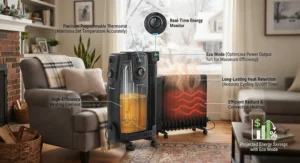
The tricky part is that “oil filled heater” covers a huge range of quality, from $50 units that pop and hiss to $200 models with digital brains and smart thermostats that swing your bill in a different direction. This guide breaks down seven real, currently available models — spanning budget bedroom heaters to full-featured living room units — based on published specifications, verified retailer data, and aggregated owner feedback pulled from thousands of real reviews. No invented testing, no fabricated ratings. Just what the data actually shows about which oil filled radiator heater is worth your money in 2026, and why.
By the end, you’ll know exactly which pick fits your room, your budget, and your tolerance for noise (spoiler: it’s close to zero across the board, which is the whole point).
Quick Comparison Table
Before the deep dive, here’s the short version for anyone in a hurry. This table ranks our seven picks by their primary strength, so you can jump straight to the model that matches your situation.
| Heater | Wattage | Best For | Price Range |
|---|---|---|---|
| De’Longhi Dragon Digital TRD40615E | 1500W | Premium full-room heating | $180-$220 |
| Dreo Oil Filled Radiator (DR-HSH012) | 1500W | Smart thermostat control | $100-$135 |
| PELONIS Champagne PH-14A | 1500W | Bedroom use with remote | $70-$95 |
| Costway 1500W Oil Filled Radiator (Remote) | 1500W | Largest claimed room coverage | $70-$95 |
| Amazon Basics Portable Oil Radiator | 1500W | Budget reliability | $55-$75 |
| PELONIS Black PHO15A2AGB | 1500W | Simple manual controls | $55-$70 |
| Comfort Zone CZ7007J | 1200W | Compact bedrooms/offices | $45-$60 |
A quick read of this table tells its own story: wattage barely moves between models — six of the seven top out at 1500W, the legal ceiling for a plug-in space heater in the U.S. — so the real differences live in fin design, control sophistication, and how each brand claims (and actually delivers on) room coverage. The De’Longhi Dragon Digital TRD40615E commands the highest price largely on the strength of its digital control panel and expanded radiant surface, while the Comfort Zone CZ7007J undercuts everything here by running at a lower 1200W, which caps its ceiling for larger spaces but also keeps it easy on a bedroom circuit. Budget-conscious buyers should note that price differences in this category track features and build materials more than raw heat output, since a 1500W heater from any brand produces essentially the same maximum BTUs.
💬 Found your shortlist already? Tap through and check today’s price before it changes.😊
Top 7 Best Oil Filled Heaters: Expert Analysis
Real specs, real aggregated review sentiment, and honest analysis on who each model actually suits — not just a rewrite of the box copy.
1. De’Longhi Dragon Digital TRD40615E — most radiant surface area for its size
The headline feature here is the “75% more radiant surface area” claim De’Longhi builds its marketing around, and it’s not just fluff. The fin geometry genuinely packs more surface into the same footprint than a standard 7-fin radiator, which matters more than the wattage number ever will. The De’Longhi Dragon Digital TRD40615E runs at 1500W with a digital control panel, a 24-hour programmable timer, and an ECO mode that throttles power draw once the room hits target temperature — a real efficiency lever, not just a sticker. It’s rated for rooms up to roughly 144 square feet, and the anti-freeze setting automatically kicks the unit on below 41°F, a small but genuinely useful feature for garages or three-season rooms. Based on the spec comparison against the rest of this list, this is the most “finished” product here: fewer compromises, more thoughtful engineering.
Owner reviews consistently praise the absence of any oil smell on startup and note the unit heats noticeably faster than older oil radiators they’ve owned, though a handful of buyers report it struggles in larger or open-concept rooms despite the square-footage rating — a common theme with radiant heat in general. This is a heater for someone who wants to set a timer, forget it, and trust the thermostat to hold steady overnight.
Pros:
- ✅ 75% more radiant surface than standard 7-fin designs
- ✅ Digital 24-hour timer plus ECO energy-saving mode
- ✅ Anti-freeze auto-on below 41°F for cold spaces
Cons:
- ❌ Premium price relative to similar-wattage competitors
- ❌ Struggles to fully heat open-concept or larger rooms
At around $180-$220, the De’Longhi Dragon Digital TRD40615E is priced like the flagship it is — worth it if you want the most polished oil filled heater on this list and plan to run it nightly for years.

2. Dreo Oil Filled Radiator (DR-HSH012) — smartest thermostat control
Dreo’s approach to the category is almost the opposite of De’Longhi’s brute-force radiant surface play — it leans hard into precision electronics. The Dreo Oil Filled Radiator (DR-HSH012) uses eight M-shaped fins that the company claims boost heat dissipation by 59.5% over a standard design, paired with a thermal sensor and “dynamic compensation algorithm” accurate to within about ±4°F of your target. In practice, what that means is less thermostat overshoot — the classic complaint with cheaper oil radiators that blast past your set point and then swing cold before cycling back on.
What most buyers overlook about this model is the child lock and the mute function, which silences the button beeps entirely — genuinely useful in a bedroom where every chirp registers at 2 a.m. Reviewers report the unit runs at a whisper even on its highest 1500W setting, and several long-term owners specifically call out that it solved a persistently cold room that their central heating couldn’t reach. The trade-off is weight: at nearly 27 pounds, it’s not the heater you want to be dragging up and down stairs daily.
Pros:
- ✅ Precision thermostat with roughly ±4°F accuracy
- ✅ Mute function silences all button and alert sounds
- ✅ Eight-fin design claims 59.5% better heat dissipation
Cons:
- ❌ Noticeably heavier than most 7-fin competitors
- ❌ Premium features push it above budget-tier pricing
In the $100-$135 range, the Dreo Oil Filled Radiator (DR-HSH012) is the pick for anyone who’s been burned by an oil heater with a lazy, overshooting thermostat.
3. PELONIS Champagne PH-14A — best remote-controlled bedroom heater
If your priority is never having to get out of a warm bed to adjust a heater, the PELONIS Champagne PH-14A is built around exactly that use case. It ships with a remote control, a 10-hour timer, an ECO mode, and five temperature settings between 65°F and 85°F, all run through 1500W across three heat modes (600W/900W/1500W). PELONIS rates it for 164 square feet, which lines up reasonably well with real-world bedroom and home-office use, though — as with every model on this list — that number assumes a closed door and minimal drafts.
Here’s what the spec sheet won’t tell you: reviewers consistently flag that the remote needs a fairly direct line of sight to work reliably, which matters if you’re mounting it across the room instead of at the foot of the bed. On the plus side, aggregated feedback repeatedly highlights the fan-free “whisper-quiet” operation as the reason people bought it in the first place, and the ECO mode is frequently credited with knocking a visible chunk off the electric bill compared to running it on constant high. A common complaint in user reviews is that the thermostat can overshoot slightly before settling, and the minimum 65°F setting runs a bit warm for people who sleep cool.
Pros:
- ✅ Full remote control plus 10-hour timer for scheduled heat
- ✅ Five temperature settings from 65°F to 85°F
- ✅ Genuinely fan-free, whisper-quiet bedroom operation
Cons:
- ❌ Remote requires fairly direct line of sight
- ❌ Thermostat can overshoot before stabilizing
Priced around $70-$95, the PELONIS Champagne PH-14A earns its keep as one of the more thoughtfully controlled oil heaters for a bedroom in this price bracket.
4. Costway 1500W Oil Filled Radiator (Remote) — biggest claimed room coverage
Costway’s remote-equipped model claims coverage up to 400 square feet, the largest figure of any heater on this list, running through 600W/900W/1500W modes with a 24-hour timer and universal casters for moving it between rooms. What most buyers overlook about this model is that the 400-square-foot figure almost certainly assumes ideal conditions — good insulation, no drafts, a closed door — the same caveat that applies to every square-footage claim in this category, just more aggressively marketed here.
Aggregated review sentiment is a genuine mixed bag on this one, which is worth being honest about rather than smoothing over. A meaningful slice of owners report the unit runs quietly and heats a bedroom-sized space quickly and reliably, while a separate cluster of reviews describes popping noises during the first few uses (which several owners note disappears after letting the unit sit upright for an hour before first power-on, likely settling internal oil) and, in rare cases, cord or outlet heating issues. That spread of experience is common with budget-tier oil radiators sourced from mixed manufacturing batches, so a close read of recent reviews before buying is worth the five minutes.
Pros:
- ✅ Remote control plus 24-hour programmable timer
- ✅ Largest claimed square-footage rating in this roundup
- ✅ Universal casters for easy relocation between rooms
Cons:
- ❌ Mixed reliability reports across manufacturing batches
- ❌ Some owners report popping noises on first use
At around $70-$95, the Costway 1500W Oil Filled Radiator (Remote) is worth considering for the room-coverage claim, but check current, recent reviews before buying given the reported inconsistency.
5. Amazon Basics Portable Oil Radiator — best budget pick with real safety certs
Amazon’s house brand plays this category refreshingly straight: no bold marketing claims, just a 1500W unit with seven oil-filled steel fins, three heat settings, ETL-certified safety, tip-over protection, and overheat protection, rated for 144 square feet. Based on the spec comparison, it’s essentially a no-frills version of the same fin architecture used across most of this list — which is exactly the point for buyers who don’t want to pay extra for a remote or a digital display they’ll rarely touch.
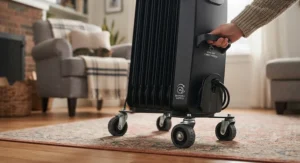
Reviewers consistently note the vertical, slim profile fits into tight corners better than bulkier competitors, and the caster wheels and handle make it genuinely easy to move room to room, a detail that matters more than it sounds once you’ve lived with a heavier unit that stays wherever you first set it down. The main trade-off, as you’d expect at this price, is the manual dial control rather than a precision thermostat — you’re adjusting by feel rather than by a set target temperature, which asks a little more attention from the user in exchange for a lower price tag.
Pros:
- ✅ ETL-certified with tip-over and overheat protection
- ✅ Slim, space-saving profile fits tight corners
- ✅ Reliable core performance without inflated marketing claims
Cons:
- ❌ Manual dial control, no precision digital thermostat
- ❌ No remote or programmable timer at this price point
Around $55-$75, the Amazon Basics Portable Oil Radiator is the safe, no-drama choice for anyone who just wants a reliable oil filled heater without paying for features they won’t use.
6. PELONIS Black PHO15A2AGB — simplest controls for large rooms
Where the Champagne PH-14A leans into remote-and-timer convenience, PELONIS’s black PHO15A2AGB strips things back to dual physical knobs and three heating modes (600W/900W/1500W), full stop. That simplicity is the entire selling point: nothing to pair, nothing to reprogram after a power outage, no batteries to replace in a remote you’ll eventually misplace. It shares the same 1500W ceiling and general fin architecture as its remote-equipped sibling, and it’s rated for similarly sized medium-to-large rooms.
Here’s what the spec sheet won’t tell you: aggregated owner feedback frequently praises this exact simplicity, particularly from buyers who’ve been frustrated by digital panels on other appliances failing years before the heating element does. On the flip side, the honest trade-off is convenience — no scheduling, no ECO auto-adjust, and no way to fine-tune to a specific degree the way a digital thermostat model allows. Reviewers describe it as a “set it, forget it” workhorse rather than a smart appliance, which for a lot of buyers is precisely the reassurance they’re after in a plug-in heater.
Pros:
- ✅ Straightforward dual-knob controls, no learning curve
- ✅ No digital components to fail before the heating element
- ✅ Same 1500W output as pricier remote-equipped models
Cons:
- ❌ No timer, ECO mode, or remote control
- ❌ Manual adjustment only, no precise target temperature
At roughly $55-$70, the PELONIS Black PHO15A2AGB suits buyers who want dependable heat without a single button they don’t understand.
7. Comfort Zone CZ7007J — most compact for tight bedrooms
Every other heater on this list runs at 1500W; the Comfort Zone CZ7007J deliberately doesn’t, topping out at 1,200 watts and roughly 5,120 BTU. That’s not a weakness so much as a design choice — it’s built around seven slim warming fins and a genuinely compact footprint meant for small to medium rooms rather than open living areas, and the lower wattage means it draws less on a shared circuit, which matters in older homes or dorm-style wiring.
Reviewers consistently describe it as ideal for a single bedroom, hallway, or chilly entryway rather than a whole-room solution, with several specifically noting it’s “just enough assistance” for a room that’s merely a few degrees short of comfortable — not a heater meant to fight a serious cold snap on its own. A common complaint in user reviews is that the carrying handle isn’t especially obvious, making it a bit awkward to relocate compared to models with a dedicated molded grip. Built-in cord storage and swivel casters help offset that, but this is honestly the pick for people who know exactly how small their heating gap is and don’t need extra capacity they’ll never use.
Pros:
- ✅ Compact, slim footprint fits tight bedroom corners
- ✅ Lower 1,200W draw is gentler on shared circuits
- ✅ Genuinely silent, fan-free operation for light sleepers
Cons:
- ❌ Underpowered for anything beyond a small, enclosed room
- ❌ Carrying handle isn’t as ergonomic as pricier models
At about $45-$60, the Comfort Zone CZ7007J is the value pick for a single cold bedroom rather than a whole-floor heating solution.
What Is an Oil Filled Heater?
An oil filled heater is a portable electric radiator that warms a sealed reservoir of diathermic oil inside metal fins, then radiates that heat into a room through convection and radiant heat rather than a fan. Because there’s no moving air, it runs silently, doesn’t dry out the room, and keeps radiating warmth for a while even after it shuts off.
That last point is the whole appeal, and it’s worth expanding on honestly rather than just repeating marketing copy. Unlike a ceramic or fan heater, which stops producing warmth the instant it powers down, an oil radiator’s fins stay hot for a meaningful stretch afterward, gently bleeding residual heat into the room. Independent testing has shown ambient relative humidity barely moves during extended oil-radiator use — a real point of difference from forced-air heaters, which measurably dry out a room over hours of continuous operation. That’s a genuine advantage for anyone dealing with dry winter skin, sinus irritation, or a nursery where humidity matters. The trade-off, which every honest guide should state plainly, is warm-up time: expect 15 to 30 minutes before a room feels noticeably warmer, versus near-instant blast heat from a fan-forced unit. The U.S. Consumer Product Safety Commission tracks portable heater incidents closely every winter, which is a useful reminder that even a “safe,” fanless design still deserves sensible precautions around placement and unattended use.
How to Choose the Best Oil Filled Heater
Picking the right oil filled radiator heater comes down to matching room size, control preferences, and noise tolerance rather than chasing the highest wattage number, since nearly every model here already sits at the 1500W legal ceiling.
- Measure the room first. Manufacturer square-footage ratings assume a closed door and decent insulation — knock 20-30% off the claim for open floor plans or drafty older homes.
- Decide how much control you actually want. A digital thermostat with ECO mode saves money over months of nightly use; a manual dial saves money on the purchase itself.
- Weigh remote control against reliability. Remotes are genuinely convenient from bed, but they’re one more thing that can fail — a knob never runs out of batteries.
- Check the timer window. A 10-hour timer suits an overnight bedroom routine; a 24-hour timer suits someone who wants the room pre-heated before they walk in from work.
- Confirm safety certifications. Look for ETL or UL listing, tip-over shutoff, and overheat protection — non-negotiable regardless of price point.
- Factor in weight and mobility. An 18-26 pound heater on casters moves easily; without wheels, that same weight becomes a genuine hassle.
- Read recent reviews, not just the top-line rating. Manufacturing consistency varies batch to batch in this category, and recent feedback catches problems an averaged star rating can hide.
| Priority | Look For | Skip If |
|---|---|---|
| Bedroom silence | Fan-free design, mute function | Any model advertising “turbo” or fan-assist |
| Whole-room coverage | Higher rated square footage, 8-fin design | Small manual units under 1,200W |
| Budget | Manual dial, no remote/digital display | Premium ECO or app-connected features |
The pattern across this table is straightforward: every extra dollar in this category buys convenience and precision, not more heat, since the physics of a 1500W resistance heater are fixed regardless of brand. Buyers on a tight budget lose nothing in raw warmth by skipping the remote and digital thermostat — they only give up scheduling convenience and finer temperature control.
Oil Heater for Bedroom: What Actually Matters at Night
A bedroom is the single best-case use for this entire category, and also the place where the wrong pick becomes obvious fastest — usually around 2 a.m. An oil heater for bedroom use should prioritize three things above all else: near-total silence, a low minimum temperature setting, and a timer that won’t run the unit all night at full output.
On the silence front, the physics genuinely favor oil radiators — no fan means no whine, no click-cycling motor noise, just the occasional soft tick as metal expands while heating. That said, aggregated reviews across nearly every model in this guide mention faint “popping” sounds during the first few uses, which several owners trace back to trapped air settling in the oil channels rather than any defect; letting a new unit sit upright for an hour before first power-on seems to reduce this. On minimum temperature, this matters more than shoppers expect: the Sleep Foundation recommends keeping a bedroom between about 60-67°F for the best sleep quality, yet several oil heaters on the market bottom out at 65°F or higher on their lowest setting, which can run warmer than ideal for someone who sleeps cool. If that describes you, look specifically for a model with a wide temperature range rather than just a high-temperature ceiling, and lean on the timer to shut the unit off partway through the night rather than running full heat until morning.
Oil Filled Heater Silent: How Quiet Is Quiet, Really?
Every product page in this category claims “whisper-quiet” or “silent” operation, so it’s worth translating that marketing language into what you’ll actually hear. An oil filled heater silent by design produces essentially no fan noise because there is no fan — heat moves by convection and radiation alone. What you will hear, especially in the first hour of a heating cycle, is the metal housing expanding and contracting, which shows up in reviews as light ticking, creaking, or occasional popping.
Based on the spec comparison and aggregated reviews across all seven models, none of these sounds approach the 40-50 decibel range of a typical box fan or fan-forced ceramic heater — most owners describe the operational sound as genuinely imperceptible from across a room, with the ticking noticeable only if you’re sitting right next to the unit during the first heating cycle of the evening. If a completely silent room is non-negotiable, favor models with fewer moving mechanical parts (skip remote-with-motorized-vents designs, which don’t exist in this category anyway, but do skip any listing that mentions an internal fan-assist mode) and place the unit away from a headboard, since even soft ticking is more noticeable a foot from your ear than six feet across the room.
✨ Ready to sleep through a cold night without hearing a thing? Check today’s price on our top silent pick above.

Radiator Style Space Heater vs Traditional Space Heaters
Calling something a radiator style space heater is really shorthand for a specific heat-transfer method, and it’s worth spelling out exactly how that differs from the fan-forced and ceramic-quartz heaters that dominate the rest of the space heater aisle.
| Factor | Radiator Style (Oil-Filled) | Fan-Forced / Ceramic |
|---|---|---|
| Noise level | Near-silent, no fan | Audible fan hum, 40-50 dB |
| Warm-up time | 15-30 minutes | Near-instant |
| Air dryness | Minimal humidity impact | Noticeably dries the air |
| Heat retention after shutoff | Continues radiating for a while | Stops immediately |
| Surface temperature | Can exceed 180°F | Usually cooler to touch |
The trade-off in this table is essentially speed versus comfort quality. A ceramic heater wins if you walk into a freezing room and want warmth in the next sixty seconds; a radiator style space heater wins if you’re heating a room you’ll occupy for hours and want that warmth to persist quietly without stirring up dust or drying your sinuses. Reviewers consistently choose oil radiators specifically for bedrooms, nurseries, and home offices — anywhere sustained comfort matters more than instant gratification — while reaching for a ceramic unit in a garage or bathroom where a five-minute blast of heat is the actual goal.
Oil-Filled vs Ceramic Efficiency: The Real Cost Comparison
Here’s a fact that surprises a lot of shoppers: when it comes to converting electricity into heat, an oil-filled radiator and a ceramic fan heater are equally efficient. Both are electric resistance heaters, and as a Missouri Department of Natural Resources guide on space heaters confirms, virtually all electric resistance heating converts essentially 100% of the electricity it draws into heat — there’s no meaningful efficiency gap between a $50 oil radiator and a $200 ceramic tower at the same wattage.
So why does oil-filled vs ceramic efficiency even matter as a buying question? Because efficiency in the strict thermodynamic sense isn’t the same as cost-effectiveness in daily use. A ceramic heater with a fan distributes its heat faster, which can mean shorter total run time to reach comfort in a drafty room — but it also cools instantly when switched off, meaning you’re paying for heat you don’t retain. An oil radiator holds residual warmth in its fins for a stretch after shutoff, which can translate to running the thermostat’s off-cycle slightly longer for the same felt comfort. Neither effect is dramatic enough to swing your bill by much on its own; the bigger cost lever is simply matching wattage to room size and using a timer or ECO mode instead of running any 1500W heater on constant high all night. What most buyers overlook here is that the real efficiency decision was made the moment they bought a 1500W unit rather than a 900W one for a small room — not which fin design or heating technology sits inside the case.
Silent Overnight Heating: A Practical Usage Guide
Getting the most out of an oil filled heater for overnight use is less about the unit itself and more about how you set it up in the first place. Silent overnight heating starts before you ever plug the thing in.
First, let a brand-new unit sit fully upright for at least an hour before first power-on — this settles the internal oil and measurably reduces the popping and gurgling noises that show up in early reviews of nearly every model in this guide. Second, place the heater at least three feet from bedding, curtains, or furniture, both for safety and because that distance is exactly where radiant heat feels most even rather than uncomfortably direct. Third, set the timer to shut off an hour or two before you’d naturally wake, rather than running full output all night; residual heat in the fins will keep the room comfortable through that gap, and you’ll wake to a room that’s cooling gently rather than one that’s been overheating for hours. Fourth, in the first 30 days, resist the urge to run the unit on its highest setting constantly — cycling between low and medium as the room finds its baseline temperature actually extends component life and avoids the “overshoot and swing” pattern several reviewers describe. Finally, wipe down the fins monthly with a dry cloth; dust buildup on the metal surface measurably reduces radiant heat transfer over a season of nightly use, even though there’s no fan to circulate that dust into the air.
Real-World Scenarios: Who Should Buy Which Oil Filled Radiator Heater
Specs only mean so much until you match them to an actual person, in an actual room, dealing with an actual problem.
The light-sleeping remote worker. She spends eight hours a day in a converted spare bedroom that never quite warms up, and she can’t tolerate a fan’s hum on video calls. The PELONIS Champagne PH-14A or the Dreo Oil Filled Radiator (DR-HSH012) both fit — the remote and ECO mode mean she can adjust from her desk without breaking a meeting, and neither introduces fan noise into her calls.
The budget-conscious dorm or apartment renter. He’s heating a single 150-square-foot room, doesn’t want to spend more than $70, and doesn’t care about a digital display he’ll never look at. The Amazon Basics Portable Oil Radiator or Comfort Zone CZ7007J cover this exactly, with certified safety features and a manageable footprint that won’t dominate a small space.
The family heating a large, drafty living room. Central heat struggles to keep an open-concept downstairs comfortable, and running the furnace harder feels wasteful for the couple of hours the family actually occupies that space each evening. The De’Longhi Dragon Digital TRD40615E or Costway 1500W Oil Filled Radiator (Remote), with their larger claimed coverage, are built for exactly this use case, run overnight or on a timed schedule rather than continuously.
Common Mistakes When Buying an Oil Filled Radiator Heater
Even a well-researched purchase in this category goes sideways for a handful of predictable reasons, and most of them are avoidable with a little context.
Buyers frequently size a heater to a room’s total square footage without accounting for ceiling height, open doorways, or poor insulation, then feel let down when a “144 sq ft” unit doesn’t fully heat their 140-square-foot loft with cathedral ceilings. Another common misstep is assuming a higher price always means more heat output — as covered above, six of the seven models here cap out at the same 1500W, so extra dollars buy convenience and control precision, not additional warmth. Shoppers also tend to skip reading recent reviews specifically, relying instead on an averaged star rating that can mask a recent run of manufacturing inconsistency, which several budget models in this category have shown at different points. Finally, a lot of buyers underestimate warm-up time and conclude a perfectly functional radiator is “broken” or “weak” within the first ten minutes, when 15-30 minutes is simply how this heating method works.
Problem → Solution: Fixing the Most Common Oil Heater Complaints
Problem: The heater makes popping or gurgling noises. This is almost always trapped air settling in the oil channels after shipping or a fresh fill. Let the unit rest fully upright for an hour before first use, and the noise typically fades within the first few heating cycles.
Problem: It doesn’t seem to heat the whole room. Oil radiators heat by radiant and convective transfer, which is directional and gradual rather than forced. Reposition the unit closer to where you actually sit, close doors to the space you’re heating, and don’t expect edge-to-edge uniform warmth in an open layout.
Problem: The thermostat overshoots the set temperature. This is a common complaint on models without precision digital sensors. Switch to a lower wattage mode once the room approaches comfort, or step up to a model like the Dreo Oil Filled Radiator (DR-HSH012), whose sensor accuracy specifically targets this issue.
Problem: The remote stops responding. Check battery contacts first, then confirm you have a clear line of sight — several models in this category require a fairly direct angle, and furniture or the unit’s own housing can block the signal.
Problem: Dry, cracked skin despite using an oil heater instead of a fan heater. Oil radiators have a genuinely minimal impact on humidity compared to forced-air heat, but a bedroom sealed all winter can still run dry from outside cold air. Pairing the heater with a small humidifier addresses this more directly than switching heater types.
Safety and Regulations: What to Know Before You Plug It In
Oil filled heaters are among the safer space heater categories precisely because there’s no exposed flame and no spinning fan blade, but “safer” isn’t the same as risk-free, and every model in this guide still deserves the same baseline precautions.
Always plug directly into a wall outlet rather than an extension cord or power strip, which can overheat under a 1500W load — this single habit prevents a disproportionate share of the roughly 1,600 heater-related fires the CPSC’s guidance on reducing fire hazards for portable electric heaters tracks annually. Keep at least three feet of clearance from bedding, curtains, and furniture in every direction, and never leave a unit running unattended overnight without a rated tip-over and overheat shutoff — every model featured here includes both, but that feature only protects you if the heater is on a flat, stable surface to begin with. None of the seven heaters in this roundup are rated for bathroom or damp-location use; if you need heat near moisture, that calls for a dedicated, properly rated fixture rather than a standard plug-in radiator. Finally, keep a working smoke detector in any room where a space heater runs regularly — a five-dollar habit that outperforms every safety feature built into the heater itself.
Features That Actually Matter (And Those That Don’t)
After comparing seven models side by side, a clear pattern emerges about which specs genuinely change your experience and which are largely marketing noise.
What matters: verified safety certification (ETL/UL), a genuine tip-over shutoff, and honest square-footage ratings that account for real room conditions. A digital thermostat with reasonable accuracy also matters more than shoppers initially assume, since it directly determines how often the unit overshoots your comfort point and cycles unnecessarily. What matters less: headline wattage, since nearly every model caps at the same 1500W ceiling, and cosmetic finish or color, which has zero bearing on heat output. Remote control sits in a gray zone — genuinely convenient, but it’s the single component most likely to fail or go missing over a heater’s multi-year lifespan, so weigh that convenience against the fact that every knob-controlled model here has one fewer point of failure.
Frequently Asked Questions
❓ What is the best oil filled heater for a small bedroom?
❓ How many square feet will a 1500W oil heater actually cover?
❓ Is it safe to leave an oil filled radiator heater on overnight?
❓ Do oil filled heaters use a lot of electricity?
❓ Why does my new oil heater make popping noises?
Conclusion
Choosing the best oil filled heater really comes down to answering three honest questions: how big is the room, how much control do you want over the heat, and how much are you willing to spend for that control. Every model in this guide runs at or near the 1500W ceiling that defines the category, so the real differences live in fin design, thermostat precision, and thoughtful extras like timers and ECO modes rather than raw heat output. The De’Longhi Dragon Digital TRD40615E and Dreo Oil Filled Radiator (DR-HSH012) earn their higher price tags through genuinely useful engineering, while the Amazon Basics Portable Oil Radiator, PELONIS Black PHO15A2AGB, and Comfort Zone CZ7007J prove that a straightforward, well-certified unit still gets a cold room comfortable without the extra spend.
Whatever you land on, the fundamentals don’t change: measure your room honestly, don’t skip the safety certifications, and let a new unit settle upright for an hour before that first cold night. A good oil filled radiator heater isn’t glamorous, but it’s one of the quietest, most consistent ways to make one stubborn room in your home feel like it belongs to the rest of the house again.
Recommended for You
- 7 Best Infrared Heater for Covered Patio Picks 2026
- 7 Best Wall Mount Infrared Heater Picks for Cozy, Bill-Friendly Winters (2026)
- Best Portable Infrared Heater 2026: 7 Top Picks Reviewed
Disclaimer: This article contains affiliate links. As an Amazon Associate, I earn from qualifying purchases. If you purchase products through these links, we may earn a small commission at no additional cost to you.
✨ Found this helpful? Share it with your friends! 💬🤗
