
In This Article
It’s 6 a.m. Your foot hits the bathroom floor. Ouch. Tile has a talent for holding onto cold like a grudge, and an electric floor heating mat is the cleanest way to end that grudge.

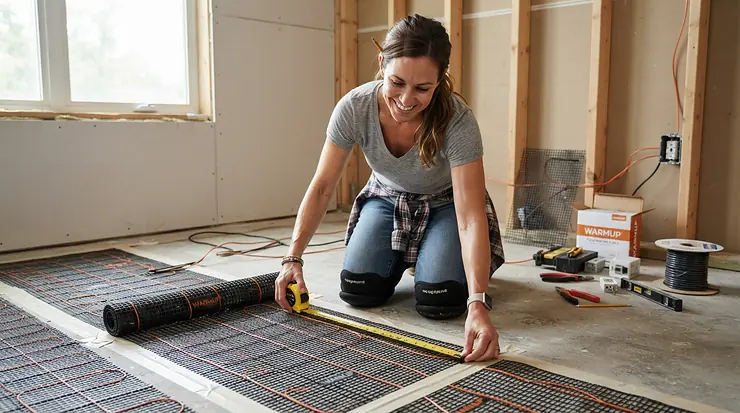
So what is it, exactly? An electric floor heating mat is a thin, pre-spaced heating cable woven onto a mesh or fabric backing. You roll it across the subfloor, embed it in thinset, tile over it, and connect it to a thermostat. The cable warms the floor surface from below, so the heat comes up through your feet instead of blowing around the room.
The U.S. Department of Energy notes that radiant heating avoids duct losses and doesn’t stir up allergens the way forced air can. That’s the appeal in one line. It’s also why a radiant heat mat for tile floor has become one of the most popular small-room upgrades in remodeling.
This guide covers seven real products, what their specs mean in practice, and where each one fits. It also covers the unglamorous parts: thermostats, GFCI rules, running costs, and DIY radiant heat mat installation. Everything here is built on published specs and aggregated review data, not invented test stories. Where I couldn’t verify something, I’ll say so.
Quick Comparison: Electric Floor Heating Mat Options at a Glance
| Product | Coverage | Output | Best For |
|---|---|---|---|
| Warming Systems 10 Sq Ft Mat | 10 sq ft | 12 W/sq ft | Powder rooms, small entryways |
| LuxHeat 20 Sq Ft Kit | 20 sq ft | 12 W/sq ft | Value-minded bathroom upgrades |
| WarmlyYours TempZone Easy Mat Kit | 24 sq ft (3 x 8 ft) | 15 W/sq ft, 360 W | Cold climates, stronger heat |
| HEATWAVE 20 Sq Ft Kit | 20 sq ft | 240 W | Mixed flooring projects |
| SunTouch TapeMat 70 Sq Ft Kit | 70 sq ft | 840 W | Master baths, kitchens |
| Schluter DITRA-HEAT-E-HK | about 32 sq ft | Cable in membrane | Premium tile jobs |
| VEVOR 100 Sq Ft Cable Kit | 100 sq ft | 1,200 W | Large or irregular rooms |
Look at coverage first, because it narrows the field fast. For a standard bathroom, the LuxHeat 20 Sq Ft Kit and WarmlyYours TempZone Easy Mat Kit are the natural starting points. Larger rooms push you toward the SunTouch TapeMat 70 Sq Ft Kit or the VEVOR 100 Sq Ft Cable Kit. If you’re laying tile anyway and want crack protection, the Schluter DITRA-HEAT-E-HK earns its premium.
💬 Just one click — help others make better buying decisions too!😊
Top 7 Electric Floor Heating Mat Picks: Expert Analysis
Prices below are directional ranges from research time. Check current price before buying, because they move.
1. Warming Systems 10 Sq Ft Mat — compact kit for tiny bathrooms
This one is the minimalist’s pick. It’s a 120V mat kit at 12 W/sq ft with a TH115 programmable thermostat, a floor sensor, and an installation monitor.
At 1/8 inch thick, it won’t wreck door clearances in a retrofit. Ten square feet at 12 W/sq ft draws only about 120 watts, so running costs are almost comically small. It’s meant to warm the “landing zone” in front of the vanity or toilet, not heat a room.
Reviewers in roundup data rate it around 4.6 out of 5. The recurring complaint is that the thermostat’s programming menu isn’t intuitive. Buyers praise the 25-year warranty and USA manufacturing.
Pros:
- ✅ Complete kit with sensor and installation monitor
- ✅ Ultra-thin profile preserves door clearance
- ✅ 25-year warranty, made in the USA
Cons:
- ❌ Thermostat programming takes patience
- ❌ Too small for anything beyond spot warming
Roughly the $150-$250 range. It’s a strong value verdict for half-baths and powder rooms. Skip it if you want whole-bathroom coverage.
2. LuxHeat 20 Sq Ft Kit — best bundle for the money
LuxHeat’s 20 sq ft kit comes with an OJ Microline UDG programmable thermostat that has GFCI built in, a floor sensor, and a cable alarm. The built-in GFCI matters. It can spare you a separate GFCI breaker, which is where a lot of electrician cost hides.
The dual-wire design with an aluminum shield is marketed as ultra-low EMF. That’s reassuring for the cautious. At 12 W/sq ft over 20 sq ft, you get 240 watts of floor warming. That’s plenty for comfortable tile in a standard bathroom but not enough to be primary heat.
Roundup data puts it near 4.6 out of 5. Reviewers frequently praise customer service. The practical caveat is that the heating wire can’t be cut, so measure carefully before ordering.
Pros:
- ✅ GFCI thermostat with 7-day scheduling included
- ✅ Dual-wire shielded design lowers EMF
- ✅ Self-adhesive mesh simplifies layout
Cons:
- ❌ Heating wire cannot be cut or shortened
- ❌ Must be embedded in thinset or self-leveler
Around the $250-$350 range. Best value for most bathroom buyers.
3. WarmlyYours TempZone Easy Mat Kit — 15 watts for colder climates
Most mats deliver 12 W/sq ft. WarmlyYours TempZone Easy Mat Kit delivers 15, a 25% increase the manufacturer highlights. The 3 x 8 ft version covers 24 sq ft at 360 W and 3 A, with a 15 ft cold lead.
That extra output matters in a poorly insulated bathroom over a cold crawlspace, where 12 W mats can feel timid. The kit pairs the mat with the nTrust 2.0 LED touch thermostat. It’s non-programmable, but it has built-in GFCI and two floor sensors.
The warranty is 25 years covering parts and labor, and the mat is cULus listed for wet locations. The brand’s own site shows high ratings (4.9 on 40 reviews for the Easy Mat line). Brand-hosted reviews skew positive, so weigh accordingly.
Pros:
- ✅ 15 W/sq ft output beats typical 12 W mats
- ✅ Built-in GFCI with two floor sensors
- ✅ 25-year warranty covers parts and labor
Cons:
- ❌ Thermostat has no scheduling without an upgrade
- ❌ Fixed 3 x 8 ft size limits layout flexibility
Roughly the $350-$500 range. A premium-leaning value for chilly rooms.
4. HEATWAVE 20 Sq Ft Kit — flexible layout for awkward floors
The headline here is the reversible mat design with adhesive backing. You can flip sections around corners, pipes, and cabinets. It’s a 120V, 2-amp, 240-watt system with a 15-foot cold lead and a 7-day, four-event GFCI thermostat.
Roundup data lists compatibility beyond tile, including laminate and vinyl. Treat that as “verify before buying.” Each flooring type has its own manufacturer instructions for thermal barriers and installation.
With about 608 reviews averaging roughly 4.4 stars in the data I found, it has the deepest review pool here. Common themes: responsive support, but tricky sizing around obstacles. Some users report the mat can float during a self-leveler pour if it isn’t pinned down.
Pros:
- ✅ Reversible mat adapts to odd room shapes
- ✅ GFCI thermostat with four daily events
- ✅ Long 15 ft cold lead eases wiring
Cons:
- ❌ Mat may float during compound pours
- ❌ Not suited for shower wet zones
Around the $250-$350 range. Good value if your floor isn’t a clean rectangle.
5. SunTouch TapeMat 70 Sq Ft Kit — big coverage, easy touchscreen
Seventy square feet at 840 watts and 7 amps turns this into a real master-bath or kitchen solution. The 24 inch by 35 foot mat cuts with scissors, so you can flip and turn it around fixtures.
The Command Touch thermostat is the daily-life upgrade. A touchscreen at 5 a.m. beats squinting at tiny buttons. The LoudMouth installation monitor audibly alerts you if the wire is damaged during installation. That’s cheap insurance before you bury it under mortar.
Warranty is 25 years on mat and cable, but the thermostat reportedly carries only two years. Reviewers rate it around 4.5. Keep wire spacing consistent (over about 3 inches can create cool spots), and prep the subfloor smooth.
Pros:
- ✅ Cuts and flips to fit large layouts
- ✅ Touchscreen thermostat with monitor included
- ✅ 25-year warranty on mat and cable
Cons:
- ❌ Premium price for the kit
- ❌ Subfloor must be very smooth
Roughly the $600-$850 range. Worth it when coverage is the priority.
6. Schluter DITRA-HEAT-E-HK — premium crack protection plus heat
This isn’t a mesh mat. It’s a cable kit (105.8 feet, roughly 32 sq ft at 120V) that snaps into Schluter’s uncoupling membrane. The membrane holds the cable at set spacing and helps protect tile from subfloor movement.
For anyone who has watched grout lines crack, that’s compelling. The twisted-pair cable keeps EMF low, and no clips or tape are needed. The catch is that you buy the membrane separately, and the warranty is 15 years, shorter than the 25 years on others. Confirm what’s in the box, including whether a thermostat is included.
Roundup data shows about 82% five-star ratings across roughly 45 reviews, a small sample. Some users mention slower heating response.
Pros:
- ✅ Cable snaps into membrane without clips
- ✅ Uncoupling layer helps prevent tile cracking
- ✅ Twisted-pair cable keeps EMF minimal
Cons:
- ❌ Membrane purchased separately raises total cost
- ❌ Shorter 15-year warranty
Around the $300-$450 range for the cable kit alone, plus membrane. Best for new, quality tile jobs.
7. VEVOR 100 Sq Ft Cable Kit — budget coverage for big spaces
When square footage is the problem, this free-form cable kit gives 1,200 watts across 100 sq ft with a smart GFCI thermostat, dual sensors, and an alarm. You coil the cable yourself, so spacing discipline matters.
Uneven gaps create hot and cool stripes. It isn’t a plug-and-roll mat, which makes it the hardest installation here. Roundup data rates it about 4.1, with praise for flexibility and complaints about marginal output in drafty rooms and occasional shipping damage to cables.
Treat it as floor comfort in an enclosed, insulated space, not as a furnace.
Pros:
- ✅ Covers up to 100 sq ft affordably
- ✅ Free-form cable fits irregular layouts
- ✅ Smart GFCI thermostat with dual sensors
Cons:
- ❌ Uneven spacing risks cool spots
- ❌ Reported underpowered feel in big, cold rooms
Roughly the $200-$350 range. Strong for large rooms, but only if you’re comfortable with careful layout work.
Top 7 Specs and Ratings Side by Side
| Product | Type | Thermostat | Warranty | Reported Rating | Best For |
|---|---|---|---|---|---|
| Warming Systems 10 Sq Ft Mat | Mat | TH115 programmable | 25 years | about 4.6 | Tiny bathrooms |
| LuxHeat 20 Sq Ft Kit | Mat | GFCI, 7-day | 25 years | about 4.6 | Everyday value |
| WarmlyYours TempZone Easy Mat Kit | Mat | nTrust 2.0, GFCI | 25 years | about 4.9 (brand site) | Cold rooms |
| HEATWAVE 20 Sq Ft Kit | Mat | GFCI, 7-day | Check listing | about 4.4 | Odd layouts |
| SunTouch TapeMat 70 Sq Ft Kit | Mat | Command Touch | 25 years (mat) | about 4.5 | Large rooms |
| Schluter DITRA-HEAT-E-HK | Cable + membrane | Confirm in box | 15 years | about 4.5 | Premium tile |
| VEVOR 100 Sq Ft Cable Kit | Cable | Smart, GFCI | Check listing | about 4.1 | Big budget jobs |
The spec grid shows a clear split: 25-year warranties dominate, while the Schluter DITRA-HEAT-E-HK trades warranty length for membrane protection. The VEVOR 100 Sq Ft Cable Kit has the lowest rating but the most coverage per dollar. The WarmlyYours TempZone Easy Mat Kit is the only one pushing 15 W/sq ft, which can justify its price in colder spaces.
What Is an Electric Floor Heating Mat and How Does It Work?
An electric floor heating mat is a pre-spaced heating cable on a mesh backing that installs under tile or stone and warms the floor through electrical resistance. A thermostat and floor sensor control the temperature, and the system adds only about 1/8 inch of height.
Think of it as a very thin electric blanket for your subfloor. Current flows through the resistance wire, the wire warms, and the thinset and tile above absorb and radiate that warmth. Because the pre-spaced mat fixes the distance between cable runs, you get even heat without planning the layout like a puzzle.
Here’s the context buyers often miss. Heat rises through the tile, then warms you and nearby surfaces directly. This is a different mechanism from forced air, and it’s why people feel comfortable at lower air temperatures.
One practical note: most mats run at 12 W/sq ft, which is a floor-warming output, not a replacement for your furnace. The mat’s job is comfort and a modest boost, not primary heat. If you set expectations there, you’ll be delighted instead of disappointed.
Radiant Heat Mat for Tile Floor: Why They’re a Natural Pair
Tile conducts heat well, and it feels cold precisely because it pulls warmth from your skin. A radiant heat mat for tile floor flips the script, since the same conductive surface becomes a warm one.
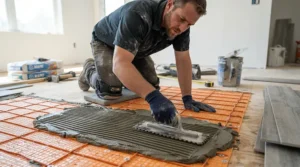
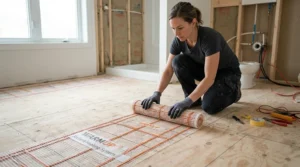
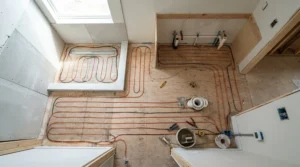
Layer by layer, the stack looks like this: subfloor, thinset, the heating mat, more thinset, then tile. A heating mat under tile is embedded in that mortar bed, which transfers heat evenly and locks the cable in place.
Thin tile and thin thinset layers heat faster than thick stone slabs. Dense natural stone takes longer to warm but holds heat afterward. Radiant heating is covered broadly on Wikipedia’s radiant heating overview, including how surface temperature shapes comfort.
Underlayment matters, too. Adding a thermal or cork-type layer below the heating element redirects heat upward instead of letting it sink into a concrete slab. Skipping it on a cold slab is one of the most common efficiency mistakes. Spend the extra money there and your running costs drop.
How to Choose an Electric Floor Heating Mat
- Measure usable floor, not room size. Exclude tubs, vanities, and cabinets. Manufacturers generally recommend covering the open floor you’ll actually walk on.
- Match the mat to your flooring. Most mats target tile and stone set in thinset. For floating floors, verify the product’s listed compatibility instead of assuming.
- Pick the output you need. 12 W/sq ft suits supplemental warmth. In a cold, poorly insulated space, 15 W/sq ft can feel noticeably better.
- Check the thermostat first. Programmable, GFCI-equipped, dual-sensor thermostats cost more upfront but save money on schedule control and breaker work.
- Look at warranty length and scope. Because the mat gets buried, 25 years matters more than it would on a toaster. Read what’s covered: parts only, or parts and labor?
- Plan the circuit. Each mat needs a dedicated, GFCI-protected circuit. Confirm your panel has capacity before you buy.
- Choose a mat or cable by room shape. Rectangular floors suit mats. Irregular floors, lots of obstacles, or large areas favor free-form cable.
That checklist cuts through the marketing. A cheap kit with a bad thermostat is worse than a pricier one you’ll actually enjoy using every morning.
Heating Mat for Bathroom Floor: Layout, Wet Zones, and Realistic Expectations
A heating mat for bathroom floor is the most common use case, and it comes with specific rules. Bathrooms are wet, small, and full of obstacles, so planning matters more than horsepower.
First, confirm the product is listed for wet locations. Kits like the WarmlyYours TempZone Easy Mat Kit and Warming Systems 10 Sq Ft Mat are described as suitable for bathrooms. But not every mat is rated for shower floors, and the HEATWAVE 20 Sq Ft Kit is reported as not rated for shower wet zones. Read the listing, not just the headline.
Second, skip areas that won’t benefit. Heat under a tub transfers poorly, and covering the area beneath vanities wastes watts. Aim at the standing zones: the vanity, the toilet, and the path from door to shower.
Third, think about circuit loads. A 20 sq ft bathroom at 12 W/sq ft is only 240 watts, so the thermostat’s GFCI rating and the dedicated circuit are what actually matter. Hairdryers and space heaters on shared lines can trip things. Keep the mat on its own path.
Finally, calibrate expectations. Even 15 W/sq ft won’t beat a cold winter alone. Pair your bathroom mat with a decent fan and insulation, and it feels luxurious.
Thermostat Controlled Floor Mat: Why the Controller Matters More Than You Think
Here’s the unglamorous truth: you’ll touch the thermostat every day and the mat never. A thermostat controlled floor mat lives or dies by its controller.
Look for three things. First, a floor sensor, so the system reacts to actual surface temperature, not guessed air temperature. Second, built-in GFCI, which kits like the LuxHeat 20 Sq Ft Kit, the HEATWAVE 20 Sq Ft Kit, and the WarmlyYours TempZone Easy Mat Kit include. Third, scheduling, so the floor is warm at 6 a.m. and idle at noon.
The SunTouch TapeMat 70 Sq Ft Kit takes a different route with a touchscreen. The Warming Systems 10 Sq Ft Mat includes a programmable thermostat that reviewers call powerful but fiddly. The WarmlyYours TempZone Easy Mat Kit keeps things simple with a non-programmable touch controller, which is great for set-and-forget buyers.
The scheduling payoff is real. The Department of Energy’s Energy Saver guide states that turning your thermostat back 7 to 10 degrees for eight hours a day can cut annual heating and cooling costs by up to 10%. Floor-heat scheduling follows the same logic: heat only when you’re there.
DIY Radiant Heat Mat Installation: A Step-by-Step Guide
DIY radiant heat mat installation is realistic for a handy homeowner, with one hard stop: the electrical hookup. Warmup’s installation guidance says heated floors need GFCI-protected power installed by a qualified electrician per local codes. Plan accordingly.
Before you start: Test the mat’s resistance with a multimeter and record the reading. Do it again after laying the mat and again after tiling. Many kits include an alarm or monitor that beeps if the wire is damaged. Use it throughout.
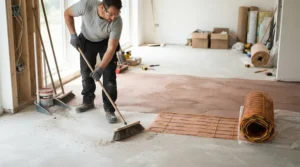
- Prep the subfloor. It must be clean, flat, and dry. Remove debris that could nick the wire.
- Plan the layout. Mark the mat zone, keep it away from walls and fixtures per the manual, and place the floor sensor between wire runs.
- Roll out the mat. Tape or adhere it down. Cut the mesh only where allowed, and never cut the heating wire.
- Test again. Check resistance and the monitor alarm before moving on.
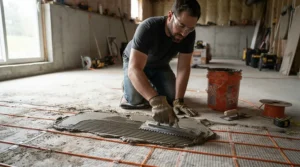
- Embed in thinset. Use a flat trowel first, then a notched trowel. Keep the wires covered without gouging them.
- Set tile and cure. Let the thinset cure fully before powering up. Skipping this step is a classic first-30-days mistake.
- Have an electrician wire the thermostat. They’ll connect the dedicated GFCI circuit.
Common mistakes include overlapping wires, trowel nicks, and forgetting a backup floor sensor. A small amount of patience here prevents a very expensive tear-out later.
Real-World Scenarios: Which Electric Floor Heating Mat Fits Your Life?
The rental-adjacent remodeler with a 20 sq ft bathroom. Budget is moderate, and the floor is a simple rectangle. The LuxHeat 20 Sq Ft Kit fits: built-in GFCI, 7-day scheduling, and decent value. Expect modest running costs and a one-weekend tile job.
The family in a cold-climate house with a drafty main bath. The room faces north and sits over an unheated space. The WarmlyYours TempZone Easy Mat Kit is worth the premium for its 15 W/sq ft output, especially paired with insulation underneath.
The couple building a master bath and gutting the kitchen. They want large coverage and an easy controller. The SunTouch TapeMat 70 Sq Ft Kit handles up to 70 sq ft with a touchscreen they’ll actually enjoy using.
The homeowner with an L-shaped laundry room or basement corner. Obstacles abound. The HEATWAVE 20 Sq Ft Kit has the reversible layout for it, while the VEVOR 100 Sq Ft Cable Kit suits bigger, odder spaces if they’re comfortable with free-form spacing.
The remodeler already planning premium tile. Crack isolation matters, so the Schluter DITRA-HEAT-E-HK earns its spot.
Match scenario to product and the decision mostly makes itself.
Tile Floor Warming System: Mat vs Cable vs Film vs Hydronic
A tile floor warming system doesn’t have to be a mat. Here’s how the major types stack up:
| Type | Best For | Install Difficulty | Strength | Weak Spot |
|---|---|---|---|---|
| Electric mat | Rectangular rooms, bathrooms | Easy to moderate | Pre-spaced, fast | Fixed shape |
| Loose cable | Irregular or large spaces | Moderate to hard | Total layout control | Spacing skill needed |
| Foil or film | Floating floors | Easy | Thin, low profile | Not for tile in mortar |
| Hydronic | Whole-house | Hard, plumber needed | Lowest running cost at scale | High upfront cost |
Electric mats win on speed for small tiled rooms. Cable wins on irregular geometry, which is why the VEVOR 100 Sq Ft Cable Kit and Schluter DITRA-HEAT-E-HK exist. Film belongs under floating floors, not thinset-embedded tile. Industry guidance consistently positions hydronic systems for whole-home heating and electric mats for small spaces needing simple floor warming.
The honest takeaway: if your project is one or two rooms, electric wins on cost and simplicity. If you’re heating an entire house, hydronic probably deserves a quote.
Long-Term Cost and Maintenance: What an Electric Floor Heating Mat Really Costs
Upfront, published installed-cost ranges for electric radiant systems commonly run around $8 to $15 per square foot, including labor, though DIY mat materials can come in lower. Running costs depend on watts, hours, and your electric rate. Here’s my own calculation at 12 W/sq ft, six hours a day at full power, and $0.17 per kWh:
| Mat Size | Wattage | Estimated Monthly Cost |
|---|---|---|
| 10 sq ft | 120 W | about $4 |
| 20 sq ft | 240 W | about $7 |
| 50 sq ft | 600 W | about $18 |
| 100 sq ft | 1,200 W | about $37 |
Those figures overstate real use, since thermostats cycle off once the floor hits temperature. Your rate and schedule will shift them. Still, the pattern is clear: small mats are cheap to run, and costs scale linearly with area. Programmable scheduling makes the biggest difference.
Maintenance is nearly nothing. No filters, no moving parts. The only real maintenance is keeping the thermostat and sensor accessible, and not drilling into the floor later. Mark the heated zone on a plan and keep it with your house documents. Future you, hanging a heavy cabinet, will be grateful.
Safety, Regulations, and Compliance for Floor Heating Mats
Safety here is mostly about electricity and water, and it’s non-negotiable.
Look for UL or cULus listing, which products like the WarmlyYours TempZone Easy Mat Kit and Warming Systems 10 Sq Ft Mat advertise. Wet-location listings matter in bathrooms. GFCI protection, either built into the thermostat as with the LuxHeat 20 Sq Ft Kit or via a breaker, is standard for these systems.
Use a dedicated circuit. Never daisy-chain mats on a shared line without confirming the manufacturer allows it. Never cut the heating wire, and never let two heating wires touch or cross. A damaged element can overheat locally.
Permits and electrical codes vary by location. Your electrician or local building department will know the rules, and codes change. EMF-conscious buyers should look at dual-wire or twisted-pair designs like those in the LuxHeat 20 Sq Ft Kit and Schluter DITRA-HEAT-E-HK. Use the installation monitor throughout the job, and test the resistance at each stage. It’s the cheapest insurance in the whole project.
FAQ
❓ Can I install a heating mat under existing tile without removing it?
❓ How long does an electric floor heating mat take to warm tile?
❓ Can I cut a heating mat to fit my bathroom?
❓ Do I need an electrician to wire a thermostat controlled floor mat?
❓ Is a heating mat for bathroom floor safe around water?
Conclusion
Warm floors aren’t a luxury trick; they’re a daily comfort that pays back every cold morning. The right electric floor heating mat depends on three things: room size, flooring, and how much you care about thermostat control.
For small bathrooms, the Warming Systems 10 Sq Ft Mat and LuxHeat 20 Sq Ft Kit are straightforward, well-equipped choices. For colder rooms, the WarmlyYours TempZone Easy Mat Kit adds meaningful extra output. The HEATWAVE 20 Sq Ft Kit handles awkward layouts, and the SunTouch TapeMat 70 Sq Ft Kit covers large floors with a touchscreen. The Schluter DITRA-HEAT-E-HK suits premium tile jobs with crack protection, and the VEVOR 100 Sq Ft Cable Kit delivers budget coverage for big spaces if you’re careful with spacing.
Measure the usable floor, check the thermostat, confirm wet-location ratings, and hire an electrician for the final hookup. Do those four things and the rest is just tile and patience.
✨ Ready to Warm Up Your Floors?
🔥 Compare the picks above, click any highlighted product to check current pricing and availability, and give your bathroom the cozy upgrade it deserves. Your feet will thank you every single morning!
Recommended for You
- Radiant Floor Heating: 7 Best Systems, Ultimate 2026
- Dyna-Glo Patio Heater: 7 Proven Picks For 2026
- Fire Sense Patio Heater: 7 Best Picks (Ultimate 2026 Guide)
Disclaimer: This article contains affiliate links. As an Amazon Associate, I earn from qualifying purchases. If you purchase products through these links, we may earn a small commission at no additional cost to you.
✨ Found this helpful? Share it with your friends! 💬🤗
