
In This Article
Here’s the dirty secret of the heated clothing world: the vest gets the glory, but the battery does the work. You can own the fanciest carbon-fiber, nine-zone, wind-blocking marvel on the market, and it’s a very expensive vest-shaped blanket the moment the pack runs dry at 2 p.m. on a frozen job site.

So let’s start with the basics.
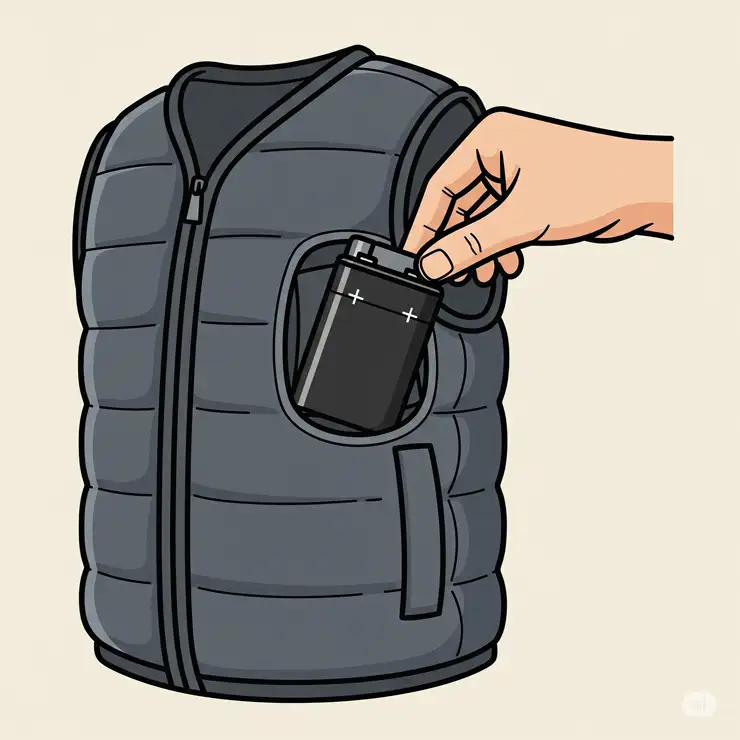
What is a battery for heated vest use? It’s a rechargeable lithium-ion pack, usually rated at 5V or 7.4V, that feeds electricity to the carbon-fiber heating panels sewn into your vest. Capacity (in mAh or Wh), voltage, and connector type decide how long it runs, how hot it gets, and whether it fits your garment at all.
That last part trips up more people than you’d think. A lithium-ion battery is a clever bit of chemistry, but it’s also fussy. Wrong voltage, wrong plug, wrong expectations, and you’re left with a cold chest and a pile of returns.
This guide is built to prevent that. We compared seven real options, from compact vest-matched packs to big-capacity power banks to a power-tool battery, and we’ve broken down what each spec actually means once you’re standing in the wind. Prices below are ranges only, because they move constantly. Check current pricing before you buy.
Ready? Let’s make sure your next battery for heated vest purchase is the last one you need for a while. 🔋
Quick Comparison: Battery for Heated Vest Options at a Glance
Before the deep dives, here’s the cheat sheet. Capacities are based on listing and manufacturer specs, and watt-hour (Wh) figures are estimates using the standard formula (volts × amp-hours).
| Battery | Output Type | Capacity | Approx. Energy | Price Range | Best For |
|---|---|---|---|---|---|
| Venustas 7.4V 5000mAh | 7.4V DC + USB 5V | 5,000mAh | ~37Wh | Budget-to-mid | Matched, no-fuss replacement |
| ORORO 7.38V 4800mAh | 7.38V DC | 4,800mAh | ~35Wh | Budget-to-mid | ORORO vest owners |
| Venustas 5V 10,000mAh | USB 5V/2.1A | 10,000mAh | ~37Wh | Budget | 5V vests, phone backup |
| JAYSUING 20000mAh | 7.4V DC + USB/Type-C | 20,000mAh | ~74Wh | Mid-range | All-day commuters |
| HIMONI 20000mAh | 7.4V DC + USB/Type-C | 20,000mAh | ~74Wh | Mid-range | Brand-mixing, easy restart |
| 30000mAh Type-C pack | 7.4V DC + 5V/9V/12V | 30,000mAh | ~111Wh | Mid-to-premium | Multi-day, multi-device |
| Milwaukee M12 CP2.0 | M12 platform | 2.0Ah (12V class) | ~24Wh | Mid-range | Tradespeople on M12 tools |
Looking at the table, the matched packs (Venustas 7.4V 5000mAh and ORORO 7.38V 4800mAh) win on simplicity, while the two 20,000mAh packs roughly double your energy for a modest jump in cost. The 30000mAh Type-C pack offers the most juice, but it crosses the 100Wh line that matters for air travel, so it’s a trade-off, not a free upgrade.
💬 Just one click — help others make better buying decisions too!😊
Top 7 Battery for Heated Vest Picks: Expert Analysis
A quick word on method. Specs below come from manufacturer pages and retailer listings. For customer sentiment, I only report what could actually be verified, and where I couldn’t confirm aggregated reviews for a specific pack, I say so. No invented quotes, no pretend field tests.
1. Venustas 7.4V 5000mAh Battery — the matched, no-guesswork baseline
If your vest is a Venustas, this is the “just works” answer. It’s the manufacturer’s own pack, which removes the single biggest risk in this category: mismatched plugs and voltages.
Venustas’s own battery guide lists it as a 7.4V, 5,000mAh unit with a DC 7.4V/3A output plus a USB 5V/2.1A port. On paper that’s roughly 37Wh, which Venustas says can run a vest with five to six heating elements for about 8 to 9 hours. Treat that as a best-case figure on lower settings.
Who is it for? Anyone who wants the vest to behave exactly as designed. Based on the spec comparison, you give up raw capacity versus the 20,000mAh packs, but you gain a pack sized for the vest’s pocket.
On reviews: I couldn’t verify aggregated customer sentiment for this specific pack, so I won’t characterize it. What’s verifiable is the manufacturer’s documentation, which is unusually clear.
Pros:
- ✅ Designed for Venustas vests, so fit is guaranteed
- ✅ Dual output: DC 7.4V plus USB port
- ✅ Pocket-friendly size and weight
Cons:
- ❌ Modest capacity for multi-day trips
- ❌ Brand-specific, so less flexible across vests
Price: check current price, but expect budget-to-mid pricing. Verdict: strong value if you stay in the Venustas ecosystem.
2. ORORO 7.38V 4800mAh Battery — the ORORO-native choice
ORORO’s pack sits in nearly the same spot as the Venustas one, and that’s not a coincidence: this is the standard 7.4V-class battery that powers many popular heated vests.
A roundup of battery heated vests lists a 7.38V 4800mAh battery with the ORORO women’s vest, which works out to about 35Wh. Another review roundup (The Drive’s heated vest guide) has named an ORORO vest a best-value pick, so the ecosystem has real traction.
Here’s what the spec sheet won’t tell you, but the math does: 4800mAh is a middle-of-the-road cell count. It’s plenty for a morning commute or a few hours of yard work, but it’s the pack you’ll want a spare for if your day runs past lunch.
On reviews: aggregated sentiment for the standalone battery wasn’t verifiable in my research, so treat the vest-level praise as indirect evidence only.
Pros:
- ✅ Native fit for ORORO heated vests
- ✅ Light enough to forget it’s in your pocket
- ✅ Easy to buy a second one as a spare
Cons:
- ❌ Roughly 35Wh won’t last a full cold workday on high
- ❌ Limited use outside the ORORO ecosystem
Price: check current price; budget-to-mid. Verdict: the sensible default for ORORO owners, ideally bought in pairs.
3. Venustas 5V 10,000mAh Battery — the USB-simple option for 5V vests
Not every vest runs on 7.4V. Plenty of lighter, cheaper vests and hoodies use plain 5V USB, and for those, this is the matching pack. Venustas lists it with a single USB 5V/2.1A output.
At 10,000mAh and 5V, you’re looking at roughly 37Wh, the same energy as the 7.4V 5000mAh pack, just delivered at lower voltage. That means gentler heat output on the same energy budget, which is exactly what you want for mild-weather layering.
The twist: a 5V vest typically warms up more slowly and tops out lower than a 7.4V one. If you live where January means single digits, this pack is a poor match for your needs. If you want a cozy buffer for fall stadium games or dog walks, it’s lovely.
On reviews: I couldn’t verify review aggregates for this specific pack. The listing details are consistent across Venustas’s own documentation, though.
Pros:
- ✅ Works as an everyday USB power bank too
- ✅ Simple plug-and-play with 5V garments
- ✅ Lower voltage means gentler, steadier heat
Cons:
- ❌ Not compatible with 7.4V vests
- ❌ Slower warm-up in truly cold weather
Price: check current price; budget range. Verdict: great for cool-weather comfort, wrong tool for deep freezes.
4. JAYSUING 20000mAh 7.4V Battery Pack — the all-day workhorse
This is where the math gets exciting. A 20,000mAh pack is roughly 74Wh, nearly double the energy of the stock 5000mAh batteries, and the Newegg listing describes it as 10 ounces, roughly 20% smaller than typical packs of this size.
The listing specifies a DC 7.4V/3A output plus USB and Type-C ports that can also charge phones, and says the pack auto-starts when plugged into the vest, which spares you a fumbling button press with gloves on. It also claims UL, FCC, RoHS, and CE certifications.
My read: this is the sweet spot for commuters and outdoor workers. At 74Wh, you stay under the 100Wh airline threshold, so it can travel with you. At 10 ounces, you’ll notice it, but you won’t resent it.
On reviews: I couldn’t verify aggregated reviews, so rely on the spec sheet and the certification claims, and confirm the certifications on the actual packaging.
Pros:
- ✅ Roughly double the energy of stock vest packs
- ✅ Auto-start when connected to the vest
- ✅ Doubles as a phone charger
Cons:
- ❌ Heavier than the matched 5000mAh packs
- ❌ Plug size must match your vest
Price: check current price; mid-range, under roughly $60 at the time of research. Verdict: the best energy-per-dollar balance in this roundup.
5. HIMONI 20000mAh 7.4V Battery Pack — the brand-mixer with a clever restart
HIMONI targets the problem that frustrates a lot of vest owners: having a vest from one brand and a battery from another. Its listing says the pack works with ORORO and Venustas apparel, with USB 5V heating vests, and with most 7.4V DC garments using 4.0mm, 3.8mm, or 3.5mm ports.
It also claims up to 12 hours of warmth, and here’s the standout detail: after turning the vest off, you flip a switch to restart heating without unplugging. In a cold garage with numb fingers, that’s a genuine quality-of-life feature, not a gimmick.
The integrated USB-C cable doubles as a lanyard, which is a neat touch for hikers. As with any “up to 12 hours” claim, assume that’s on the lowest setting.
Honest take: universal compatibility claims deserve a quick plug test before you rely on them. Check your vest’s connector size first.
On reviews: aggregated sentiment couldn’t be verified, so I’m leaning on documented features only.
Pros:
- ✅ Multiple DC plug sizes for wider compatibility
- ✅ Restart switch avoids unplugging the cable
- ✅ Lanyard-style cable for easy carrying
Cons:
- ❌ Compatibility claims need a personal fit-check
- ❌ Runtime claims are best-case
Price: check current price; mid-range. Verdict: smart for households with more than one brand of heated gear.
6. 30000mAh 5V/9V/12V Type-C Battery Pack — the big-capacity wildcard
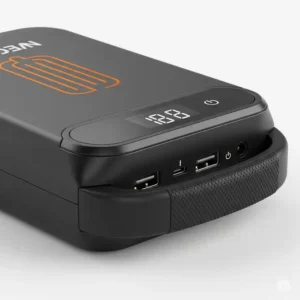
Capacity junkies, meet your match. This 30000mAh pack advertises a pocket-sized form, an LED display, a Type-C port that handles input and output, multiple output modes (5V/3A, 9V/2A, 12V/1.5A), and 3.8mm and 4.0mm DC cables for 7.4V vests.
The multi-voltage design is unusual for this category and could power more than a vest, but it also means you should read the manual twice before plugging in expensive gear.
The big flag is energy. At roughly 111Wh by the standard calculation, it lands in the 101 to 160Wh band, where airlines require approval and cap you at two spares. That’s a real consideration if you travel. Always check the Wh printed on the pack itself.
Who is it for? Multi-day campers, ice-fishing trips, and anyone who’d rather charge once and forget it for a long weekend.
On reviews: I couldn’t verify aggregated customer reviews for this pack. The documented specs are solid on paper, but unproven in my sourcing.
Pros:
- ✅ Huge reserve for multi-day outings
- ✅ Multiple voltage modes plus included DC cables
- ✅ LED display shows remaining charge
Cons:
- ❌ Needs airline approval for flights
- ❌ Heavier and bulkier in a vest pocket
Price: check current price; mid-to-premium, in the $60-$90 range at the time of research. Verdict: overkill for commuting, ideal for expeditions.
7. Milwaukee M12 REDLITHIUM CP2.0 — the tool-battery crossover
Different animal entirely. Milwaukee’s heated vests run on the company’s M12 battery platform, and the brand’s own product page lists the vest as compatible with all M12 batteries and its Heated Gear Power Source with app control.
The CP2.0 is the compact 2.0Ah pack in that lineup. At 12V class, it’s roughly 24Wh, which is modest on paper, but Milwaukee’s vest lists two heat zones (chest and back), three heat settings, and a zippered pass-through pocket that lets you route the battery for comfort.
Here’s the real argument for this one: if you already own M12 tools, you already own a stack of heated-vest fuel. Swap the pack from your drill to your vest. No new chargers, no new ecosystem.
On reviews: I didn’t verify aggregated sentiment specific to the CP2.0 in a heated-vest context.
Pros:
- ✅ Shares batteries with M12 tools
- ✅ Rugged, jobsite-oriented design
- ✅ Wide availability and replacement options
Cons:
- ❌ Low energy per pack for all-day heat
- ❌ Only useful with M12-compatible vests
Price: check current price; roughly the $30-$60 range for a single pack. Verdict: smart for tradespeople, weaker for everyone else.
How to Choose a Battery for Heated Vest: 7 Steps
This is the part Amazon listings never explain, so let’s slow down and do it properly. Work through these in order.
- Confirm your vest’s voltage. Most modern vests are 5V USB or 7.4V DC. Some are 12V. A 5V pack won’t properly heat a 7.4V vest, and a 12V garment needs a 12V source. Check the label, not the marketing page.
- Match the connector. The DC plug is typically 3.5mm, 3.8mm, or 4.0mm. A pack with multiple adapters gives you flexibility, but a quick physical check beats trusting a listing.
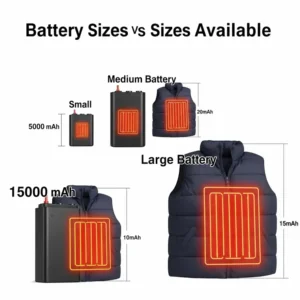
- Choose capacity by your day, not by your ego. A short commute needs 5,000mAh; a full workday outdoors needs 10,000 to 20,000mAh.
- Check the Wh rating if you fly. Under 100Wh is easy. Between 101 and 160Wh needs airline approval. The FAA’s lithium battery guidance lays it out clearly.
- Look for safety certifications. UL, FCC, RoHS, and CE marks aren’t guarantees, but their absence is a red flag.
- Weigh the weight. A 20,000mAh pack is a real object. Make sure your pocket can carry it without sagging.
- Plan for a spare. Two modest packs beat one giant one: you can swap in the field, and you aren’t hostage to one failure.
Battery for Heated Vest: 5V vs 7.4V vs Alternatives
Voltage is the most misunderstood spec in this entire category, so let’s compare the real-world options side by side.
| Option | Typical Voltage | Heat Strength | Flexibility | Best For |
|---|---|---|---|---|
| Matched vest battery (e.g., Venustas 7.4V 5000mAh) | 7.4V | Strong | Low | Brand-loyal buyers |
| USB power bank (e.g., Venustas 5V 10,000mAh) | 5V | Gentle | High | Mild weather, phones too |
| High-capacity universal pack (e.g., HIMONI 20000mAh) | 5V/7.4V | Strong | High | Mixed-brand households |
| Tool-platform battery (e.g., Milwaukee M12 CP2.0) | 12V class | Strong | Medium | Tradespeople on M12 |
The pattern is clear. Matched packs minimize risk, universal packs maximize flexibility, and tool batteries maximize ecosystem savings. If you only buy one, the universal 20,000mAh route offers the best blend of runtime and compatibility, while the Venustas 5V 10,000mAh is the right call only if your vest is natively 5V.
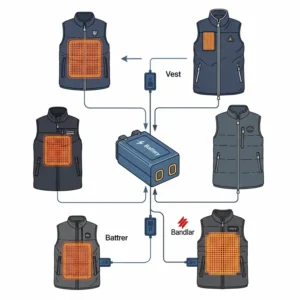
Why does voltage matter so much? Think of it like water pressure. Higher voltage pushes the same job through the panels with more authority, which is why 7.4V vests heat faster and hotter. A 5V pack isn’t “weaker” in energy terms, it’s just a gentler hose.
Practical Usage Guide: Getting the Most From Your Battery for Heated Vest
Buying the right pack is half the battle. Using it well is the other half, and it’s where most of the real savings live.
First charge. Fully charge before first use. Many manufacturers recommend avoiding charging other devices off the pack at the same time, since it slows the charge and can stress the cell. One listing notes a 16,000mAh pack fully charging in under five hours using a 5V/3A charger.
First-use warm-up. Start on the highest setting for the first five to ten minutes, then drop to medium or low. Your body is the real heater once the panels get you past the initial chill. Staying on high all day is like keeping a sports car in sixth gear on a city street.
Pocket placement. Keep the battery in an inside pocket close to your body. Cold air saps lithium-ion performance, and body heat keeps the pack efficient. A pack stuffed into an outer pocket at 15°F will drain faster than the same pack against your ribs.
Maintenance schedule. Every month, wipe the connectors with a dry cloth. Every few weeks, check that the cable strain relief isn’t fraying. If you store the vest for summer, leave the pack at partial charge rather than empty or full, and keep it away from heat and moisture. Venustas’s own guidance echoes the sunlight-and-moisture warning.
Common mistakes in the first 30 days:
- Running high the entire time and wondering why the pack died by noon.
- Using a phone-charging cable that can’t carry enough current.
- Forgetting that washing the vest requires removing the battery first.
Build these habits and a quality pack should serve you well for several winters.
Real-World Scenarios: Matching a Battery for Heated Vest to Your Life
Specs only mean something in context. Here are three realistic profiles and how I’d match each to the products above, based on the numbers.
Scenario 1: The college student commuter. Eight-mile bike ride, 25 minutes each way, cold mornings, tight budget. This buyer needs the vest warm for under an hour at a time. The ORORO 4800mAh or Venustas 5000mAh is plenty, and charging nightly covers a full week of short rides without stress. Spending more would be wasted capacity.
Scenario 2: The outdoor worker on a ten-hour shift. A landscaper or utility worker on a cold site needs sustained heat for a full day. The JAYSUING 20000mAh or HIMONI 20000mAh makes sense, with a small spare for emergencies. If this person already owns Milwaukee M12 tools, the Milwaukee M12 CP2.0 becomes a smart supplemental pack, since a second battery is already in the toolbox.
Scenario 3: The weekend ice fisher or hunter. Hours of sitting motionless in subzero air, far from an outlet. Here the 30000mAh Type-C pack earns its weight, since the big reserve protects against the single worst outcome in cold weather: running out of heat when you can’t move to generate your own.
Notice the pattern? The right battery for heated vest owners isn’t the biggest, it’s the one that matches the day’s actual demand with a modest safety margin.
Problem and Solution: Fixing Common Battery Headaches
Heated gear fails in predictable ways. Here are the most common problems and what to try first.
Problem 1: The vest feels weak or lukewarm. Check voltage first. A 5V pack on a 7.4V vest will heat poorly. Next, check charge level, since low power can stop a vest from heating properly. Charge fully, then test again.
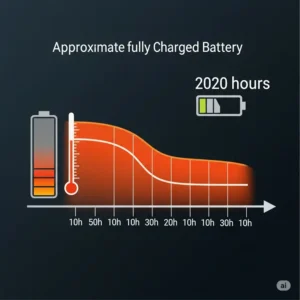
Problem 2: The battery dies far faster than promised. “Up to 12 hours” claims assume the lowest setting. Drop one level, keep the pack in an inside pocket, and consider carrying a second one. Cold also reduces effective capacity, so expect shorter runs in deep freezes.
Problem 3: The vest won’t turn on after connecting. Reseat the plug and check for a loose or bent connector. Some packs auto-start when connected, others need a button press. Check the specific pack’s behavior in its manual.
Problem 4: The plug doesn’t fit. Check the DC size (3.5mm, 3.8mm, or 4.0mm). Packs like the HIMONI 20000mAh and the 30000mAh Type-C pack include multiple adapters for this reason.
Problem 5: The pack runs hot. Stop using it, disconnect it, and let it cool. If it’s swollen, damaged, or smells odd, stop using it entirely and dispose of it at a proper battery recycling point.
Features That Actually Matter (And Those That Don’t)
Marketing language loves big numbers. Let’s separate signal from noise.
What matters:
- Verified voltage and connector match. Everything else is irrelevant if these don’t fit.
- Realistic capacity. Capacity in mAh on power banks is typically quoted at the cell’s nominal 3.7V, so a 20,000mAh pack is roughly 74Wh, not 148Wh. The US DOT’s battery guidance explains how to calculate watt-hours from voltage and amp-hours.
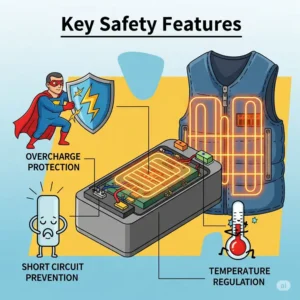
- Built-in protection. Overcharge and overload protection are standard on reputable packs.
- Auto-start or easy restart. This is a surprisingly big deal with gloves on.
What matters less:
- LED displays. Nice for remaining charge, but not essential.
- Lanyard cables and aesthetics. Charming, rarely decisive.
- Maximum-capacity bragging rights. Bigger isn’t better if it’s too heavy to wear comfortably.
One more subtle point. Capacity isn’t the only variable: a pack that can’t deliver enough current will underperform on high settings no matter how big its label says it is. The 3A DC outputs listed on the JAYSUING 20000mAh and Venustas 7.4V 5000mAh are a good benchmark for typical vests.
Common Mistakes When Buying a Battery for Heated Vest
I’d rather you learn these from a list than from a cold afternoon.
Mistake 1: Buying by capacity alone. A huge pack in the wrong voltage is a paperweight. Voltage compatibility always comes first.
Mistake 2: Assuming “universal” means “tested with your vest.” Compatibility claims are marketing until you confirm connector size and voltage. If the listing says “NOT for DC 12V,” believe it.
Mistake 3: Ignoring airline rules. If you travel, a battery above 100Wh requires airline approval, and spares can’t go in checked bags. Many a traveler has had a pack confiscated at security.
Mistake 4: Skipping the spare. Two moderate packs give you redundancy, field-swapping, and flexibility. One giant pack gives you a single point of failure.
Mistake 5: Trusting “up to” runtimes. Those numbers are best-case. Plan for roughly half on cold, high-heat days.
Mistake 6: Charging in the cold. Charging lithium-ion cells in freezing temperatures isn’t ideal. Bring packs indoors to charge, then carry them out.
Long-Term Cost and Maintenance of a Battery for Heated Vest
Sticker price is a poor guide to what a battery actually costs you. Total cost of ownership is a function of capacity, lifespan, and how many times you’ll have to replace it.
Consider a simple framework. A budget pack in the lower price range delivers roughly 35 to 37Wh. A mid-range 20,000mAh pack delivers roughly 74Wh at a modestly higher price. On a per-watt-hour basis, the bigger pack often wins, which is why heavy users should lean toward capacity.
| Factor | Small Matched Pack | Large Universal Pack | Tool Battery |
|---|---|---|---|
| Upfront cost | Low | Mid | Low-to-mid |
| Energy per dollar | Moderate | Strong | Weaker |
| Flexibility | Low | High | Medium |
| Replacement ease | Easy | Moderate | Very easy |
Reading the table, the large universal pack looks best for frequent, long-duration use, while the small matched pack is the efficient choice for light users. The tool battery’s real advantage isn’t price per Wh, it’s the ecosystem you’ve already paid for.
Lithium-ion cells slowly lose capacity over hundreds of charge cycles, which is simply how the chemistry works. To stretch the lifespan, avoid heat, avoid deep discharge, and store at partial charge for long stretches. A pack that’s treated well can reasonably serve you across multiple winters, while one left in a hot car every summer will fade much faster.
Safety, Regulations, and Flying With a Battery for Heated Vest
Lithium-ion packs are safe in everyday use, but they deserve a little respect. The key regulatory rules for U.S. travelers are worth knowing before you pack.
Airline basics. According to FAA guidance, rechargeable lithium-ion batteries are limited to 100Wh per battery in carry-on, and with airline approval you may carry up to two spares between 101 and 160Wh. Spare lithium batteries belong in carry-on baggage, not checked bags.
How to find your Wh. If it’s not printed on the pack, multiply voltage by amp-hours. A 20,000mAh pack at 3.7V works out to about 74Wh. A 30,000mAh pack at 3.7V is about 111Wh, which is why the 30000mAh Type-C pack needs extra planning for flights.
Protect the terminals. Spare batteries should be protected from short circuits. Individual pouches or covered terminals are the simple fix.
Everyday safety checklist:
- Don’t use damaged, swollen, or leaking packs.
- Don’t leave a battery charging unattended on a soft surface.
- Keep packs away from direct heat and moisture.
- Use the cable that came with the pack, or a good-quality equivalent.
None of this is alarming. It’s just common sense scaled to an energy-dense device you’ll be wearing against your body.
Battery for Heated Vest by Audience: Who Should Buy What
Different people want different things, so here’s a quick tailored guide.
Beginners: Start with a matched pack, either the Venustas 7.4V 5000mAh or the ORORO 7.38V 4800mAh. Zero compatibility guesswork, and you’ll learn how long your vest really lasts before you invest in more capacity.
Commuters and cyclists: The JAYSUING 20000mAh covers a long day and still charges your phone. Its auto-start function is a gift when you’re wearing gloves.
Tradespeople: If you live on the M12 platform, the Milwaukee M12 CP2.0 puts battery sharing to work for you. Pair it with a larger pack for the long days.
Outdoor enthusiasts: The 30000mAh Type-C pack and the HIMONI 20000mAh suit hunting, fishing, and camping, where reliable all-day warmth beats weight savings.
Seniors and cold-sensitive users: Prioritize simplicity and reliability. A matched pack with a clear charge indicator makes daily use effortless, and a spare in the house is cheap peace of mind.
FAQ: Battery for Heated Vest Questions Answered
❓ Can I use a regular power bank for my heated vest?
❓ Can I take a battery for heated vest owners use on a plane?
❓ Can I use another brand's battery on my vest?
❓ How long does a battery for heated vest wearers use take to charge?
❓ Should I buy a second battery for my heated vest?
Conclusion: Choosing Your Battery for Heated Vest With Confidence
Let’s land this plane. 🛬
The best battery for heated vest owners isn’t the biggest, the flashiest, or the cheapest. It’s the one that matches your vest’s voltage, fits its plug, and covers your real-world day with a little headroom to spare.
For most people, that means one of three paths. Stay matched and simple with the Venustas 7.4V 5000mAh or ORORO 7.38V 4800mAh. Step up to a 20,000mAh option like the JAYSUING 20000mAh or HIMONI 20000mAh for all-day work. Or lean on a tool ecosystem with the Milwaukee M12 CP2.0. And if you need serious reserves, the 30000mAh Type-C pack is there, with the airline caveat noted above.
Remember the golden rules: confirm voltage, match the connector, check the Wh if you travel, and carry a spare. Do those four things and your vest will earn its keep from the first frost to the last thaw.
✨ Ready to stay warm all winter? 🔍 Check current pricing and availability on the packs above, pick the one that fits your day, and never let a dead battery steal your warmth again. Your future, toasty self will thank you! 🔥
Recommended for You
- 15 Best Voltex Heating Vest Reviews 2025: Ultimate Buyer’s Guide & Expert Tests
- Heat Straps Jacket: 10 Revolutionary Heated Jackets That Will Transform Your Winter in 2025
- 15 Best Heated Hunting Jackets That Will Transform Your Winter Hunts in 2025
Disclaimer: This article contains affiliate links. As an Amazon Associate, I earn from qualifying purchases. If you purchase products through these links, we may earn a small commission at no additional cost to you.
✨ Found this helpful? Share it with your friends! 💬🤗
