

In This Article
Your ears don’t get a vote on how cold it is outside, but they’re always the first body part to file a complaint. By the time your face goes numb, your toes are still insisting they’re fine — ears, though, surrender almost instantly. That’s just anatomy: thin skin, almost no insulating fat, blood vessels sitting close to the surface. A regular knit cap traps a little of your own body heat and calls it a day. A heated beanie does something different — it adds heat of its own.
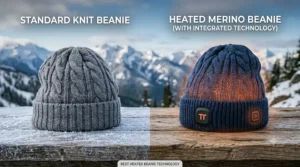
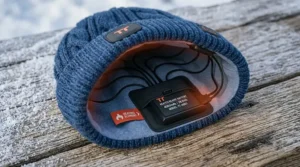
In the simplest terms, a heated beanie is a battery-powered knit or fleece hat with thin carbon-fiber or far-infrared heating panels stitched in near the ears and forehead, run off a small rechargeable 5V or 7.4V lithium battery tucked into a pocket at the back of the head. Press a button, wait under a minute, and the hat starts generating warmth instead of just hoarding yours.
I went looking for options that are actually sitting on Amazon shelves right now — not concept products, not Kickstarter vaporware, not the suspiciously specific listings that vanish after one bad winter. What turned up is a small, surprisingly competitive category dominated by a handful of OEM specialists plus one or two names you’ll recognize from the outdoor aisle. Consider this less a generic thermal headwear review and more a spec-by-spec teardown: what each one is actually good at, and — just as important — where each one quietly falls short.
Quick Comparison Table
Here’s the lay of the land before we get into specifics:
| Beanie | Battery | Heat Settings | Runtime (Low) | Best For | Price Range |
|---|---|---|---|---|---|
| SVPRO | 7.4V 2200mAh | 3 | Up to 7 hrs | First-time buyers | $25–$35 |
| Autocastle | 7.4V 2200mAh | 3 | 6–7 hrs | Daily commutes | $25–$35 |
| ARRIS | 7.4V 2450mAh | 3 | Up to 7 hrs | Full ear coverage | $30–$40 |
| ActionHeat 5V | 5V Li-Po | 3 | ~4.5+ hrs | Hunting & ice fishing | $40–$55 |
| Dr.Warm APP | 7.4V 2200mAh | 3 + app | Up to 5 hrs | Smart/app control | $30–$40 |
| MMlove | 7.4V 2200mAh | 3 | 6–7 hrs | Gifting & budget use | $25–$35 |
| Savior Heat | 7.4V 2200mAh | 3 | Up to 8 hrs | All-day outdoor work | $35–$45 |
A few things jump out once you line these up side by side. Almost everyone in this category has converged on the same battery chemistry — a 7.4V lithium-polymer pack in the 2,200–2,450mAh range — which tells you it’s a solved problem at this price point, not a place to gamble on an outlier spec. The real exceptions are ActionHeat’s lower-voltage 5V system, which trades raw runtime for a faster, more controlled heat curve, and Savior Heat’s far-infrared panels, which stretch an identically sized battery further by heating more efficiently rather than just pumping out more wattage. And if “best heated beanie under $50” is your actual search term, six of these seven qualify outright — only the premium ActionHeat kit brushes past that line.
💬 Just one click — help others make better buying decisions too! 😊
Top 7 Best Heated Beanies: Expert Analysis
Here’s the breakdown, ranked roughly budget-to-premium rather than “best to worst” — because the right pick depends entirely on what you’re doing in it.
1. SVPRO Rechargeable Heated Beanie Hat
SVPRO Rechargeable Heated Beanie Hat is the one I’d hand to someone who’s never owned heated gear and isn’t ready to commit real money to the idea yet.
The spec sheet is unremarkable on purpose: a 7.4V 2200mAh lithium-polymer battery, three heat settings, and a claimed runtime of up to seven hours on the lowest setting. In practice, the roughly one-minute heat-up time is the number that matters most — you’re not standing in your driveway waiting for your hat to decide it likes you. The heating panels sit specifically over the ear area rather than blanketing the whole skull, which is the right call: ears are where cold registers first, so concentrating heat there beats spreading it thin everywhere.
Who this is for: anyone testing the heated-beanie waters before springing for something pricier, or anyone whose cold exposure is genuinely short — dog walks, the school pickup line, scraping ice off a windshield. What most first-time buyers overlook is that the fleece-and-acrylic shell is already a decent hat with the power off, so you’re not paying a premium just for a feature you’ll use twice a winter.
Reviewers consistently point to the fast heat-up and the price as the wins; the recurring complaint is a small, slightly fiddly battery pocket that takes a beat to get used to.
✅ Heats up in about a minute
✅ Genuinely warm even unpowered
✅ Easiest price of entry in this list
❌ Battery pocket is a little awkward at first
❌ Heating zone is ears-only, not full-head
Price range: around $25–$35. For the money, it’s hard to argue with.
2. Autocastle 7.4V Heated Knit Beanie
Autocastle 7.4V Heated Hat comes from a company that’s been making nothing but heated apparel since 2010, and it shows in the small details — this isn’t a side-hustle product bolted onto a generic beanie mold.
The numbers mirror SVPRO almost exactly: 7.4V, 2200mAh, three heat settings, 6–7 hours of claimed runtime on low. What’s different in practice is the knit itself, which runs a touch thicker and holds its shape better after repeated wear, so it looks less like a gadget and more like a hat you’d choose anyway. The brand backs it with what it calls a lifetime guarantee on the heating hardware — worth noting, though as with any small-brand warranty claim, I’d treat “lifetime” as “as long as the company keeps answering emails,” and hang onto your original packaging just in case.
Who this is for: the daily commuter who wants the heated feature to disappear into an otherwise normal-looking winter hat — at the bus stop, nobody needs to know yours has a battery in it.
Owner feedback skews toward “does exactly what it says,” with the occasional note that medium is plenty for most days and high drains the battery noticeably faster — which, fair, that’s how heat settings work everywhere.
✅ Thicker, more natural-looking knit
✅ Established heated-apparel specialist, not a one-off
✅ Solid mid-setting balance of warmth and runtime
❌ “Lifetime guarantee” claims should be taken with some skepticism
❌ High setting burns through the battery noticeably faster
Price range: roughly $25–$35, putting it neck-and-neck with SVPRO on cost.
3. ARRIS Electric Heated Beanie Hat
ARRIS Heated Beanie Hat earns its spot here on a single design decision: the cut is deep enough to fully cover your ears rather than just brushing past them, and the heating element extends to match.
It runs a slightly larger 7.4V 2450mAh battery than the budget pair above, with the same up-to-seven-hour claim on low. The real-world meaning of that extra capacity isn’t dramatic — maybe twenty extra minutes — but the ear coverage is the bigger story. A lot of cheaper heated beanies warm a strip near the ear and call it done; ARRIS’s panel placement is built around actually enclosing the ear, which matters enormously if you’re someone whose ears go numb and stay numb on a windy commute.
Who this is for: anyone in a genuinely windy climate — coastal commuters, anyone biking or scootering to work, people who’ve specifically complained that other heated hats “don’t really heat the ears.” This is the spec that solves that exact complaint.
Feedback patterns lean toward praise for warmth, with a recurring note that the elastic fit runs a bit snug for larger heads — sizing up mentally is worth doing here.
✅ Best ear coverage in this lineup
✅ Slightly larger battery than the budget tier
✅ Stimulates circulation around the whole ear, not just a strip
❌ Snugger fit may not suit larger head sizes
❌ Bulkier profile under a hood or helmet
Price range: around $30–$40 — a small step up that buys real coverage.
4. ActionHeat 5V Battery Heated Winter Hat
ActionHeat 5V Battery Heated Winter Hat is the name on this list you’ve probably already seen — it’s stocked at REI, Cabela’s, and Bass Pro Shops, which says something about the brand’s standing outside the Amazon-only OEM crowd.
ActionHeat runs its own 5V lithium-polymer system rather than the 7.4V standard everyone else here uses, paired with a touch-button controller and three heat settings topping out around 130°F. The lower voltage isn’t a downgrade — it’s a deliberate engineering choice that trades peak heat for a gentler, faster-acting curve, and it’s part of why the hat heats up in under ten seconds flat. What most buyers overlook about the 5V architecture is that it’s the same battery family ActionHeat uses across its hand-warmer and hat lineup, so if you already own one of their products, your batteries are likely cross-compatible.
Who this is for: hunters and ice anglers who sit nearly motionless for hours in genuinely brutal cold and want a brand with an actual customer service department behind it, not just an Amazon storefront.
Owners consistently mention the snug, stretchy softshell fit as a plus for wearing under a hood, with the most common gripe being that runtime on the highest setting trails the 7.4V competition — which tracks, since lower voltage trades some ceiling heat for that faster warm-up.
✅ Recognizable, retail-backed brand
✅ Heats up in under 10 seconds
✅ Snug softshell fit layers well under hoods
❌ Pricier than the 7.4V competition
❌ Shorter runtime on the highest setting
Price range: typically $40–$55 — you’re partly paying for the brand and the retail support behind it.
5. Dr.Warm APP Control Heated Beanie Hat
Dr.Warm Heated Hat with APP Control is the one for anyone who’d rather not strip off a glove to fumble with a tiny button in freezing weather.
It runs the now-familiar 7.4V 2200mAh setup, three heat settings, and a claimed runtime up to five hours — the shortest number on this list, worth flagging upfront. The trade-off is smartphone control: the companion app lets you change temperature or check battery percentage without exposing bare fingers to the cold, on top of a physical button if you’d rather skip the phone entirely. This is the kind of feature that sounds gimmicky until you’re standing outside in 15°F wind trying to operate anything with numb hands, at which point “control it from inside your pocket” stops sounding like a gimmick.
Who this is for: tech-leaning buyers who already live with Bluetooth-everything, or anyone who genuinely struggles with small buttons while gloved — arthritis, thick mittens, whatever the reason.
Feedback is mixed on the app itself, described in app-store reviews as functional but occasionally fussy about pairing distance; the physical button as a fallback is what saves the experience for most owners.
✅ App control means no glove-off fumbling
✅ Physical button works as a reliable backup
✅ Same proven 7.4V battery platform as the rest of the category
❌ Shortest claimed runtime on this list (up to 5 hours)
❌ App pairing can be finicky depending on phone and distance
Price range: roughly $30–$40 for the smart-control premium.

6. MMlove Rechargeable Heated Beanie Hat
MMlove Rechargeable Heated Beanie Hat is the practical, slightly anonymous workhorse of this list — the one you buy three of because you keep losing winter hats to coat closets and car trunks.
Spec-wise, it’s the familiar 7.4V 2200mAh battery, three heat settings, and a 6–7 hour claimed runtime — basically tied with SVPRO and Autocastle on paper. What sets it apart slightly is the acrylic-and-polyester build, specifically marketed as warm enough to function as a normal beanie with the battery left at home or dead — useful for anyone who wants one hat that works in both modes rather than a separate backup beanie taking up drawer space.
Who this is for: gift-buyers (it shows up constantly in “stocking stuffer” and “gift for dad who works outside” searches for good reason), and anyone who wants a no-drama, no-app, just-press-the-button electric heated beanie without a learning curve.
Owner sentiment tracks closely with its budget siblings — solid warmth for the price, with the most common note being that the battery indicator light is easy to overlook, so check charge status before heading out rather than mid-walk.
✅ Functions as a normal warm beanie, battery or no battery
✅ Reliable 6–7 hour runtime on low
✅ Popular, low-risk gift option
❌ Battery charge indicator is easy to miss
❌ No standout feature beyond the category basics
Price range: around $25–$35, squarely in budget territory.
7. Savior Heat Rechargeable Heated Beanie
Savior Heat Rechargeable Heated Beanie is the premium pick, and it earns that label through pedigree rather than flash — the company has been making heated gloves, socks, and hats since 2008, with UL-tested electronics across its battery packs.
The 7.4V 2200mAh battery is identical in size to the budget options above, but Savior Heat squeezes more out of it using far-infrared heating elements rather than basic resistive wire — the practical result is a claimed 8 hours of runtime on low, the longest figure in this entire lineup, plus sub-30-second heat-up targeting both ears and forehead. The fabric blend (fleece cotton plus elastane) is also noticeably thinner than the acrylic knits in the budget tier, which is the whole point if you’re wearing it under a ski helmet or motorcycle lid where bulk is the enemy.
Who this is for: anyone spending genuinely long stretches outside in serious cold — all-day outdoor work, multi-hour hikes, or anyone who’s been burned before by a cheap hat that died at hour three.
Long-running heated-apparel brands tend to attract more detailed, repeat-customer feedback, and Savior Heat’s pattern follows that — owners frequently mention buying a second piece (gloves or socks) after the hat performed well, a decent proxy for trust beyond a single purchase.
✅ Longest claimed runtime in this lineup (up to 8 hours)
✅ UL-tested electronics from an established heated-gear specialist
✅ Slim, low-bulk fit for under helmets and hoods
❌ Highest price point of the seven
❌ Far-infrared heating runs slightly less intense at peak than resistive-wire competitors
Price range: around $35–$45 — a fair ask for the longest runtime here.
✨ Don’t Miss These Exclusive Deals!
🔍 Take your cold-weather setup to the next level with one of these seven heated beanies. Check current pricing and availability on Amazon before you buy — stock and prices shift constantly, especially heading into peak winter. ❄️
Practical Usage Guide: Getting the Most Out of Your Heated Beanie
None of the Amazon listings above will tell you this part, so here’s what actually matters once the box is open.
Charge it fully before the first wear, every time. Lithium batteries ship partially charged for safety reasons, not because the company forgot. Give it a full 2–3 hour charge before trusting it outside in real cold, and do the same after long storage — a battery that’s sat dead since March needs a full cycle to wake back up properly.
Start on low, even if you’re freezing. It sounds backwards, but jumping straight to high both drains the battery fastest and risks pressing overheated material against skin before your body’s acclimated. Give it ninety seconds — most of these hats heat the ear zone fast enough that you’ll know within a minute if you need to bump it up.
Remove the battery before washing, always. Every hat in this roundup uses a removable battery pocket specifically so you can wash the shell. Skipping this step is the single most common way people kill a $30 hat in one laundry cycle.
Store the battery partially charged for the off-season, not dead. Lithium cells degrade fastest when left fully drained for months. Packing this away in March? Top it to about 50% first.
Replace, don’t repair, a swollen or punctured battery. If the pack ever looks puffy or feels warm while sitting unused, stop and contact the manufacturer for a replacement rather than attempting any DIY fix.

Real-World Scenarios: Matching the Right Beanie to Your Life
The ice angler or deer-stand hunter. You’re sitting nearly motionless for three, four, five hours in punishing cold, and shivering yourself warm isn’t an option because movement spooks fish and game alike. Runtime on the low setting is the only spec that matters here — Savior Heat‘s 8-hour claim or ActionHeat‘s field-tested durability are built for exactly this, not the budget options designed around twenty-minute errands.
The daily commuter or dog walker. Your actual cold exposure is fifteen to thirty minutes, twice a day, and you mostly want something that doesn’t look like medical equipment under office lighting. Autocastle or MMlove make the most sense — you’ll never come close to draining a 6–7 hour battery on a walk around the block, so paying extra for runtime you’ll never use is pure waste.
The winter cyclist or motorcyclist. Wind chill, not ambient temperature, is your real enemy, and you need a snug, low-profile fit that works under a helmet without creating pressure points. ARRIS‘s full ear coverage and ActionHeat‘s tight softshell cut both solve for this specifically; a loose, bulky knit beanie bunches uncomfortably under a chin strap.
The gift buyer shopping for someone who works outside. You want reliability over novelty, and something that won’t embarrass anyone if the battery dies mid-shift — that’s SVPRO or MMlove territory: cheap enough to not feel like a big swing, functional enough to actually get worn.
How to Choose the Best Heated Beanie for You
Cut through the marketing copy with these seven questions, in order:
- How long will you actually wear it per outing? Under thirty minutes, runtime barely matters — buy on comfort and price. Over two hours, runtime becomes the single most important spec on the page.
- What’s your wind exposure? High wind (cycling, motorcycling, open fields) demands full ear coverage and a snug fit; low wind (dog walks, shoveling) tolerates a looser knit just fine.
- Do you need glove-free controls? If you wear thick mittens or have dexterity concerns, app or remote control — like Dr.Warm’s — earns its premium.
- Will it go under a helmet or hood? If yes, prioritize thinner, low-bulk builds; far-infrared options like Savior Heat tend to run slimmer than thick acrylic knits.
- What’s your real budget ceiling? Every hat here clusters in the 7.4V, 2200–2450mAh range at the budget tier; paying more should buy a specific feature — app control, longer runtime, full coverage — not just a logo.
- Do you want it to double as a normal beanie? If the battery dies or you forget to charge it, does the shell still function as a warm hat? Most do, but check.
- Is the brand still around in two years? Smaller OEM brands can vanish. Check how long a brand has specifically sold heated gear before trusting any “lifetime” warranty claim.
Common Mistakes When Buying a Heated Beanie
Buying based on the highest advertised temperature. A hat claiming 150°F sounds impressive until you realize you’d never run it that hot against your scalp for more than a few minutes. Low and medium are where you’ll actually live; judge a hat by those numbers, not the eye-catching maximum.
Ignoring battery capacity in favor of brand name alone. A recognizable name like ActionHeat is genuinely worth something — but comparing two unfamiliar OEM brands, the 7.4V/2200mAh spec sheet tells you more about real performance than a seller’s star rating, which can be inflated by incentives that have nothing to do with actual warmth.
Skipping the sizing details. “One size fits most” is doing a lot of work on these listings. If you have a larger head, a snug-fit hat like ARRIS will feel tight by hour two; check stretch percentage or fit-related reviews before assuming universal sizing applies to you.
Forgetting the battery exists when washing. Covered above, but worth repeating — it’s the single most common five-star-to-zero-star failure mode in this entire category.
Expecting whole-head warmth from an ear-zone heater. Most budget heated beanies concentrate heat near the ears, not across the entire scalp. That’s not a flaw — ears genuinely are the priority zone — but don’t expect a sauna effect across your whole head.
Heated Beanie vs Traditional Thermal Beanie vs Heated Hood
| Feature | Heated Beanie | Traditional Thermal Beanie | Heated Hood/Balaclava |
|---|---|---|---|
| Active heat source | Yes, battery-powered | No, insulation only | Yes, usually larger battery |
| Typical runtime | 4–8 hrs | N/A (passive) | 3–6 hrs |
| Coverage | Ears + partial head | Full head | Full head + neck/face |
| Bulk under helmet | Low to moderate | Low | Moderate to high |
| Price range | $25–$55 | $10–$25 | $50–$90 |
| Best for | Moderate-to-severe cold, short-to-medium exposure | Mild cold, budget priority | Extreme cold, full-face exposure |
The honest answer to “which one should I buy” comes down to how cold it actually gets where you live and how much of your face stays exposed. A $15 fleece-lined beanie handles most winters fine down into the 20s and 30s — no shame in skipping the battery entirely if that’s your reality. A heated beanie or any electric heated beanie earns its premium once temperatures dip into the teens and below, or once wind chill becomes the dominant factor, because that’s where passive insulation alone starts losing the fight. Heated hoods and balaclavas exist for a narrower, more extreme use case — ice fishing guides, snowmobilers, anyone with their entire face exposed for hours — and they cost more because they’re heating a larger surface with a bigger battery to match.

Features That Actually Matter (And Those That Don’t)
Matters: heating element placement. Ear-focused panels (SVPRO, ARRIS, Savior Heat) beat full-scalp coverage for actual comfort, because — contrary to the old “you lose 40% of your body heat through your head” myth — a 2008 study revisited by the Cleveland Clinic found head heat loss sits closer to 10% of the body’s total, which roughly matches the head’s share of total skin surface area. What actually happens in the cold is that ears and face, being thin-skinned with blood vessels close to the surface, feel cold faster and more intensely than the rest of the scalp — so targeted ear heating solves the real complaint without wasting battery power on hair that was never the issue.
Matters: heat-up time. Ten seconds versus sixty seconds sounds trivial until you’re standing in a parking lot in January. ActionHeat’s sub-10-second claim is a genuine, meaningful advantage for anyone who’s impatient or just stepping outside briefly.
Doesn’t matter much: maximum advertised temperature. As covered above, nobody runs these on max for long.
Doesn’t matter much: app control, for most people. Genuinely useful for glove-free adjustment, but it’s a convenience feature, not a warmth feature — don’t pay a premium for it if you’re fine pressing a small button.
Matters more than people expect: washability. A heated beanie you can’t clean becomes a smelly heated beanie by February. Removable batteries solve this; confirm before buying.
Battery Safety & Compliance: What the Certifications Actually Mean
Every product in this roundup runs on a small lithium-polymer battery worn close to your scalp — exactly the kind of detail worth understanding rather than glossing over.
The reassuring acronym to look for in the listing or manual is UL — as in tested by UL Solutions, the organization that evaluates lithium battery packs against abuse scenarios like overcharging, short-circuiting, and physical damage before a battery earns that certification. It isn’t legally required for every product that reaches Amazon, which is part of why quality varies so much across near-identical listings from different sellers.
Practically, here’s what that means for you: stick to the original charger that ships with the hat rather than substituting a random USB adapter, never charge the battery while it’s still inside the hat and on your head, and treat any battery that feels unusually warm, swollen, or smells faintly of plastic as a signal to stop using it immediately rather than “just one more wear.”
None of the seven hats above have any public history of safety recalls as of this writing, which is a point in their favor — but “no recall yet” isn’t the same as “certified.” If battery safety is a genuine priority (say, you’re buying for an elderly relative), Savior Heat’s explicitly UL-tested electronics give you documentation the budget OEM brands generally don’t.
Long-Term Cost & Maintenance: The Real Cost of Staying Warm
The sticker price is only part of the math. Here’s what adds up over a few winters of ownership.
| Tier | Price Range | Hats in This Tier | What You’re Paying For |
|---|---|---|---|
| Budget | $25–$35 | SVPRO, Autocastle, MMlove | Core heating, basic 6–7 hr runtime |
| Mid-range | $30–$40 | ARRIS, Dr.Warm | Full ear coverage or smart app control |
| Premium | $35–$55 | Savior Heat, ActionHeat | Longest runtime, brand reputation, UL-tested electronics |
Replacement batteries. Most of these hats use a proprietary or semi-proprietary pack, which degrades somewhere around 300–500 charge cycles — roughly two to four winters of regular use — at which point you’re often buying a replacement from the same brand. Budget $15–25 for that, on top of the hat itself.
Charging habits affect lifespan. Lithium batteries degrade faster when stored fully dead or left on the charger long after hitting 100%. Unplugging promptly and storing at partial charge during the off-season meaningfully extends how many winters you get from one battery.
Total cost of ownership, roughly: a $30 budget hat plus one battery replacement over four years lands around $45–55 total. A $40 premium hat with a longer-lasting battery and slower fabric wear can end up cheaper per winter despite the higher upfront price.
Heated Beanies for Specific Cold-Weather Lifestyles
Outdoor and construction workers. If you’re outfitting yourself — or a whole crew — for a winter of working outside, headwear is one piece of a much bigger safety picture. OSHA’s cold stress guidance covers the broader protocol — buddy systems, warm-up breaks, recognizing early symptoms — that a battery powered winter hat alone can’t replace, but pairing a longer-runtime pick like Savior Heat or ActionHeat with that bigger plan covers both comfort and risk reduction. It’s also worth knowing the CDC’s frostbite prevention guidance, since numbness is often the first sign something’s wrong — exactly the risk a heated beanie is designed to reduce around the ears.
Hunters and ice anglers. Stillness is usually the enemy of staying warm, which is exactly why this group benefits most from the longest-runtime picks. Low and slow wins here — set it once at the stand and forget it.
Winter runners and cyclists. You’re generating your own body heat through movement, so you generally want the lowest setting, a snug fit that won’t bounce, and a hat that’s comfortable powered off for the moments you warm up faster than expected.
Seniors and anyone with circulation issues. Reduced peripheral circulation means cold-related discomfort — and real risk — sets in faster. App-controlled options like Dr.Warm remove the need for cold-fingered button-fumbling, and starting conservatively on low is doubly important here: comfortable warmth, not maximum heat, is the goal.

FAQ
❓ Do heated beanies actually work?
❓ How long does a heated beanie battery last?
❓ Are heated beanies safe to wear?
❓ Can you wash a heated beanie?
❓ What is the best heated beanie for extreme cold?
Conclusion
Here’s the short version, if you’ve skimmed this far down: there’s no single best heated beanie for everyone, because “best” depends entirely on how long you’re outside and how cold it actually gets where you live.
If this is your first heated beanie and you just want to know whether the category lives up to the hype, start with SVPRO or MMlove — cheap enough that a bad experience doesn’t sting, good enough that most people end up pleasantly surprised. If you’re outside for hours at a stretch in serious cold — hunting, ice fishing, a winter job site — spend the extra money on Savior Heat or ActionHeat, where the runtime and build quality earn their higher price. If wind and ear coverage are your specific complaint, ARRIS solves that directly. And if you genuinely hate fumbling with small buttons in gloves, Dr.Warm‘s app control is worth the modest premium.
What none of these hats can do is replace common sense in genuinely dangerous cold — know the signs of frostbite, dress in layers, and don’t treat a heated beanie as a substitute for getting indoors when conditions turn serious. Used as intended, though, any of these seven will make a cold winter noticeably more bearable, which is really all anyone’s asking a $30 hat to do.
✨ Don’t Miss These Exclusive Deals!
🔍 Ready to stop dreading the walk to your car? Check current pricing and availability on any of these heated beanies before you buy — availability shifts fast once temperatures actually drop, so don’t wait until the coldest week of the year to start shopping. ❄️🔥
Recommended for You
- Heated Socks vs Heated Insoles: 7 Best Picks Compared (2026)
- Heated Gloves Buying Guide: 7 Best Picks for Winter 2026
- Heated Vest vs Heated Jacket: 7 Best Picks & Expert Guide 2026
Disclaimer: This article contains affiliate links. As an Amazon Associate, I earn from qualifying purchases. If you purchase products through these links, we may earn a small commission at no additional cost to you.
✨ Found this helpful? Share it with your friends! 💬🤗
